Hav. Comprising Last Letters from Hav [and] Hav of the Myrmidons by Jan Morris.
London: Faber and Faber, 2006. vii, 301 pp. £16.99
Reviewed by Henry Wessells
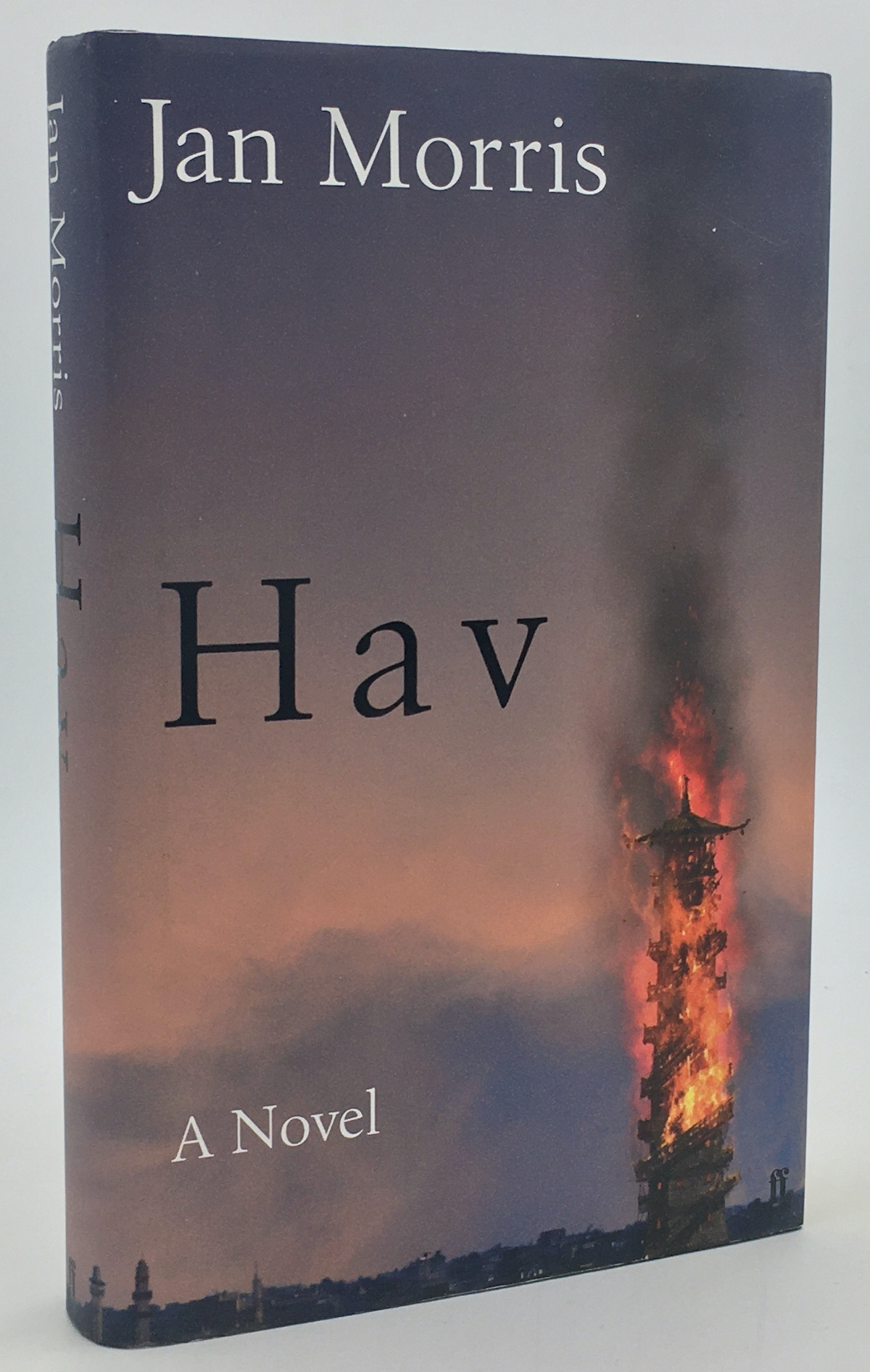
Last Letters from Hav (1985) by the celebrated travel writer Jan Morris had been for some time on my list of books To Be Read Soon. I knew of the book as a successful narrative of a visit to an imaginary port city. Most recently, I had again been meaning To Read It Soon, after some digging in the author’s much, much earlier portrait of The Hashemite Kings (1959) for material connected with the vexillology of the Arab Revolt. Morris has always been an engaging writer willing to travel to unusual places and the idea of Hav seemed promising. My intentions failed to keep pace with events. Hav reprints the 1985 novel with a new, second visit to the imaginary port city and an afterword by the author.
Last Letters from Hav, Six Months in 1985 (as the sectional title
reads) is a
graceful and fluid account of the author’s residence in the autonomous
enclave of Hav, a port with unique and unusual geographical, political, historical,
ethnological, linguistic, cultural, architectural, and ecological characteristics.
The location is never quite specified, but there is a flavor of the eastern Mediterranean
in the intersections of Greek, Crusader, Muslim, Venetian, Russian, British,
and Turkish histories (with dashes of Chinese and Italian for spice). For a sense
of the imaginative range, think of a few of the various political anomalies of
pre-1945 Europe (and beyond): Trieste, Gibraltar, the Panama Canal Zone, Port
Arthur, with the literary landscapes of the Corfu of My Family and Other
Animals by Gerald Durrell, the Tangier/Interzone of William Burroughs’ novels,
Ballard’s Vermilion Sands , the tropical cities of Graham Greene’s
novels, the decaying city of Ernst Jünger’s Auf den Marmorklippen ,
even Austin Tappan Wright’s Islandia . These texts are not cited as influences
but to evoke the complexity of the picture of Hav that emerges. I loved the “snow
raspberries”, an impossible delicacy that ripens one day each year. There
are splendidly contrived, telling details beyond number.
A Fantasy of Historiography
Narratives of travel have been part of literary activity from the days of Marco Polo and John Mandeville though George Anson and Lemuel Gulliver to the present. Distinguishing fact from fiction is often a doubtful task, for what is true artistically may not always be judicially. I have written before of If It Had Happened Otherwise. Lapses into Imaginary History , edited by J. C. Squire (1932), and the pleasures of Philip Guedalla’s contribution, “If the Moors in Spain had Won.” One recent piece of travel fiction that Morris’ description of Hav recalled to mind is “Visit Port Watson !” in Semiotext(e) SF (1989), a putative account of the libertarian commonwealth of Sonsorol. It is merely a guidebook whimsy, where Last Letters from Hav is a critical fiction that engages with hundreds of years of travel writing.
The fabric of name-dropping and anecdote is essential to the structure of the novel. To learn a lost aphorism of Mark Twain, a new couplet of Cafavy, or an undocumented episode in the life of Sigmund Freud, would be rewarding enough. And then: “Hemingway, so legend says, deliberately jogged the elbow of Count Ciano, thus saving the life of a bear offering a perfect shot upon the skyline (‘You fool,’ said the count. ‘You Fascist,’ said the writer)” (48). The incident is not, ultimately, about the endangered Hav grizzly bear.
For this reader, the plateau of marvels was reached about page 141 where, it seemed, everyone in the pantheon of exotic literary travel had passed through Hav, and I found myself thinking of Richard F. Burton (unequalled among nineteenth-century voyagers in search of the real not found in the confines of Victorian London). And then, at the turn of the very next page, Morris brought him on stage in Arab costume and adding yet another scandalous achievement to his fame. I smiled, calm in the assurance that I was in the hands of a true guide, and enjoyed the roller coaster ride.
“Successful polders do not change. Polders change only when they are being devoured from without” (John Clute, Encyclopedia of Fantasy , 773). During the narrator’s stay in Hav, political shadows begin to creep toward center stage with successive anecdotes of a thwarted abduction of Pu Yi, the last Emperor of China, or how T.E. Lawrence, visiting the British Agent, met with the young Mustafa Kemal in 1913 and planned the Arab Revolt (and learned how to ride a motorcycle). By the novel’s end, after warnings by the British Agent of the worsening political situation, “Dirleddy” (as the narrator is frequently called) is obliged to flee up across the threshold as invading warships near the enclave.
[As an aside, I raise the question of why there is no entry on Morris and Last
Letters from Hav in the Encyclopedia of Fantasy . To this reader there seems no
doubt the work constitutes a fantasy of historiography.]
Architecture and Ideology
The first book of Hav starts as an idyll and reveals itself a study in the historiography
of the imaginary voyage — think along the lines of Vermilion Sands , not,
however, as in Ballard’s book, looking forward to a vacant timeless future,
but gazing backwards to a richer, colorful past when giants strode the earth — how
startling then is the second work, Hav of the Myrmidons, Six Days in 2005 . The
narrator returns to Hav at the invitation of the government, to find that the
accreted history of the place has been erased by architecture and ideology. The
description of the first day’s arrival in the hermetic luxury of the Lazaretto!
resort, and some of the fellow guests, is choice.
Form is function, and when “Dirleddy” (the usage survives even a revolution) is invited to come to the Office of Ideology, the nature of the new Hav becomes clear. Think of a nasty police state cocktail of Club Med, post-1997 Hong Kong or Macao, Dubai, countries of the former Soviet central Asia, and Singapore, with a threatening jolt of Guantanamo Bay . . . .
This second part is delightful satire, full of incident and surprise as seeds planted in the first work bear unexpected fruit. The narrator learns that traditional agriculture has been set on a rational footing, “ ‘this is the very site where the first genetically modified snow raspberry was produced, available all the year round.’ [. . .] I could not help thinking that if this is what snow raspberries had always tasted like, the mystique that surrounded them was misplaced” (255-6).
Clute employed the phrase “toughened reality” in the Encyclopedia of Fantasy entry for Polder to describe the heightening effect of fantasy. Hav of the 1980s was a somewhat chaotic anachronism, a magical place that experienced sudden, severe thinning. Toughened reality takes on new meaning in the Hav of the Cathar Myrmidons, a brutally efficient corporation, the newest face of very old money. “Old Money in the truest sense, since it was originally made out of the silk trade with the Venetians” (154).
Is it possible to have a Black Polder, a polder of evil ? Hav of the Myrmidons
is the sort of delightful satire that makes you grit your teeth at the mirror
it holds to contemporary life. Quite an accomplishment.
First published in The New York Review of Science Fiction , April 2007. Copyright © 2007 Henry Wessells. All rights reserved.