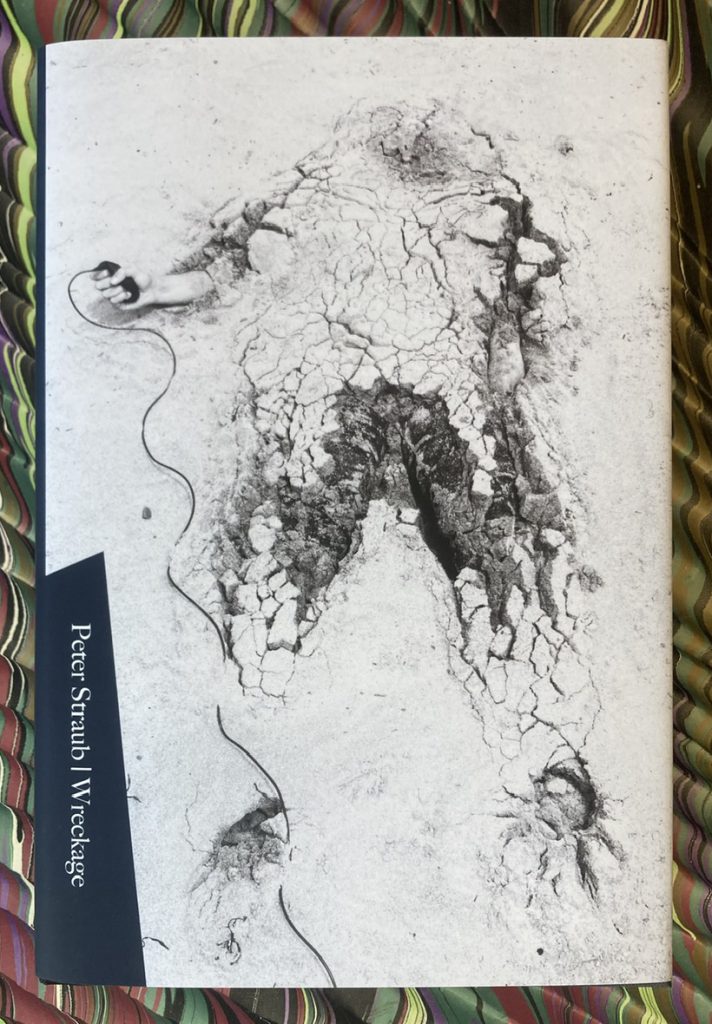
— Peter Straub. Wreckage [Introduction by Susan, Benjamin, and Emma Straub]. What Happens in Hello Jack [Introduction : Linkages, by Gary K. Wolfe]. 447 ; 141 pages. 2 vols., Subterranean Press, 2025. Edition of 500 numbered copies. [Dust jackets after photographs by Jenny Calivas].
‘party to some larger, less explicable understanding’
WRECKAGE, the unfinished final novel of Peter Straub, is the best book I have read this year. “It was to be a near perfect interweaving of Jack the Ripper and Henry James, two of Peter’s abiding interests : a timeless unsolved murderous mystery with the ultimate stylist and artist” (from the introduction by his family). The book is in two parts : the long sustained narrative of Wreckage is as fine and subtle and tricky (and funny) as anything Straub ever wrote, and What Happens in Hello Jack is a succinct, complete linear outline and summary of Straub’s plans for the novel (prepared in 2103), with extensively detailed and even polished vignettes. Why wouldn’t a modern master of horror grapple with the conceits and sources of The Turn of the Screw, that masterpiece of American imaginative prose ?
incidents in the life of Henry James
Wreckage is nineteen chapters (most with multiple episodes) chronicling events in the life of Tilly Hayward, whose activities as a serial killer in Milwaukee are masked by the deep and undetectable cover of his life in Columbus, and his sister Margot Mountjoy, whose married life in one of the richer suburbs of Minneapolis was one hell of an American Dream, the anatomy of which is charted as she begins her new life as a wealthy widow. These two lines are deeply rooted evocations of midwestern America in the late 1950s, even as they are connected to The Gathered Clan, a painting stolen from the ancestral home, Blane, by an English great grandfather as he fled to America, and to other events of seventy years before, when Henry James accepted an invitation to a country house weekend and encountered uncertainty. The “interlude” early in the novel, a vignette of Henry James in Monte Carlo (published last year in Conjunctions) makes explicit one of the transtemporal narrative threads. The Archbishop’s Tale, recounted in slightly different form in The Process, takes on new implications in Wreckage when a sinister group of three persons, that “larger, less explicable understanding”, recurs in odd variations throughout the novel (in the 1950s as well as the 1880s). The settings and minor characters are as accomplished as anything Straub has written. And the conversation between Tilly Hayward and one of his victims after her death, and more precisely, how and where the narrative runs with this, where the ghost of Lori Terry leads Tilly — “Ridiculous, he knew, yet . . .” — are quite simply spectacular, and a key to understanding the psychogeography and chronology of the narrative. Wreckage is, of course, a gripping headlong race to the cliff of incompletion, but the reader, this reader, goes willingly.
What Happens in Hello Jack offers pleasures of a different order. It dates to 2013 and Straub continued to work on the book for a decade beyond that fixed moment in time, so that the two volumes are sometimes usefully at odds with each other. I have no issue with fragmentary or even contradictory narratives, and the summary carries the several arcs through to the end. The prose is accomplished even as the terrain remains inherently unstable : “as James watches, Ayling seems briefly to vibrate in and out of sight [. . .]. James thinks he may have tricked himself into seeing this, but Ayling appears to waver in front of his canvas”. And then, in the space of a few pages, Straub thrusts Henry James into primal territory and a scene unlike any other in any fictional account of Henry James. Following this encounter, Straub has James draft two letters unknown to scholars, along with the explanation of how what we have just read is not preserved. The insightful and provocative Henry James set pieces are inseparable from the entangling narratives, and both volumes resonate with elements from A Dark Matter and The Skylark and The Process (a short novella which I loved), and offer variant riffs on earlier, teasing pieces presented at Readercon and in accounts of the artistic movement Das Beben. All of this amplifies the stories nested within Wreckage.
WRECKAGE is facinating in so many ways, chief among them the way in which the main narrative Wreckage demonstrates how Straub repeatedly altered and reworked the lines laid down in the Hello Jack summary. It is a gripping tale. The matter of Jack the Ripper is addressed and is made new. The playfulness of the novelist, is found everywhere, too, with stray shots at a country house partridge shoot (in equal measure homage to Isabel Colegate’s The Shooting Party and riff on an incident in the life of Dick Cheney, I think) ; the imaginary books, especially “that dreary children’s book”, The Distant Land, and what ripples out from it ; the episodes in the life of painter Hugo Ayling gleaned from a fourth volume of the Autobiography of Francis Frith ; and in the cameo appearances by Sherlock Holmes, Philip Marlowe, and “Little Alex C.”, a depraved juvenile Aleister Crowley ready to embark upon mischief and worse.
When, deep in the labyrinth of story, when Henry James tells Tilly Hayward : ‘It is in the nature of this place, which is not real except in the mind’, it is Peter Straub who has led the reader there.
The Endless Bookshelf book of the year.