Featured

Reading the Structure of the World


READING THE STRUCTURE OF THE WORLD

Bookbinding, Artificial Intelligence, and Life

by Henry Wessells

[This is the lightly edited text of a talk I gave at Oberlin College on Thursday 9 April 2026 at the invitation of librarian Valerie Hotchkiss.]

It is a great pleasure to be here at Oberlin at the invitation of Valerie Hotchkiss who is a really good librarian and who knows what books are for. I am a reader, a polyglot, a science fiction writer, an antiquarian bookseller, a micropublisher, and a competent hand bookbinder who has over the last 25 years produced somewhere around 400 case bindings in edition sizes ranging from 1 to 17 to 52, and six or seven hundred or so stitched pamphlets, too. I am a USER of books. I will be talking to you in each of these capacities and you will see that there is considerable interplay between the categories.

A bit about my background first. When I was seven years old I understood I could read the entire school library and tried to do so. I also discovered (on my father’s bookshelves) the Bantam paperback reprints of the Doc Savage science fiction novels from the pulp magazines of the 1930s and 1940s. He bought them out of nostalgia, I think, because his own pulp magazine collection was lost when the barn blew over in a storm in Vermont in 1948. So, science fiction from an early age, and in another spark of good fortune, I was taught French from an early age and then transplanted to France for three years as a teenager, and so I added Jules Verne (science fiction again) and Baudelaire. While I enjoyed mathematics and had aptitude for the subject, the transatlantic exchange meant that I ended up studying languages instead of calculus: first German, a smattering of Russian, and then Arabic. I remained a reader of science fiction. I am NOT telling you my life story in any detail.

Instead, I will talk about some of my heroes in the world of books, three individuals from whom I learned different things in different ways.

Let’s jump ahead to 1990 or 1991. Some months after our daughter was born, my wife took an introductory bookbinding class at the local historical society. At the last class, I came along and met the instructor. We got talking, and that is how I met Herbert Nieder, who was a master tanner by training, a mostly self-taught bookbinder, and a man generous with his tools and knowledge.

Over the next dozen years, while working as an editor on a reference book and then at a weekly trade magazine, and beyond, I studied with him when I could, sometimes at irregular intervals. I learned to sew and case in books, some rudiments of repair and conservation binding, and we explored interesting papers and cloth for binding. I was not his best student and I was in one sense a profound disappointment to him : I had no interest in working with leather. Bookbinding teaches an awareness of process and the importance of examining the underlying structure of things : how the artefact is put together, how much collaborative or community effort is required to produce a book. This knowledge is portable : it can be applied to other fields.

And then at one brief moment in early 2000 when I was in marginal freelance employment, a science fiction editor friend, David G. Hartwell, asked me if I would do a hardcover edition binding for a book he was publishing, Puck Aleshire’s Abecedary by Michael Swanwick. I asked Herbert if he thought I had mapped out the steps correctly, and if I might use his stamping tools for the front boards. The total edition was about 48 copies, sewn and cased in and bound at the kitchen table and using a small iron nipping press that had been my grandmother’s. A set of encyclopaedias works just fine to keep books under weight while the glue dries overnight. I soon undertook to produce another edition binding for El Vilvoy de la Islas by Avram Davidson, which I published, and have gone on from there. I am a lifelong reader, but it was Herbert Nieder who really showed me how to look at books. I count the late Herbert Nieder as one of my heroes in the book world.

To go back a bit, the trade magazine where I worked for three plus years was AB Bookman’s Weekly, established 1948 and in 1996 still central to the rare and out-of-print book trade. On my first day on the job, I wrote two book reviews, adapted several obituaries and notices to fill out space on production day. The magazine’s editor, Jake Chernofsky, enjoined me from using semi-colons, and warned me not to be snotty in my writing. The next day I headed to Boston for the Antiquarian Book Fair, where I met David Godine and others who have remained friends ever since. It was in those first days on the job that I encountered the writings of Joel Silver, Librarian at the Lilly in Bloomington (and now its director). He was a contributing editor and regular columnist for AB. Everything I know about the narrative disclosure of information comes from attentive reading of his essays on bookish topics. And then, nothing like a weekly deadline to put that learning into practice. It was the only time I have been a prolific writer. In the summer of 1997, I attended the Colorado Antiquarian Book Seminar, a weekly intensive overview of the book trade from business basics to cataloguing and pricing and more. (It’s still in operation as CABS-Minnesota and has a generous scholarship fund.) In those days I could write 50 or 60 pages of finished prose ahead of the weekly deadline, but I had no idea what went into writing a price on the flyleaf of a book. I met Joel Silver in person when he taught the session on the reference books of the trade : this was opening the door to a new branch of knowledge. We have been friends ever since. I have no library degree (my terminal degree is an MFA in writing), but I consider myself a pupil of Joel Silver. He bears no responsibility for the meanders and digressions in my written and spoken work. I am bibliographer and editor of Avram Davidson who was a master of the zigzag. Joel Silver is a great teacher and I consider him another of my heroes.

THE PRIVATE LIFE OF BOOKS II
How books are made

In musty blackness above old stables,
Forgotten shelves in crowded, disused rooms
Where a faded rose silk wallpaper blooms ;
From ruined boxes, piled high on tables,
Cripples walk, worn red morocco gleams,
Vellum sweats, rubbed calf, dull roan copulate
On uncut sheets, stained wraps and text dilate :
Planting seeds into dark shuddering dreams.
Early morning gilt full moon of August,
Tangled spines and broken boards upon the floor,
Limp vellum, greasy sheep spawned on this shore :
Cascade of lost words made new in this thrust.

A modern Prometheus, disbound, steps from
Emptied pages into the summer day.

For Ed Maggs

[This is one in a sequence of poems, sonnets more or less in the Ted Berrigan mode, first published in 2014. The title poem, The Private Life of Books, read by the author, can be heard as the concluding voiceover in The Booksellers documentary (2019).]

In the bookbinding studio, learning and doing are inseparable : standing at the bench or the kitchen table and accomplishing the sequence of tasks. For an intermittent or semi-amateur binder such as myself, this often required re-learning or recovering a skill. The trial bindings of two of my edition bindings have a note on the flyleaf, MY SHIRT’S TOO TIGHT, because I hadn’t set the appropriate space between spine and covers for the French groove ; but then one adds that extra board thickness or eighth of an inch and the production line gets going. In the same way, it would usually take a couple of fumbles before I regained the light touch and precision for turning and setting the corners. Learning can also involve attempting projects one has NEVER done before.

At the end of 1999, AB Bookman’s Weekly folded, having swiftly become irrelevant as the internet changed the nature of communication in the book trade as in other areas of life. I figured I could write book catalogue descriptions. I asked a friend if he knew anyone looking for a part-time cataloguer, and so I met Jim Cummins. It turned out I could catalogue and sell books. It was never part-time, and the rest is history, to be told another time.

When I was an undergraduate I studied Arabic and the history of the Islamic World from Spain and West Africa to Central Asia. I failed the English usage portion of the State department exams and I was not a suitable candidate to be a spook or a professor. I have kept up my Arabic as best I could, and it has come in useful on occasion. In those years of the Bush administration right after 2001, I saw the UN reports of the weapons inspectors in Iraq, chronicled truthfully in France but brushed aside by the hawks. I despaired of U.S. policy in the Middle East, and wrote postcards to the White House urging the president to think of the children of Iraq and NOT go to war. A small gesture of protest.

In 2008, when I was visiting science fiction friends John and Judith Clute in London, Judith showed me an etching she had just made in response to a poem by Joe Haldeman, the title of whose novel The Forever War (1974) is now a commonplace of newspaper headlines. Judith said she saw the etching as first in a series, and I said, I don’t know what shape it will take, but I want to publish your etchings and Forever Peace in a book. The only way to do it was as a large format album of the series of etchings. I had never made so big a book. I devised a structure, learned to make paste paper in the back yard, and produced 31 copies, which sold out pretty quickly. An esoteric protest, to be sure, but I also printed up and distributed a pamphlet version, which I sent to the U.S. Senate and others around the world. (In November 2016, I did not want to weep silently, and roped in a few friends to contribute to an obscene political pamphlet published on 22 November in front of 725 Fifth avenue, aka Trump Tower. I couldn’t fit the cover placards into my suitcase to show here at Oberlin.)

Michael Zinman is a New York-based collector and living legend. One day he dropped an orange Sainsbury’s bag on my desk and said brusquely, “What is this ? Should I give it to one of my customers in the Middle East ?” Inside was a cotton flag of red and black and green and white, with a label on it reading, in English, given to me by the Sheikh of Aqaba.

I said, let me think about it. When I got finished thinking about it a few months later, I had identified the third surviving example of the flag of the Arab Revolt of 1916 led by T. E. Lawrence and the Hashemite prince Feisal. It sold at auction in London for a tidy sum and now hangs in a museum in Jordan. Over the next many years, I produced Michael’s Annals of Collecting series, and worked on many joint ventures between him and the Cummins firm. One of his biggest collections was of early American imprints, material printed before 1801, now at the Library Company. Once he disposed of that collection in a joint sale/gift arrangement in 2000, he began collecting other things. So sometimes our collaborations were on early printing for the blind — a window into the nineteenth century origins and impulses of the American progressive vision : abolition, prison reform, assistance to refugees, education of the blind, and more — or exotic imprints or tart cards (trade cards of modern-day London prostitutes) or good old rare books. I learned a variety of things from Michael Zinman, to be less fussy about condition (and even completeness) when dealing with material of supreme rarity. If a copy can be completed or restored, that is good ; even when one does not restore the copy, it is also good. During the early years of the covid epidemic, I casually asked Michael if he had any children’s books. And so I became a specialist in eighteenth-century American children’s material : it takes one source and one collector. I have probably handled more examples of the New-England Primer than any dealer since Charles Heartman (a dealer overshadowed by Dr. Rosenbach).

What Michael Zinman also taught me is to be ready to take another look at the material. That is the task of the reader, the bookbinder, the human being. As Henry David Thoreau said, “It is never too late to give up our prejudices” (from the first chapter of Walden).

When I said I am a user of books I mean that books are necessary to the trade of writer and antiquarian bookseller. Yes, I read for pleasure and take pleasure in what I read when it is well written, but books are one of the tools with which I think about the world, learning about subjects of interest and trying to create context.

Bookbinding encourages thinking about how each element must fit and work with the others. One learns by doing it.

The book is an engineered object. When it functions properly that engineering is almost invisible unless you know how to look at the structure. A book functions best when OPEN. [Accompanying gesture of holding a book by the front board and letting it fall open.]

To be a science fiction writer is, in the words of Tom Disch, to read the newspaper “in a state of alert anxiety and think about what each headline portends”.

In the twenty-first century one can push a button and a machine will extrude a hardcover book. You will have the text, yes, but that is about all you will have apart from what my friend Reno W. Odlin called a paperback in drag. Learning to make a hand binding offers another order of knowledge.

So too, with reading and thinking. There is a current ad in the New York City subway for some brand of generative AI designed to produce reports. You can see the possible allure for employers and owners. Push a button and something comes out at minimal perceived cost, and with no knowledge gained by the employee in the process. No investment in the employee as asset : to carry this notion to its logical conclusion, why bother to have employees at all ?

Roman Jakobson wrote, “It is the purposeful poetic use of lexical and grammatical tropes and figures that brings the creative power of language to its summit”. How much of that occurs when a button is pushed ?

Charles Darwin wrote in a letter on 1 November 1846 : “I have unfortunately lost the reference & it is a high crime, I confess, ever to refer to an opinion, without a precise reference.”

The nature of generative AI is in fact degenerative, serving only to cut information loose from its tether. It is the opposite of learning.

We are human beings on a small bit of rock circling our sun, one star moving through our vast universe (I am paraphrasing Fredric Brown’s “Imagine”). How do you want to experience the universe during your brief, illusory, impermanent interval here? Do you want to instruct a machine to do it for you? The great satirist of science fiction Robert Sheckley wrote about this in a story called “The Robot Who Looked Like Me”.

To make a book is to work with other people, to make a society. A legal system is an engineered object, too, created by a group of humans : for whose benefit ?

Interrogate the book on your desk, interrogate the nature of the legal system. Attempt things you haven’t done before.

Copyright © 2026 Temporary Culture.

Featured

The Elfland Prepositions by Henry Wessells

The Elfland Prepositions

— Henry Wessells. The Elfland Prepositions. Temporary Culture, 2025.
Printed on Mohawk superfine white eggshell. Pictorial wrappers. 26 copies, lettered A to Z, were reserved for presentation ; there were also 100 copies numbered 1 to 100. Edition of 326 copies.

Collection of four previously unpublished short stories :
Cleaning up Elfland
The Barmaid from Elfland
John Z. Delorean, Dry Cleaner to the Queen of Elfland
A Detective in Elfland

Published 27 February 2025. Click on link or photo to order.
ISBN13 978-0-9961359-0-0 ISBN 0-9961359-0-1

Elfland is not a nice place, but it’s important to know how it works.

— — —

“elegant” — MICHAEL DIRDA, in the Washington Post

“Here is an Elfland as implacable as ever, but now ruthlessly enmeshed in contemporary mortal affairs.” —  MARK VALENTINE

“very clever, beautifully dark in implication. [. . .] Wessells is not prolific at all (in fiction) but what he does is outstanding.” — RICH HORTON

”If you don’t believe in magic, read Henry Wessells and find out how wrong you are.” — GUY DAVENPORT

news & notes : mid-May

on Hampstead Heath, May 2026

In London for the Firsts antiquarian book fair at the Saatchi Gallery (14-17 May). Come say hello (Cummins booth A10).
https://www.firstslondon.com/

— — —

bronze plaque for Andrew Marvell (1621-78), on a wall in Highgate

— — —

current reading :

— Jean-Paul Sartre. Les Mots [1964]. Gallimard / Folio, [January 2026].

— Camille de Toledo. L’internationale des rivières. Un recit de l’avenir. Verdier, [février 2026].


current reading : late march / early april


BOOKBINDING & POLITICS
On the afternoon of Thursday 9 April I will be giving a talk at Oberlin College in connection with a program and workshop on bookbinding and politics at the library, We hold these Truths . . . to be Binding! Austin binder Jace Graf will be leading the workshop.  Information on the event can be found here :  https://oberlin.libcal.com/event/16363787
My talk is open to the public and is entitled Reading the Structure of the World : Bookbinding, Artificial Intelligence, and Life
I am looking forward to this, and to the idea of a bookbinding project that is not an all-consuming thrust to meet the deadline for an edition binding.
— — —

recent reading :

— Larry McMurtry. Lonesome Dove. A Novel [1985]. Foreword by Taylor Sheridan. [2], 858 pp. Simon & Schuster Paperbacks, [2025].

A spectacular book, every sentence and every chapter, from the Rio Grande up to the northern reaches of Montana. Engaging, devastating, even horrifying, and compelling at every level. This is a work of fiction so richly imagined that the reader walks, rides, listens, all the way. I cite a very few passages of interest :

“I ain’t a natural bachelor,” Augustus said. “There’s days when a little bit of talk with a female is worth any price. I figure the reason you don’t have much to say is that you probably never met a man who liked to hear a woman talk. Listening to women ain’t the fashion in this part of the country. But I expect you got a life story like everybody else. If you’d like to tell it, I’m the one that’d like to hear it.”

“The Earth is mostly just a boneyard. But pretty in the sunlight,” he added.

“Jake just mostly drifts. Any wind can blow him.”

“Ride with an outlaw, die with him.”

I though that slavery was the Matter of America, but McMurtry makes a pretty good case for the cattle drive and shoot-out and massacre as the vernacular Odyssey at the heart of the heart of the country.

(I read Lonesome Dove because David Streitfeld’s book Western Star sparked my curiosity.)

— — —

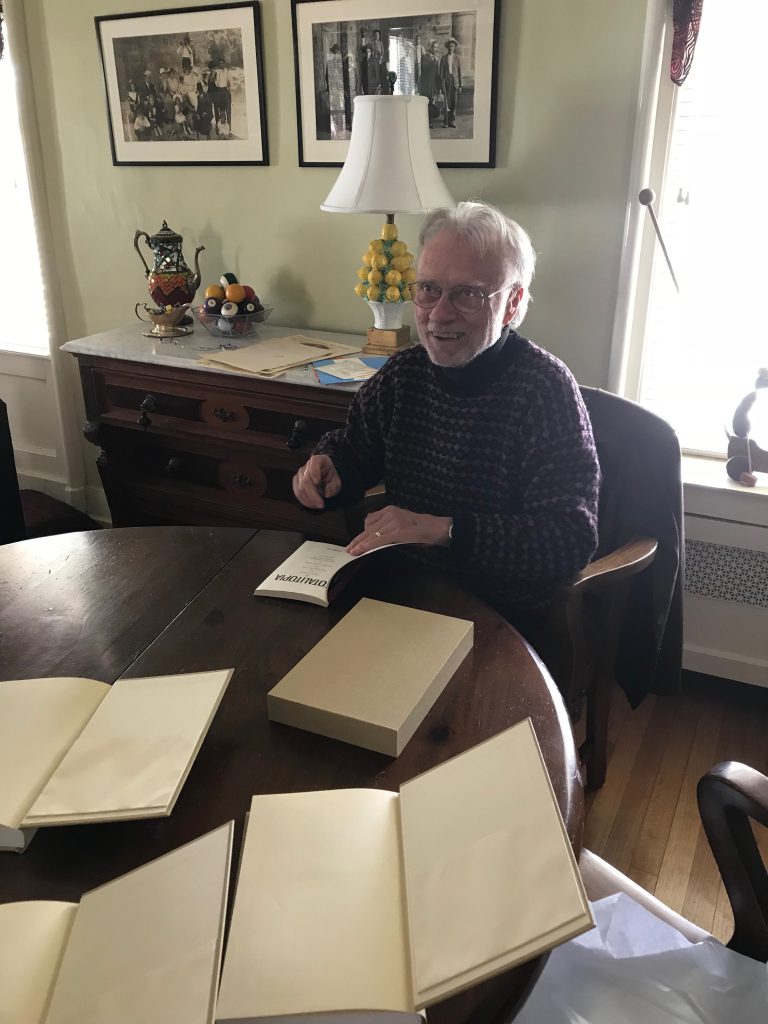
— John Masefield. ODTAA. A novel. William Heinemann, 1926. One of 275 copies signed by the author.
Picaresque account of a revolution in a tinpot Latin American dictatorship.  Prequel, of sorts, to Sard Harker (1924).
For an essay that will appear on Wormwoodiana.

— — —

Michael Swanwick has published a brief, funny, and opinionated account of the New Wave in science fiction, The New Wave Explained

He followed with A Box Full of Controversy, a look at the origins of his 1986 essay A User’s Guide to the Postmoderns, Including the Battle for the Future, Unbridled Ambition, the Fate of the Children in the Starship, the Cyberpunk-Humanist Wars, Blood under the Banquet Tables, Metaphors Run Amok, and the Destruction of Atlantis !

— — —

the Story Prize 2026

the winner of the 22nd annual Story Prize award is André Alexis, author of Other Worlds. Stories (FSG Originals. Farrar, Straus & Giroux, 2025).

— — —

current reading :

— Marcel Proust. A la recherche du temps perdu. I. [Du côté de chez Swann. À l’ombre des jeunes filles en fleurs]. NRF Gallimard, [2019]. Bibliothèque de la Pléiade.
/ I am back into it.

The Supernatural Omnibus. Being a collection of Stories of Appraitions, Witchcraft, Werewolves, Diabolism, Necromancy, Satanism, Divination, Sorcery, Poetry. Voodoo, Possession, Occult Doom and Destiny. Edited, with an Introduction, by Montague Summers. Gollancz, 1931.

Metaphrasis


— William S. Wilson. Why I Don’t Write Like Franz Kafka. New York : The Ecco Press, [1977].

— —. Γιατι Δεν Γραφω Σαν Τον Φραντς Καφκα. Athens : Ekdoseis Apopeira, 1994. Translated by Sonia Salimpha, Stratos Kakadellēs. OCLC: 610587751 (Johns Hopkins).

William S. Wilson (1932–2016) was a friend for more than twenty-five years. I esteem his collection of stories and included it in my Grolier Club show for the beauty and clarity of his prose : and because several of the stories push at the boundaries of what we understand as science fiction in the same way that some of the work of Borges does.  “Desire” is a (quietly) spectacular example of what the short story can accomplish.

Bill was not a prolific writer. He published one novel, Birthplace, and a long stream of essays on art, literature, and philosophical topics. He was an exacting writer whose work demands of the reader the same rigor and sheer energy of attention with which he wrote and thought. And because of where and he lived in Chelsea, he knew everyone in the New York art scene of the Sixties and Seventies, not as a celebrity hanger-on but as an intelligent observer. There is a fascinating transcript of Jonathan D. Katz’s 2012 interviews with Bill at the Smithsonian Archives of American Art.

One sparkling memory from 1994 stands out among all our exchanges. I dropped in to visit him on 25th street and he said, I too have been published in Athens. He showed me a copy of his story collection, and all the history of philosophy was contained in his smile.

I remembered this some months ago, and now I have a copy of the book, thanks to a friend who set a family member on a quest through all the bookshops of Athens. It is locally scarce in the U.S., too. I don’t read Greek (ancient or modern) beyond the alphabet, but I am gratified to have this additional reminder of my friend Bill Wilson.

And this just on my desk : the 1528 Vier Bücher, Dürer’s four books on proportions of the human form.

commonplace book : late february & early march

current reading

— David Streitfeld. Western Star. The Life and Legends of Larry McMurtry. Mariner Books, [forthcoming March 2026].

Even the worst events in America, such as the slaughter of Native Americans, are soon repackaged as entertainment. [27]

There were, he calculated with the help of a detective he hired, at least five Larry McMurtrys operating throughout the Southwest and Mexico. [282]

Larry took the opposite approach. He never complained about any of those who appropriated the Lonesome Dove name for their ranch or saloon, much less sued them. He would tell interviewers that the story was an American version of the Arthurian legends. It overflowed single ownership and had been set loose in the national psyche. [295]

Western Star is an engaging book about an American writer — who once had a sweatshirt reading Minor Regional Novelist — and a fascinating study of obsession, book collecting, and the old ecosystems of the used and rare book trade.

— — —

a title is not a book

— Michael Swanwick. The Universe Box. Tachyon, [2026].
This is another fabulous Swanwick collection ! “Starlight Express” and “Ghost Ships” are subtle ghost stories ; and “The Star-Bear” is a very tricky story to read in the centenary year of Lud-in-the-Mist and The Book of the Bear.
Swanwick must just light up with glee when he decides to take up a literary challenge : what chutzpah to write an interplanetary science fiction story with the title “The Warm Equations” ! And to pull off the critique unspoken but ever-present ! And that is barely scratching the surface of this box of delights.

In the first month of the Endless Bookshelf, a chance comment by a reader prompted me to observe that “a title is not a book” ; and this newest collection  from Tachyon prompts me to note (with glee) the occasional significance of the definite article ; and I can talk the talk, for I am one of the few to have a Universe Box and The Universe Box upon my shelf :

Wait. The cigar box you were carrying around contains the universe ?

The 2016 edition of Universe Box was issued by Dragonstairs Press in an edition of 13, in a cigar box containing the printed book, a shredded printout, celestial map, taxidermy eye, calling cards, and other secret treasures.

— — —

The Library at Melmerby

https://wormwoodiana.blogspot.com/2026/03/a-telephone-box-library-guest-post-by.html

— — —

Friends of the Library Sale

by Ernest Hilbert

‘The world still new, the journey not begun’

https://thesonneteer.substack.com/p/friends-of-the-library-sale

— — —

a picture and short essay here at the weekly Shelfies edited by Lavie Tidhar and Jared Shurin

https://shelfies.beehiiv.com/p/shelfies-78-henry-wessells

— — —

[February]

not the first book fair

in San Francisco for the 57th California International Antiquarian Book Fair, 27 February through 1 March at the Cruise Terminal building, pier 27 on the Embarcadero. I will be in booth 117 (Cummins).
It would have been 1997, I think, that I first came to the book fair at the Brannan Center (long gone). Come say hello if you are here, and write if you would like a pass.

— — —

California poppies

— — —

meanwhile, back at the ranch

— — —

recent reading

— Anthony Powell. The Military Philosophers [1968]. Fontana Books, [1971].
My favorite of the ‘Dance’ novels, a pleasure to re-read.

— Fletcher Pratt. The Blue Star [1953]. Introduction by Lin Carter. Ballantine Books, [1969].


re-reading in winter

commonplace book :

From Tatlin !  Six stories by Guy Davenport (1974) :

Our sense of the old is always modern. Starlight is hundreds of years old. We live in the phoenix time of antiquity.
[from “1830”]

Perhaps only in the awful light of the extraordinary was there real calm in human action. Nothing he might do was superfluous to the moment.
[from “The Airplanes at Brescia”]

an everlasting fire, dying and flaring up again
[from “Herakleitos”]

— — —

recent reading :

— Naoto Fukasawa and Jasper Morrison. Super Normal. Sensations of the Ordinary [2007]. Lars Müller Publishers, [2024].
Fascinating exhibition of objects from daily life, Tokyo and London 2006 ; Trienniale di Milano 2007.

— Anthony Powell. At Lady Molly’s [1957] and The Kindly Ones [1962].
I picked up At Lady Molly’s and was drawn in, and then on to another . . . An earlier reader of the copy of The Kindly Ones has noted a few passages  : not always ones I might have marked, but I like these :

Moreland could never get used to the fact that most people — in this case, Templer — lead lives in which the arts play no part whatsoever. That is perhaps an exaggeration of Moreland’s attitude. All the same, he always found difficulty in accustoming himself to complete aesthetic indifference.

It was like trying to shake hands with Ophelia while she was strewing flowers.

One passes through the world knowing few, if any, of the important things about even the people with whom one has been from time to time in the closest intimacy.

I have read the complete cycle, out of sequence, and several of the novels more than once or twice ; with the Dance I don’t think it matters whether or not one reads the books in any particular order, for Powell’s prose moves across time within each book and sometimes within a single paragraph, always with such clarity that there is  no doubt (indirection and obliqueness, yes : muddiness, no). Once one has the work as a whole in one’s head, the characters and incidents and phrases play out in memory and recreation. My favorite remains The Military Philosophers, with At Lady Molly’s close on its heels.
The most interesting parts of Hilary Spurling’s Invitation were the indices of literary or musical references and places, to tease out subtle allusions that slipped by unnoticed ;  the index of persons with biographical summaries and concordance of appearances gives a doleful feeling : a litany of all the facts with none of the pleasure of the text.

— — —

nineteen years of the Endless Bookshelf

Friends,

today marks nineteen years of the Endless Bookshelf website. It was sunny and bitterly cold outside (the rhododendron leaves were tightly rolled) : a good day to be indoors with a book. I looked into Sir Thomas Browne’s Pseudodoxia Epidemica (sixth ed., 1672), and dug around in the chapters on the basilisk, bears, mermaids, dolphins, wolves, the phoenix (some of these I can see as touchstones for Avram Davidson). A pleasure to taste again Browne’s leisurely examination of delusions and sloppy thinking.

I have never been what they call a numbers driven person, so I don’t know what sort of “traffic” the ’shelf attracts (the newsletter list hovers around six hundred, and some recipients anyway may read theirs). But I do see occasional remarks or notes from readers, and on this occasion I reprint one which arrived by post last week :

I saw your post “Very Few Letters” and figured that was a good prompt for me to write you this short note.
There is no other site or place on ye olde internet that has provided me with as much continued enjoyment as the Endless Bookshelf. I continually return to the archives to discover new books or authors, and to read your good words.
My TBR pile/list always grows and I always somehow feel better after a visit. Weird, I know, but thought that a letter expressing my thanks might be welcomed.

— — —

Comments arrive at the Endless Bookshelf in many forms : a reader from California has just sent more than two dozen Seville oranges (pronounced in Shakespeare’s day as “civil as an orange” as Much Ado about Nothing reminds us). These will soon be transmuted into marmalade.

I will be in San Francisco at the end of February for the California International Antiquarian Book Fair, 27 February through 1 March at the Cruise Terminal building on the Embarcadero. I will be in booth 117 (Cummins). Say hello if you are there, and write if you would like a pass.

— — —

‘Lolly Willowes’ at 100

I wrote a centenary celebration of Sylvia Townsend Warner’s Lolly Willowes or the Loving Huntsman for Wormwoodiana (published earlier this week) :

http://wormwoodiana.blogspot.com/2026/01/sylvia-townsend-warners-lolly-willowes.html

— — —

recent reading

— Howard Waldrop. Masters of Science Fiction. Introduction by Paul Di Filippo. 1048 pp. Centipede Press, [2026]. Edition of 500 copies signed by Paul Di Filippo. Just began reading this giant compendium of stories from 1972 to 2005 : many familiar tales and some I haven’t seen before.

— [Charlotte Adams]. Jean Grolier [1884]. [Grolier Club, 2025]. Re-issue of an essay on collector Jean Grolier (1476-1565) from the earliest days of the club, designed by Jerry Kelly and the first use of his new Grolier typeface, based on the earliest roman and italic type cut by Francesco Griffo for Aldus Manutius. The colophon serves as a type specimen (though it does not show the tiny flourishes or extenders which also echo the early type forms).

— Tom La Farge. The Crimson Bears. Part One. A Hundred Doors. Part Two. Tough Poets Press, [2025]. I pulled the new edition from the shelf, started reading, and just kept going on from there. (I re-read the original edition last summer.) What a playful, sophisticated book.

— Ngaio Marsh. Artists in Crime [1938]. Penguin Books, [1957].

— — —

Thank you to all the readers. As always, send me your news or tell me about books I have overlooked.

— — —

A singular interview with Gregory Feeley

Gregory Feeley is author of The Oxygen Barons (1990), Kentauros (2010), and many novellas and short stories published in magazines or anthologies, including “Aweary of the Sun” (1994) ; “The Weighing of Ayre” in Starlight 1 (1996) ; “Fancy Bread” (2005) ; and “The Unpastured Sea” (2023). His work often engages incidents of cultural and technological change. We have known each other for many years through our shared interest in the writings of Avram Davidson. In 2005 I published his short novel of coffee and ideas in early seventeenth-century Venice, Arabian Wine. A recent work,  Th’Erratic Stars (2022) is an extract from his novel « Hamlet the Magician ».

Henry Wessells : Allusions to Shakespeare and his writings run deep throughout your work, including several novellas and your novel Hamlet the Magician. Can you point to a specific line or passage in the Plays and say, “It all started here” ?

Gregory Feeley : I think it must have been sometime around the age of 10 or 11, when I first saw a production of Macbeth and heard Macbeth declare that “Good things of day begin to droop and drowse, / While night’s black agents to their preys do rouse.” I recognized “Night’s Black Agents” as the title of a collection by Fritz Leiber (I was at that time much better read in science fiction than in Shakespeare) and immediately Got It : you could take an especially good phrase from Shakespeare — or anyone else — and appropriate it for a story title ! This seemed such a wonderful thing that when I began reading what Terry Southern called Quality Lit a few years later and noticed how common the practice was, I knew that I could do this myself if I liked.
Macbeth has been heavily picked over, and I suspect I got the last good one. But I notice that Hamlet still has (at least) one left, and am surprised that no one has nabbed “A Crafty Madness”. It’s available for whoever wants it.


very few letters

Very Few Letters

— [T. E. Lawrence]. To tell you that in future I shall write very few letters. T. E. S. Printed card, [February 1935], sent by Lawrence to his correspondents in early 1935. O’Brien A161. An uncommon piece of ephemera.

/ from the archives

— — —

Bibliography Week 2026

the A.B.A.A. Bib Week showcase will be held 10:30 a.m. to 4:00 p.m., Wednesday 21 January at the Alliance Française on east 60th street. Open to the public, come say hello if you are in the neighborhood. I’ll be there (Cummins table).

https://bibliographyweek.org/2026/calendar

— — —

— — —

If you ever wondered how science fiction writers live on after their death

/ thank you, Bruce Sterling, for this excellent headline

https://brucesterling.tumblr.com/post/796103278446493696/if-you-ever-wondered-how-science-fiction-writers

— — —

current reading

— Tom La Farge. The Crimson Bears. Part One.  A Hundred Doors. Part Two. [Introduction by Wendy Walker]. Tough Poets Press,  [2025].

— ——

Wreckage by Peter Straub : the Endless Bookshelf book of the year 2025

— Peter Straub. Wreckage [Introduction by Susan, Benjamin, and Emma Straub]. What Happens in Hello Jack [Introduction : Linkages, by Gary K. Wolfe]. 447 ; 141 pages. 2 vols., Subterranean Press, 2025. Edition of 500 numbered copies. [Dust jackets after photographs by Jenny Calivas].

‘party to some larger, less explicable understanding’

WRECKAGE, the unfinished final novel of Peter Straub, is the best book I have read this year. “It was to be a near perfect interweaving of Jack the Ripper and Henry James, two of Peter’s abiding interests : a timeless unsolved murderous mystery with the ultimate stylist and artist” (from the introduction by his family). The book is in two parts : the long sustained narrative of Wreckage is as fine and subtle and tricky (and funny) as anything Straub ever wrote, and What Happens in Hello Jack is a succinct, complete linear outline and summary of Straub’s plans for the novel (prepared in 2103), with extensively detailed and even polished vignettes. Why wouldn’t a modern master of horror grapple with the conceits and sources of The Turn of the Screw, that masterpiece of American imaginative prose ?

incidents in the life of Henry James

Wreckage is nineteen chapters (most with multiple episodes) chronicling events in the life of Tilly Hayward, whose activities as a serial killer in Milwaukee are masked by the deep and undetectable cover of his life in Columbus, and his sister Margot Mountjoy, whose married life in one of the richer suburbs of Minneapolis was one hell of an American Dream, the anatomy of which is charted as she begins her new life as a wealthy widow. These two lines are deeply rooted evocations of midwestern America in the late 1950s, even as they are connected to The Gathered Clan, a painting stolen from the ancestral home, Blane, by an English great grandfather as he fled to America, and to other events of seventy years before, when Henry James accepted an invitation to a country house weekend and encountered uncertainty. The “interlude” early in the novel, a vignette of Henry James in Monte Carlo (published last year in Conjunctions) makes explicit one of the transtemporal narrative threads. The Archbishop’s Tale, recounted in slightly different form in The Process, takes on new implications in Wreckage when a sinister group of three persons, that “larger, less explicable understanding”, recurs in odd variations throughout the novel (in the 1950s as well as the 1880s). The settings and minor characters are as accomplished as anything Straub has written. And the conversation between Tilly Hayward and one of his victims after her death, and more precisely, how and where the narrative runs with this, where the ghost of Lori Terry leads Tilly — “Ridiculous, he knew, yet . . .” — are quite simply spectacular, and a key to understanding the psychogeography and chronology of the narrative. Wreckage is, of course, a gripping headlong race to the cliff of incompletion, but the reader, this reader, goes willingly.

What Happens in Hello Jack offers pleasures of a different order. It dates to 2013 and Straub continued to work on the book for a decade beyond that fixed moment in time, so that the two volumes are sometimes usefully at odds with each other. I have no issue with fragmentary or even contradictory narratives, and the summary carries the several arcs through to the end. The prose is accomplished even as the terrain remains inherently unstable : “as James watches, Ayling seems briefly to vibrate in and out of sight [. . .]. James thinks he may have tricked himself into seeing this, but Ayling appears to waver in front of his canvas”. And then, in the space of a few pages, Straub thrusts Henry James into primal territory and a scene unlike any other in any fictional account of Henry James. Following this encounter, Straub has James draft two letters unknown to scholars, along with the explanation of how what we have just read is not preserved. The insightful and provocative Henry James set pieces are inseparable from the entangling narratives, and both volumes resonate with elements from A Dark Matter and The Skylark and The Process (a short novella which I loved), and offer variant riffs on earlier, teasing pieces presented at Readercon and in accounts of the artistic movement Das Beben. All of this amplifies the stories nested within Wreckage.

WRECKAGE is facinating in so many ways, chief among them the way in which the main narrative Wreckage demonstrates how Straub repeatedly altered and reworked the lines laid down in the Hello Jack summary. It is a gripping tale. The matter of Jack the Ripper is addressed and is made new. The playfulness of the novelist, is found everywhere, too, with stray shots at a country house partridge shoot (in equal measure homage to Isabel Colegate’s The Shooting Party and riff on an incident in the life of Dick Cheney, I think) ; the imaginary books, especially “that dreary children’s book”, The Distant Land, and what ripples out from it ; the episodes in the life of painter Hugo Ayling gleaned from a fourth volume of the Autobiography of Francis Frith ; and in the cameo appearances by Sherlock Holmes, Philip Marlowe, and “Little Alex C.”, a depraved juvenile Aleister Crowley ready to embark upon mischief and worse.

When, deep in the labyrinth of story, when Henry James tells Tilly Hayward : ‘It is in the nature of this place, which is not real except in the mind’, it is Peter Straub who has led the reader there.

The Endless Bookshelf book of the year.