John Crowley


In Memoriam : John Crowley
1 December 1942 – 8 August 2026

John Crowley was a great writer, one whose work I prize above most other writers. I first knew and esteemed Crowley through his work, as with Borges and Avram Davidson (neither of whom I ever met), but the subculture of science fiction is permeable, so before long we met in person and became friends. (Peter Straub was the other magician writer I was lucky enough to get to know.) Our paths, it turned out, had many meeting points. I remember more than one Readercon where John and I were both wearing seersucker.
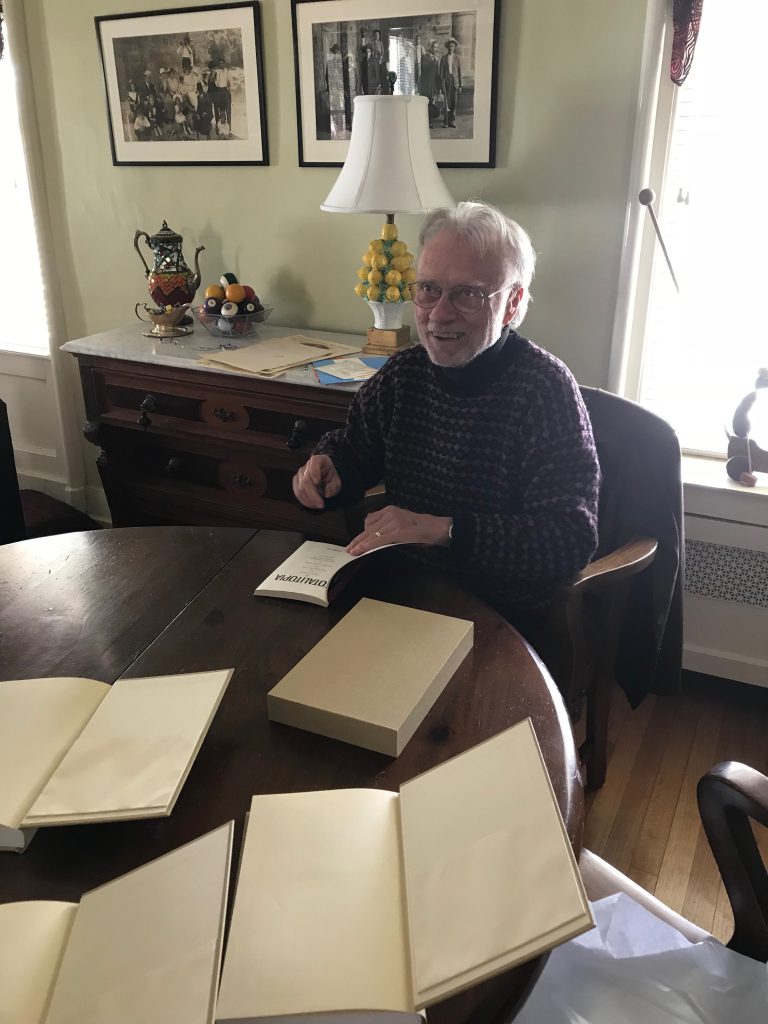
John Crowley, signing books in Conway, Mass., late March 2018 [Photo by MJ Duffy].
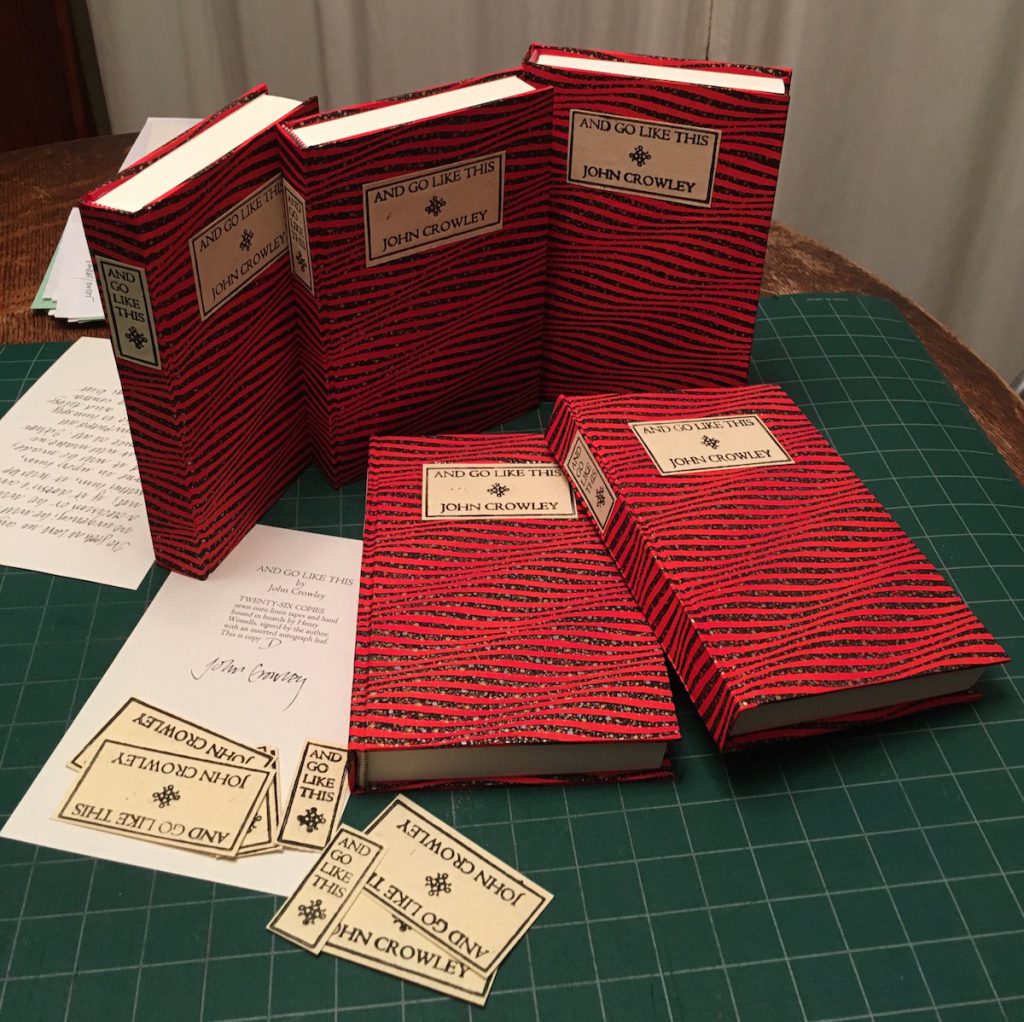
When John was agentless and somewhere in the morasse of writing Endless Things, Temporary Culture proposed decent terms to publish a small edition ; he declined graciously, reminding me that he sought a wider readership than I could achieve. Some years later, as Small Beer Press was getting ready to publish Endless Things in the spring of 2007, Gavin Grant commissioned a special binding of six copies for author and publisher and friends. It was a pleasure to oblige (and thus participate in the book) ; I designed and executed two further hand bookbinding projects for Crowley titles published by Small Beer, the Chemical Wedding and And Go Like This.

Some of the hand bound copies of And Go Like This on the bindery table (Small Beer Press, 2019).

John was very generous to me : he accepted my invitation to participate in the Critical Fiction panel to celebrate the publication of Wendy Walker’s My Man and Other Critical Fictions (2011), and the event went well. John was funny, a smart reader whose essays and conversation demonstrated his wide reading and ability to make interesting connections. It was curious that he was for a time so resistant to the notion of the critical fiction ; yet when he grasped the concept, he saw the playfulness and deep roots of the mode.
[A recording of the symposium here : http://criticalfiction.net/wordpress/?p=209 .]

John contributed a nimble preface to A Conversation larger than the Universe (2018). His “Hatful of Adjectives for Henry Wessells” contains one of the trickiest sentences he ever composed :

. . . he holds (though lightly) the idea that a literature of impossibilities can be a revealing mirror of actualities. Hamlet says that playing (into which we can enfold “fiction” in a sense Shakespeare didn’t use) holds a mirror up to nature; but of course the image in the mirror (as C. L. Dodgson never tired of pointing out) is always reversed.

Read that again : Alice and Hamlet and mirrors in a single sentence.

The sage came down from the mountain top (or, anyway, from the Utopian Berkshire village of Conway) to the Big Apple for the SF Symposium I organized in connection with the Grolier Club exhibition in early March 2018. John joined Christopher Brown, Siobhan Carroll, Ellen Datlow, Samuel R. Delany, and Maria Headley. It was a good panel and a fun conversation at dinner afterwards.
[Link to the Grolier Club video here : https://vimeo.com/259778546 .]

In his essay on re-reading, William Hazlitt talks of certain books as “links in the chain of our conscious being. They bind together the different scattered divisions of our personal identity. They are land-marks and guides in our journey through life” : this very much applies to my re-readings of Little, Big. John did not merely write Little, Big. The four volumes of Ægypt (over a twenty-year period), The Deep, Engine Summer, The Translator, Ka, and his short stories and essays form a substantial and enduring body of work. The John Crowley papers are held at HRC in Austin (Manuscript Collection MS-01003).

John was a modest, even humble person. One afternoon in the spring of 2018 I got a call from him, saying he was in town to go to an awards banquet, would I like to come to the reception (he couldn’t get me in to the gala dinner). I met him at his hotel. As we walked down to the much grander hotel, talking of many things along the way, he told me, “it’s a story set in a library. There’s no chance I’ll win but the publisher asked me to be present, so here I am”: that evening the Mystery Writers of America presented the Edgar award for best short story to “Spring Break” by John Crowley.

Some years ago John and I were asked to be a panelist at an event in Boston organized to identify One Hundred Famous Massachusetts Books (there are a great many of them). At the last minute, John couldn’t make it. Only a couple of people showed up, so we panelists had a great conversation and came up with a good preliminary list. My friend David Godine was there. And so was Matt Tannenbaum, of the Bookstore in Lenox, Mass. We both agreed that Little, Big ranked high on the list : his was the shop where forty-five years ago today a publication party was held for Little, Big by John Crowley (see below).

John Crowley was a kind man and a wonderful writer. We are all fortunate that he wrote his books.
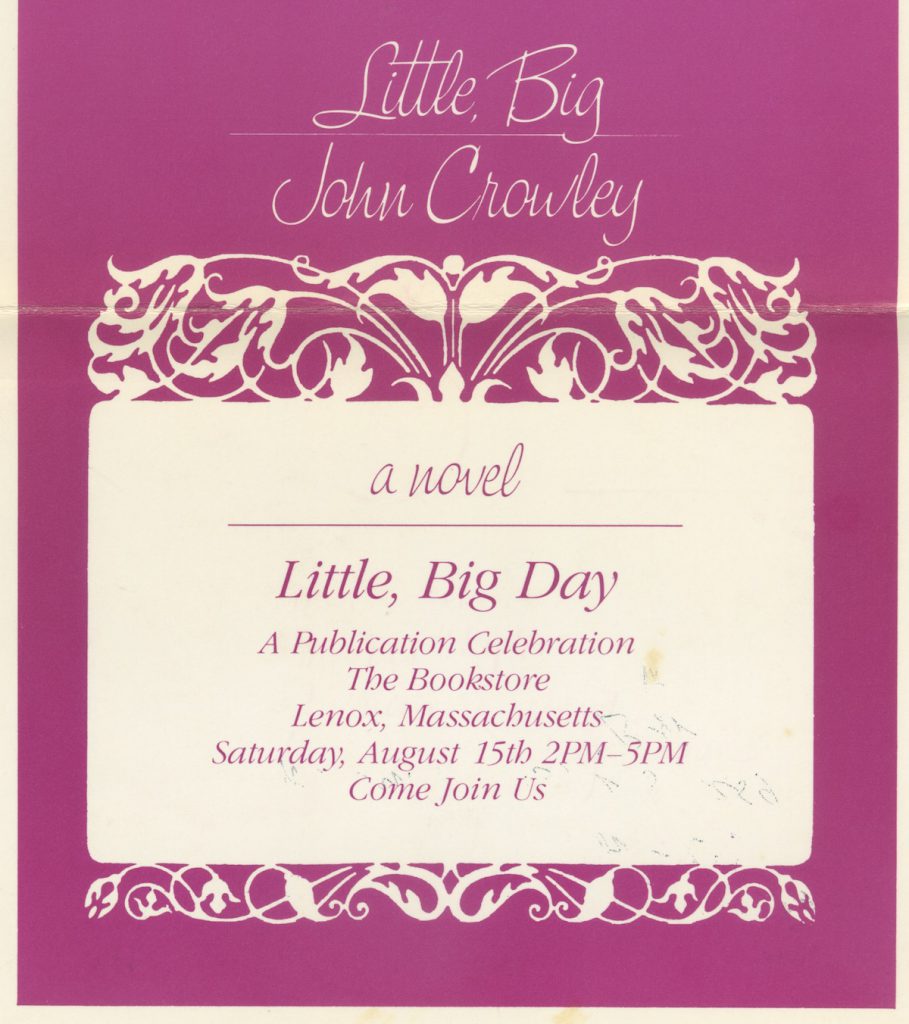
detail from an invitation, 1981
Detail from the invitation to Little, Big Day (15 August 1981).

dust jackets and scientific romance

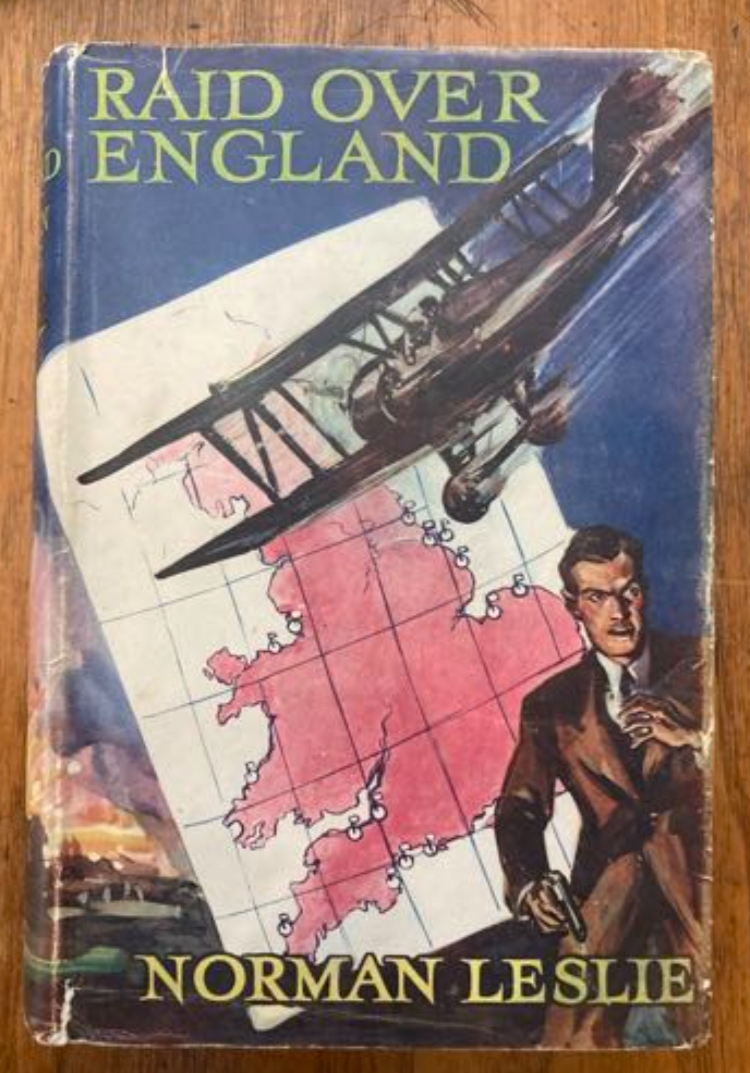
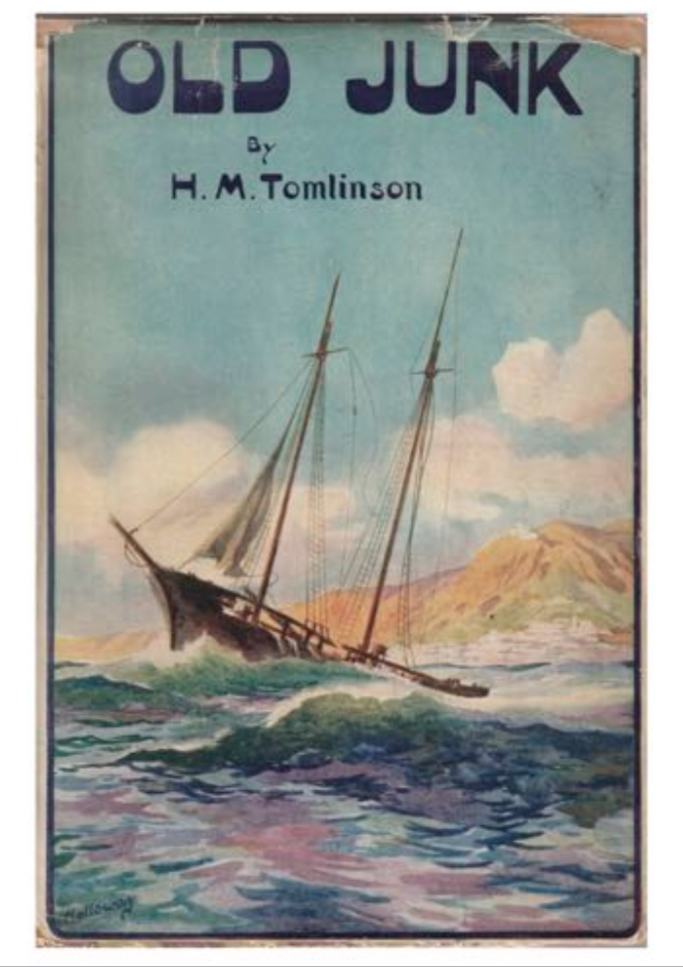
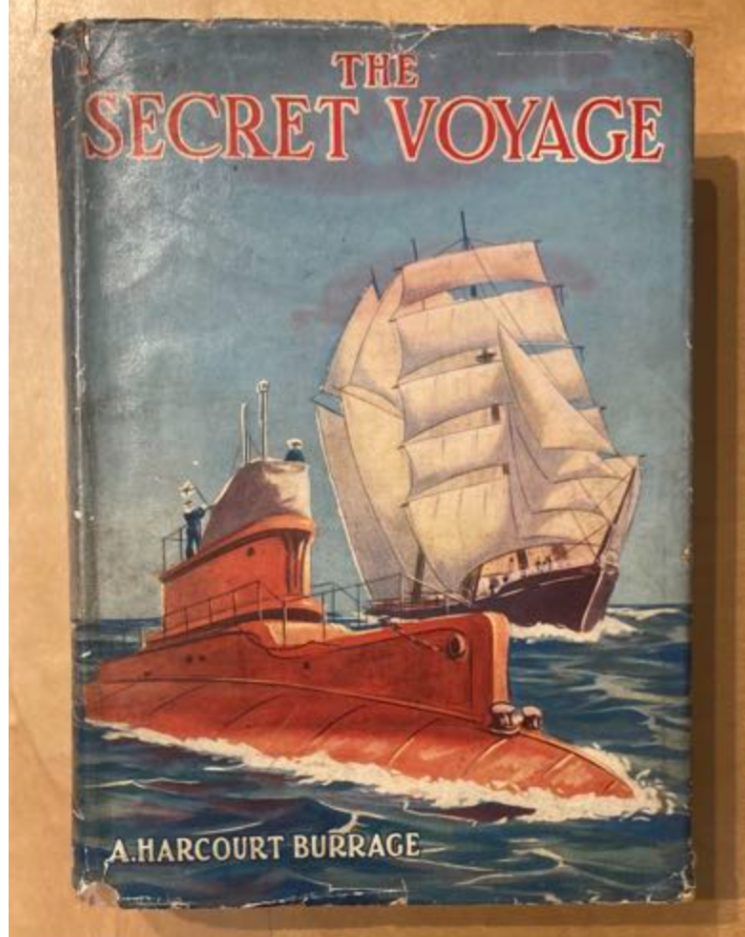
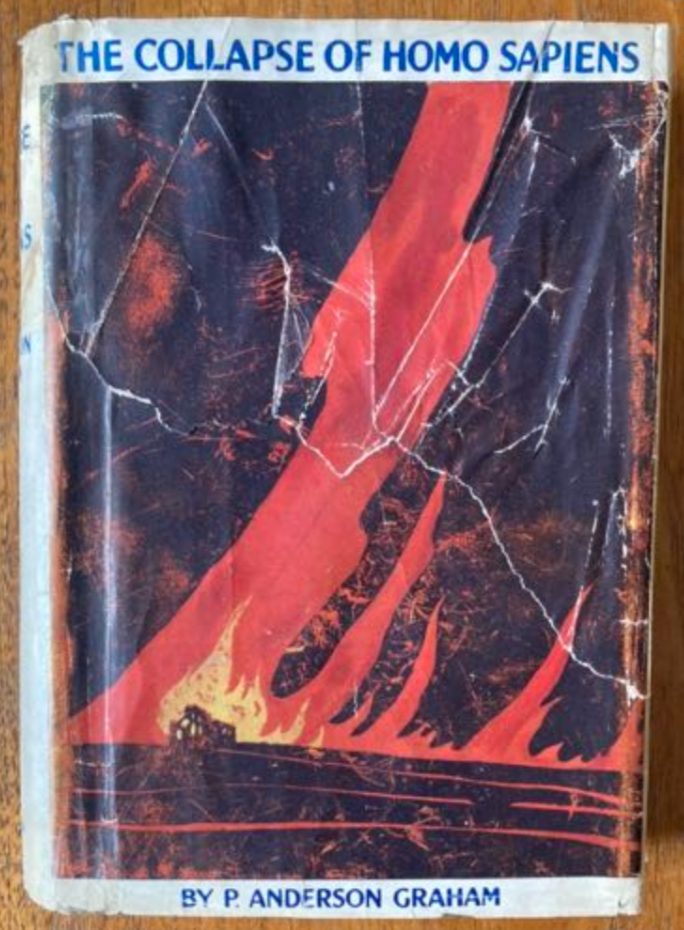
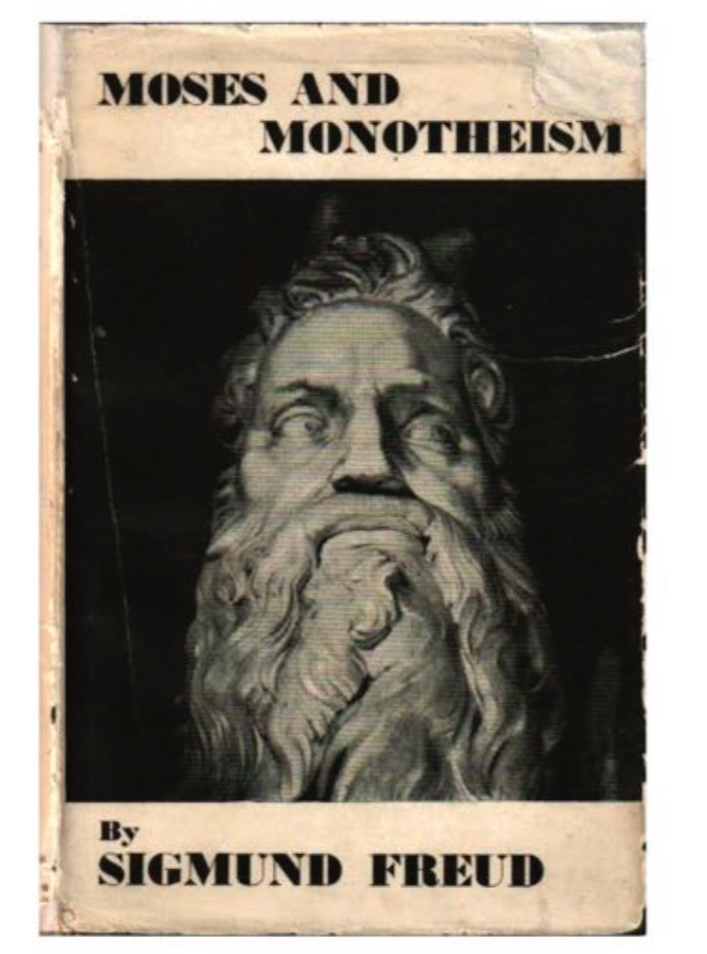
At Readercon in mid-July, the great delight was the panel / conversation with John Clute about dust jackets and the information they encode (in and out of science fiction), with examples from The Book Blinders (2024), my own collection, and the Clute Library at the Telluride Institute [click on things to see bigger pictures].

Moses and Monotheism by Sigmund Freud (dust jacket from the Clute collection, Telluride)
Raid over England by Norman Leslie (dust jacket from the Clute collection, Telluride)
Old Junk by H. M. Tomlinson (dust jacket from the Clute collection, Telluride)


Clute also talked about the Scientific Romance in interwar British publishing, with Michael Dirda, a good chat. His thesis in progress is outlined at the SFE, lots of interesting titles (most of them in the Telluride hoard), details here :
https://sf-encyclopedia.com/entry/scientific_romance

The World Ends by William Lamb [Storm Jameson] (dust jacket from the Clute collection, Telluride)

The Secret Voyage by A. Harcourt Burrage (dust jacket from the Clute collection, Telluride)
The Collapse of Homo Sapiens by P. Anderson Graham (dust jacket from the Clute collection, Telluride)


Readercon 34 (July 2025)

Readercon 34 Schedule
at the Boston Marriott Burlington in Burlington, Mass.
https://readercon.org

Saturday 19 July
10:00 a.m., at the autographer’s table
Autograph Session : Henry Wessells

Sunday 20 July
10:00 to 11:00 a.m., in : Create / Collaborate
The Art of the SF Book Cover
John Clute & Henry Wessells
Panel description : Since its inception, the British Library, the national library of the UK, has stripped dust jackets off books in its holding and discarded the unwanted wrappers, losing an essential piece of their cultural and artistic significance. In The Book Blinders, science fiction historian and theorist John Clute details the “annals of vandalism” at the British Library, with a focus on works lost (and found). John Clute and antiquarian bookseller Henry Wessells give a joint presentation on this subject, with numerous illustrations, and with extra time for Q&A.

11:00 to 11:30 a.m., in : Empower / Embrace
Reading : Henry Wessells
Henry Wessells reads from The Elfland Prepositions and from Another Green World (both newly published in 2025).

12:00 noon to 1:00 p.m., in : Create / Collaborate
The Art of the SF Book Cover
John Clute & Michael Dirda
Panel description : The early divergence of American and British science fiction may best be witnessed in the works of UK authors in the 1930s and ’40s that have been called “scientific romances.” Unlike their pulp cousins in the US, these works lack the optimistic outlook of young square-jawed heroes out to conquer the galaxy. Instead, they offer anxiety about rogue scientists armed with Ultimate Weapons out to blackmail the world to either peace or servitude. In this presentation, famed fantastika theorist John Clute and Michael Dirda will discuss this less-recognized strand of SF.
[N.B. I will be running a slide show not dissimilar to the one for dust jackets.]

I should arrive at Readercon by midday on Friday. Temporary Culture will have a table in the book room on Friday and Saturday, and copies of A Conversation larger than the Universe, The Private Life of Books, The Elfland Prepositions, and Another Green World (advance copies of the Zagava paperback), the publications of the Avram Davidson Society, Sexual Stealing by Wendy Walker, and a variety of other books will be available for sale (cash, cheque, or paypal). If you see me, come say hello. There is always plenty of time for conversation.

Readercon 33, July 2024

It’s July, so that means Readercon! Once again!

I’ll be there in Quincy, Mass., Friday through Sunday 12-14 July, and if you are there you will see me wandering about, and occasionally at fixed locations, according to the following schedule.

Friday 12 July 2024
6:00 p.m. (Salon B) The King of Elfland’s Daughter at 100 (moderator)
8:00 p.m. (Salon B) Book Club : Elizabeth Hand’s Winterlong trilogy

Saturday 13 July 2024
6:30 p.m. (Blue Hills) Reading : “John Z. Delorean, Drycleaner to the Queen of Elfland” (new work)

Sunday 14 July 2024
12:00 p.m. (Salon A) The Manuscripts of Arthur Machen (talk)

Copies of The Private Life of Books, A Conversation larger than the Universe, and other publications of Temporary Culture will be on hand. Come say hello if you see me.

Readercon 32 : a brief report

Very happy to have attended this year’s Readercon, held 13-16 July in Quincy, Mass. I arrived on the Thursday evening after a research visit to the American Antiquarian Society, and during the course of the weekend saw many old friends and acquaintances (including a couple of unexpected surprises), met a couple of people whom I had only known from correspondence, and made a few new friends.  I am
one who found the convention masking policy (generally observed inside the con areas) and ventilation precautions most reassuring. I ate my meals out of doors (or went down into Quincy to eat al fresco). The hotel patio was a good place to sit down and see who showed up, and the weather was warm but clement until a deluge began on Sunday morning.
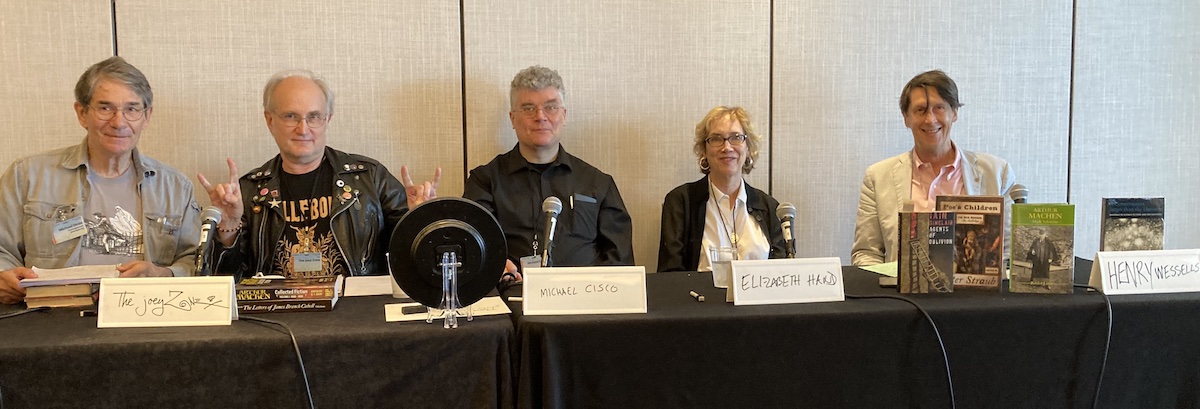
I was much encouraged by the decision to include the  panel on Arthur Machen in the twenty-first century, Machen’s Legacy in Modern Horror & Fantasy, which I had proposed on a dark winter evening. It was very well attended and with such a knowledgeable group of panelists the conversation was so lively we ran out of time before there was any space for questions.
Arthur Machen panel at Readercon 32. Photo by Paul Witcover. From left : Michael Dirda, The Joey Zone, Michael Cisco, Elizabeth Hand, Henry Wessells (moderator)
Chris Brown’s Field Notes from the End of the World was an illustrated talk on nature writing in dystopian fiction, a good glimpse of some of my friend’s predilections and wild thinking, firmly grounded in the concerns of his Field Notes newsletter. Who else but Chris would consider Neuromancer from this perspective?  I attended the interviews with the guests of honor: Jeff Vandermeer in conversation with his wife Ann, and Justina Ireland interviewed by Arley Sorg,  lots of intelligent fun. I had not known of Justina Ireland before coming to Readercon, and found the panel on the author’s works to be exemplary in its mix of fact, interpretation, and enthusiasm. The panel in memory of Maureen Kincaid Spiller, a conversation between Graham Sleight and Romie Stott of Strange Horizons, was also very good. Of course there were time conflicts on panels & readings that I had to miss, testimony to rich multistream programming.

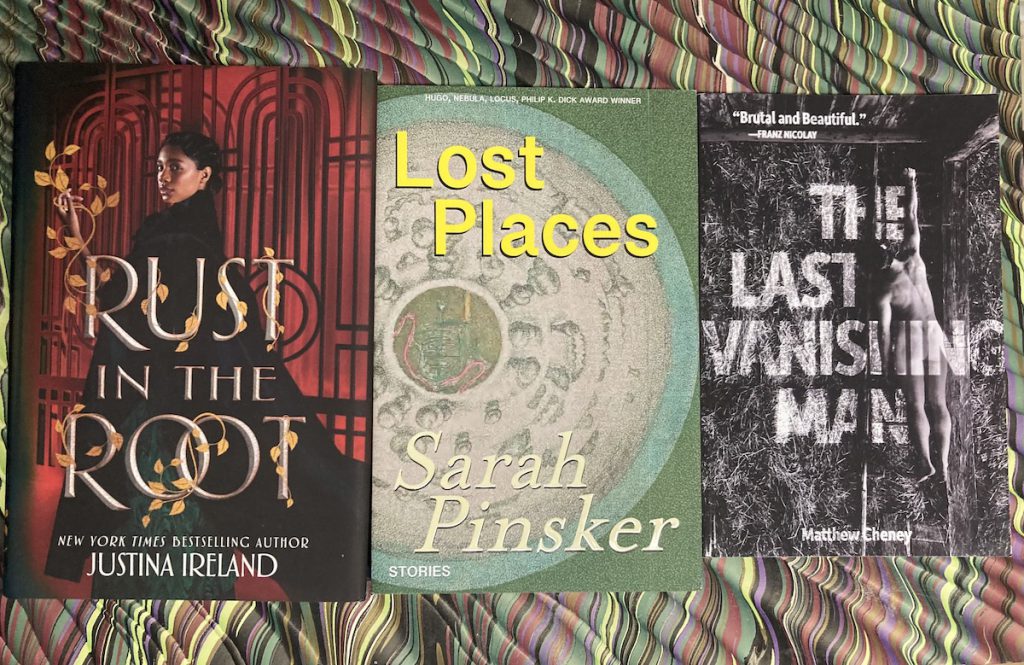
The book room felt a bit of a ghost town, with few antiquarian or older books, but I bought six new books (a few of them shown above) including one by Ireland (Rust in the Root) on the basis of the panel, and one by a member of a panel I moderated.
I have reached the age of insouciance, knowing that I am much older than many of the attendees and that our interests often diverge, but I had fun and will plan to attend next year. [HWW]