In Memoriam : John Crowley
1 December 1942 – 8 August 2026
John Crowley was a great writer, one whose work I prize above most other writers. I first knew and esteemed Crowley through his work, as with Borges and Avram Davidson (neither of whom I ever met), but the subculture of science fiction is permeable, so before long we met in person and became friends. (Peter Straub was the other magician writer I was lucky enough to get to know.) Our paths, it turned out, had many meeting points. I remember more than one Readercon where John and I were both wearing seersucker.
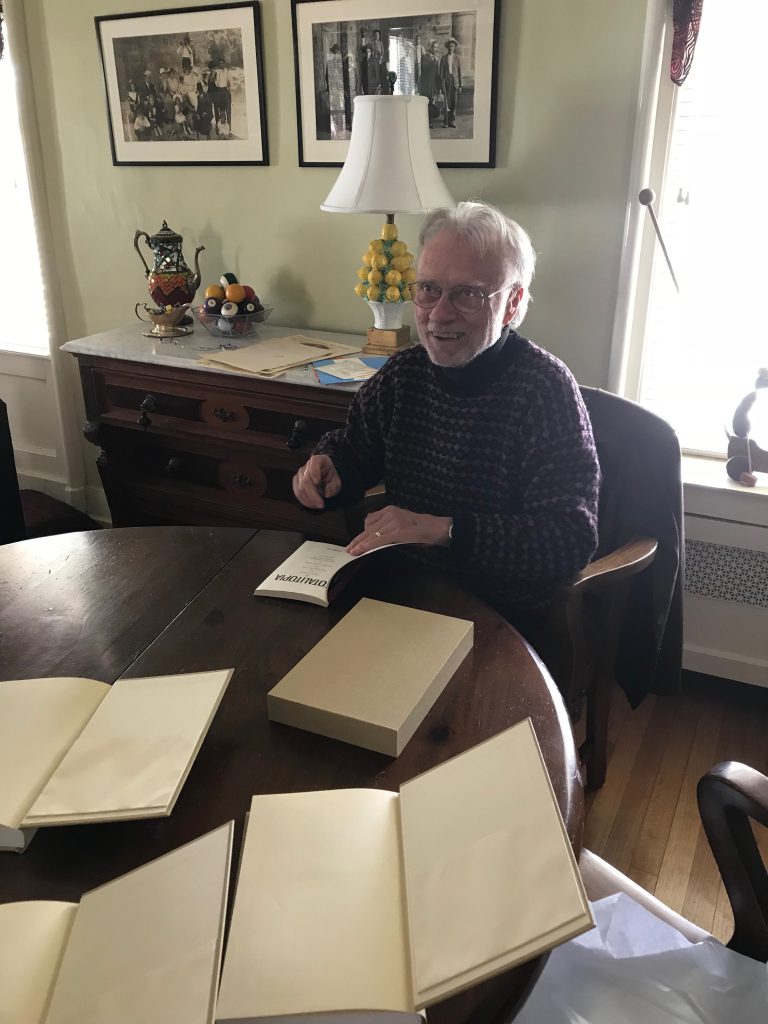
John Crowley, signing books in Conway, Mass., late March 2018 [Photo by MJ Duffy].When John was agentless and somewhere in the morasse of writing Endless Things, Temporary Culture proposed decent terms to publish a small edition ; he declined graciously, reminding me that he sought a wider readership than I could achieve. Some years later, as Small Beer Press was getting ready to publish Endless Things in the spring of 2007, Gavin Grant commissioned a special binding of six copies for author and publisher and friends. It was a pleasure to oblige (and thus participate in the book) ; I designed and executed two further hand bookbinding projects for Crowley titles published by Small Beer, the Chemical Wedding and And Go Like This.
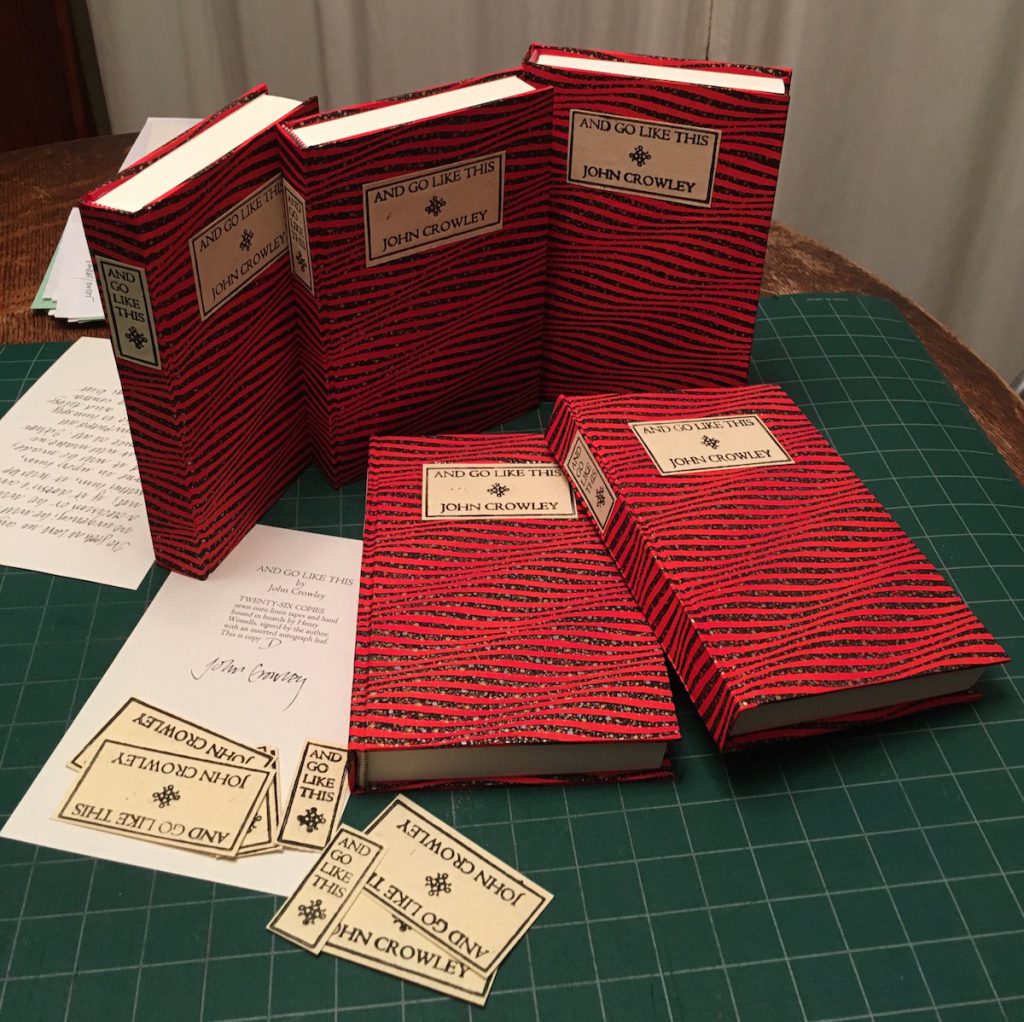
Some of the hand bound copies of And Go Like This on the bindery table (Small Beer Press, 2019).
John was very generous to me : he accepted my invitation to participate in the Critical Fiction panel to celebrate the publication of Wendy Walker’s My Man and Other Critical Fictions (2011), and the event went well. John was funny, a smart reader whose essays and conversation demonstrated his wide reading and ability to make interesting connections. It was curious that he was for a time so resistant to the notion of the critical fiction ; yet when he grasped the concept, he saw the playfulness and deep roots of the mode.
[A recording of the symposium here : http://criticalfiction.net/wordpress/?p=209 .]
John contributed a nimble preface to A Conversation larger than the Universe(2018). His “Hatful of Adjectives for Henry Wessells” contains one of the trickiest sentences he ever composed :
. . . he holds (though lightly) the idea that a literature of impossibilities can be a revealing mirror of actualities. Hamlet says that playing (into which we can enfold “fiction” in a sense Shakespeare didn’t use) holds a mirror up to nature; but of course the image in the mirror (as C. L. Dodgson never tired of pointing out) is always reversed.
Read that again : Alice and Hamlet and mirrors in a single sentence.
The sage came down from the mountain top (or, anyway, from the Utopian Berkshire village of Conway) to the Big Apple for the SF Symposium I organized in connection with the Grolier Club exhibition in early March 2018. John joined Christopher Brown, Siobhan Carroll, Ellen Datlow, Samuel R. Delany, and Maria Headley. It was a good panel and a fun conversation at dinner afterwards.
[Link to the Grolier Club video here : https://vimeo.com/259778546 .]
In his essay on re-reading, William Hazlitt talks of certain books as “links in the chain of our conscious being. They bind together the different scattered divisions of our personal identity. They are land-marks and guides in our journey through life” : this very much applies to my re-readings of Little, Big. John did not merely write Little, Big. The four volumes of Ægypt (over a twenty-year period), The Deep, Engine Summer, The Translator, Ka, and his short stories and essays form a substantial and enduring body of work. The John Crowley papers are held at HRC in Austin (Manuscript Collection MS-01003).
John was a modest, even humble person. One afternoon in the spring of 2018 I got a call from him, saying he was in town to go to an awards banquet, would I like to come to the reception (he couldn’t get me in to the gala dinner). I met him at his hotel. As we walked down to the much grander hotel, talking of many things along the way, he told me, “it’s a story set in a library. There’s no chance I’ll win but the publisher asked me to be present, so here I am”: that evening the Mystery Writers of America presented the Edgar award for best short story to “Spring Break” by John Crowley.
Some years ago John and I were asked to be a panelist at an event in Boston organized to identify One Hundred Famous Massachusetts Books (there are a great many of them). At the last minute, John couldn’t make it. Only a couple of people showed up, so we panelists had a great conversation and came up with a good preliminary list. My friend David Godine was there. And so was Matt Tannenbaum, of the Bookstore in Lenox, Mass. We both agreed that Little, Big ranked high on the list : his was the shop where forty-five years ago today a publication party was held for Little, Big by John Crowley (see below).
John Crowley was a kind man and a wonderful writer. We are all fortunate that he wrote his books.
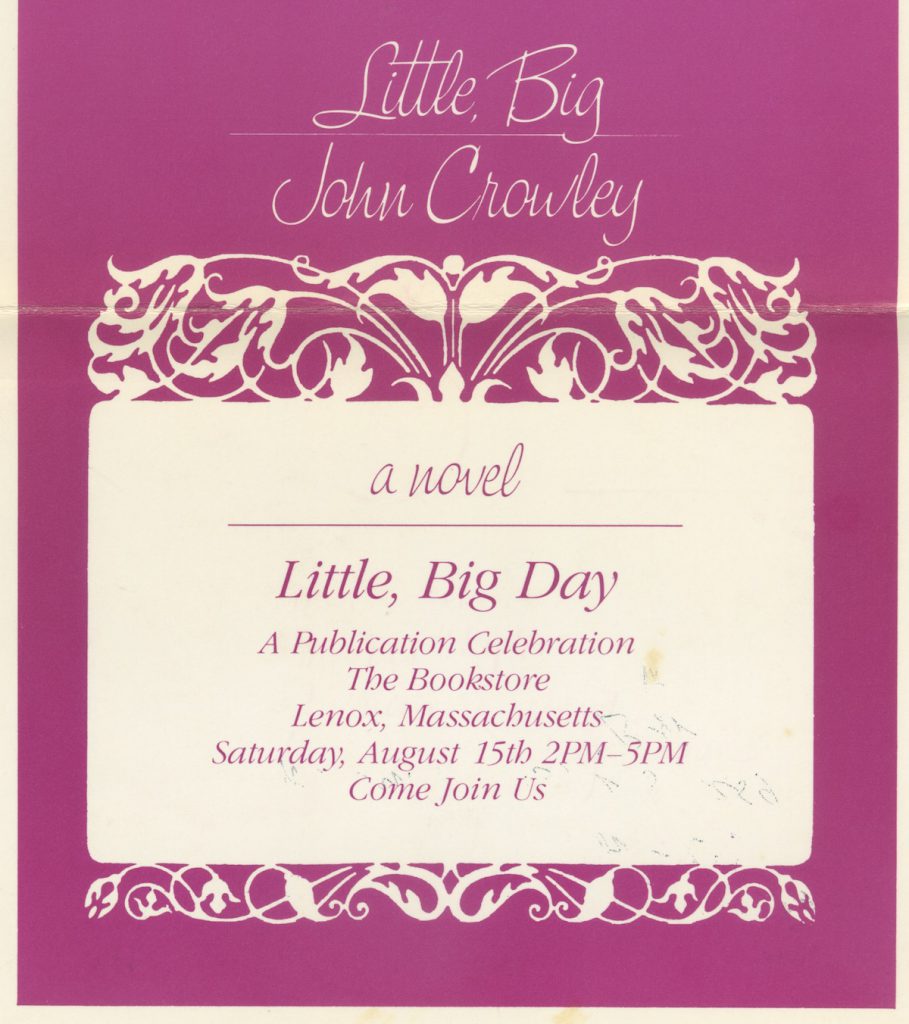
Detail from the invitation to Little, Big Day (15 August 1981).
Very happy to have attended this year’s Readercon, held 13-16 July in Quincy, Mass. I arrived on the Thursday evening after a research visit to the American Antiquarian Society, and during the course of the weekend saw many old friends and acquaintances (including a couple of unexpected surprises), met a couple of people whom I had only known from correspondence, and made a few new friends. I am
one who found the convention masking policy (generally observed inside the con areas) and ventilation precautions most reassuring. I ate my meals out of doors (or went down into Quincy to eat al fresco). The hotel patio was a good place to sit down and see who showed up, and the weather was warm but clement until a deluge began on Sunday morning.
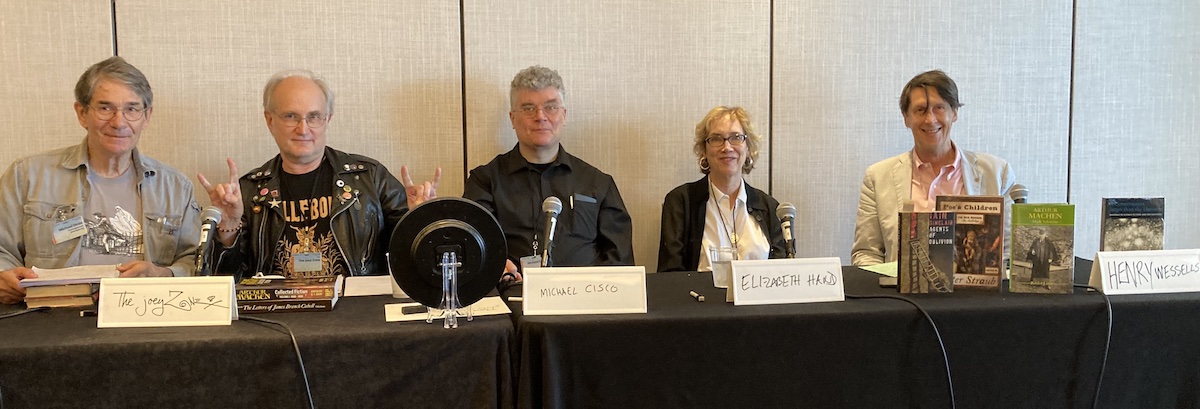
I was much encouraged by the decision to include the panel on Arthur Machen in the twenty-first century, Machen’s Legacy in Modern Horror & Fantasy, which I had proposed on a dark winter evening. It was very well attended and with such a knowledgeable group of panelists the conversation was so lively we ran out of time before there was any space for questions.
Arthur Machen panel at Readercon 32. Photo by Paul Witcover. From left : Michael Dirda, The Joey Zone, Michael Cisco, Elizabeth Hand, Henry Wessells (moderator)
Chris Brown’s Field Notes from the End of the World was an illustrated talk on nature writing in dystopian fiction, a good glimpse of some of my friend’s predilections and wild thinking, firmly grounded in the concerns of his Field Notes newsletter. Who else but Chris would consider Neuromancer from this perspective? I attended the interviews with the guests of honor: Jeff Vandermeer in conversation with his wife Ann, and Justina Ireland interviewed by Arley Sorg, lots of intelligent fun. I had not known of Justina Ireland before coming to Readercon, and found the panel on the author’s works to be exemplary in its mix of fact, interpretation, and enthusiasm. The panel in memory of Maureen Kincaid Spiller, a conversation between Graham Sleight and Romie Stott of Strange Horizons, was also very good. Of course there were time conflicts on panels & readings that I had to miss, testimony to rich multistream programming.
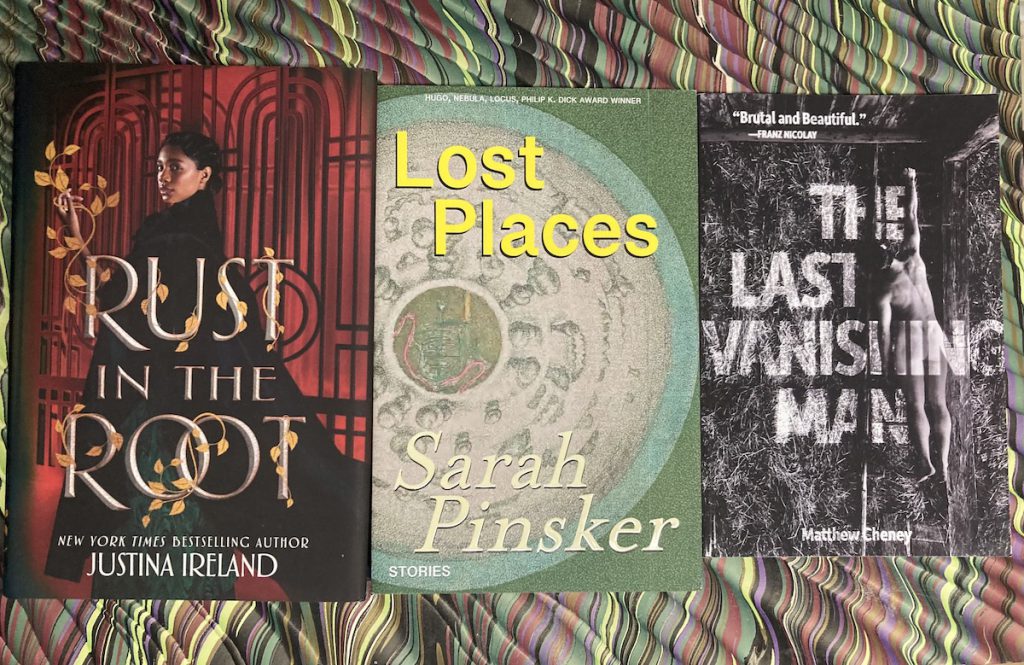
The book room felt a bit of a ghost town, with few antiquarian or older books, but I bought six new books (a few of them shown above) including one by Ireland (Rust in the Root) on the basis of the panel, and one by a member of a panel I moderated.
I have reached the age of insouciance, knowing that I am much older than many of the attendees and that our interests often diverge, but I had fun and will plan to attend next year. [HWW]
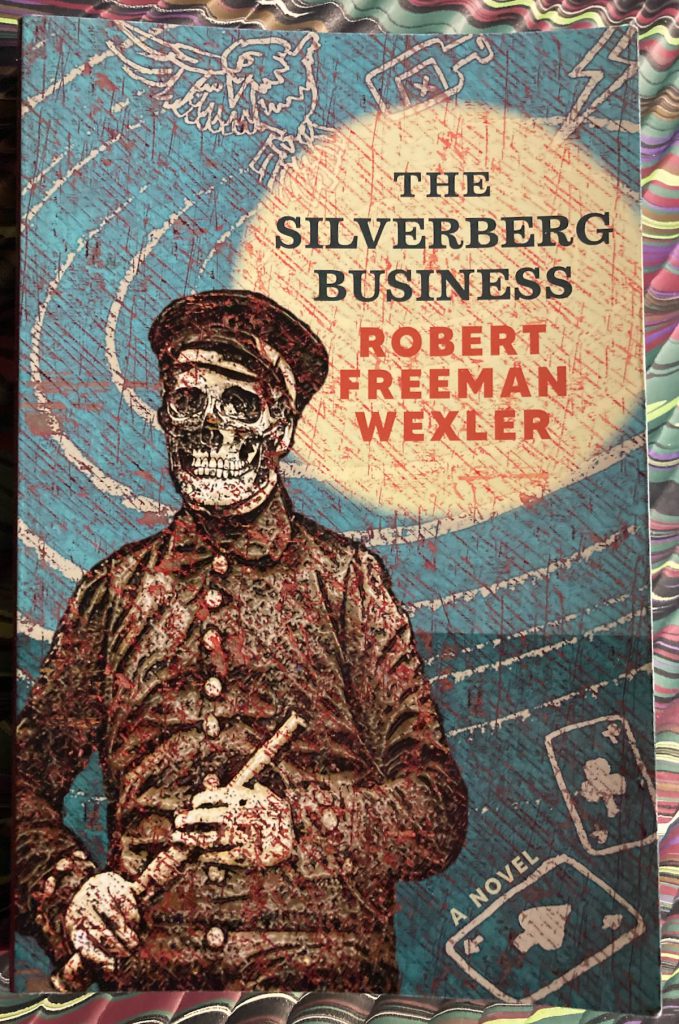
— Robert Freeman Wexler. The Silverberg Business. [vi], 269, [1, blank], [1, about the author], [5, blank], [4, ads]. Small Beer Press, [2022]. Wrappers with illustration by Jon Langford.
The Silverberg Business follows Shannon, a Jewish private detective who has come to Victoria, Texas, in late October 1888, in search of information about a missing man and the large bank draft he carried, representing funds raised on behalf of a Romanian Jewish refugee settlement plan. Shannon, a Galveston native with a talent for finding bodies, uncovers fraud and murder, and indications of concerted sinister activity in and around southern coastal Texas. We get a clear sense of the “feel of a frontier town” in Victoria, and the people living there. Shannon gets knocked over the head on several occasions. He works for a Chicago agency and has considerable autonomy. The detective talks, and listens to people from all walks of life, bankers and bank clerks, railroad conductors and bartenders, laundresses and rooming-house owners, marshals and horse dealers, gamblers, whores, and rabbis. In the course of his narration, Shannon drops elements of his own history and character. His tenacity of purpose leads him into strange places, and the reader goes with him, out into sparsely populated terrain, and elsewhere.
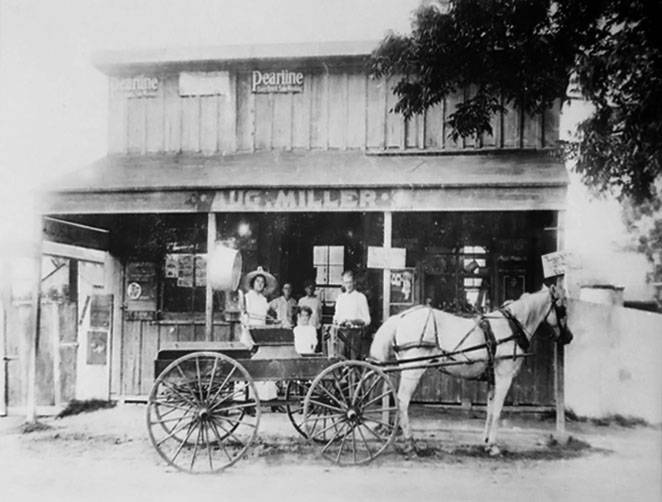
August Miller Store, Victoria, Texas. Courtesy of Victoria Regional History Center.
Shannon’s first-person narrative voice is matter-of-fact, smart and aphoristic, and keenly observant of his surroundings. He is Hammett’s Continental Op on the ground in 1880s Texas, which would be interesting enough, but Wexler also reappropriates the Western as a literary domain, and goes farther even than William S. Burroughs did in The Place of Dead Roads. Wexler’s achievement is to have created a formally innovative fiction that moves seamlessly, and beautifully, from dream to waking to sensory hallucination and then back to the mug of coffee the waitress has set before Shannon in the dining room at the Delmonico Hotel. He soon discovers that Silverberg, an Easterner, was seen in the company of a well-dressed Westerner with bad teeth and a gambler named Stephens. A conductor describes Stephens: “whitish hair, somewhat taller than average, red-brown eyes, a tendency toward fancy dress.”
Shannon muses:
Was Stephens the man who walked past the hotel restaurant and stared in at me? White . . . blond . . . storm of white-capped waves gouged the coast . . . an oak that had stood for centuries screamed and gave up its life . . . nothing remained, nothing but naked earth twisted into shapes of the dead and dying. I cried for the land, but what use are tears?
Stephens wears an onyx ring with a Greek god carved into it, and demonstrates a capacity to come and go as he pleases. There is often a stench of sea rot as the mark of his passage.
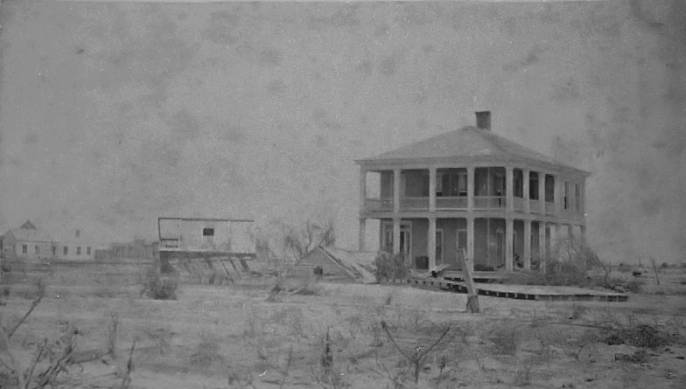
Indianola, Texas after the August 20, 1886, hurricane that destroyed the city. The residence of Peter Clement showing driftwood against it. Courtesy of Victoria Regional History Center.
Pursuing the gambler, Shannon saddles up his horse, Blue Swamp, and rides out of Port Lavaca towards the ruined town of Indianola, which had been flattened by an earlier hurricane. He spends a couple of nights camping, fishing and shooting ducks for his meals, befriending a one-winged bald eagle, and has strange dreams. The next day as he gets near Matagorda Bay, the noon sky turns dark. “Reddish light washed the salt-cedars and cactus.” When his Blue Swamp refuses to move further, Shannon goes ahead on foot and finds an unexpected sand hill on the barrier island.
Sand hills form, blow apart, re-form, eventually becoming immobilized by growth of sea oats, goateed, and other plants. This one was crusty, bare, more like sandstone than sand, and the front looked sculpted, carved into features . . . curl of lip, open mouth, deep eye holes. A rotting animal festered in the mouth.
Then I found the body.
It is the murdered Silverberg. When the weather turns inclement, Shannon passes the night at the farm of Ratface Conroy. Out in the tumble-down barn, “a lean-to strung together from broken parts of other structures,” Shannon’s sleep is interrupted when his hosts attempt to murder him. Shannon shoots the husband and goes after Mrs. Conroy, who is armed. Pushing through a curtain in the sod farmhouse, Shannon enters a giant, ruined stone mansion. He shoots her dead, and returns to find a zombie “skull-head” Conroy armed and awaiting him. Shannon is faster at the draw, and sets the house ablaze as he leaves. This is not the last of the skull-heads Shannon will encounter.
— — —
Though I wasn’t playing poker, the same rules applied — watch, wait, calculate the odds.
There’s a lot of poker in The Silverberg Business, stud poker where only the first card is dealt face down to each player, and all the other cards are visible upon the table as they fall. This is emblematic of Wexler’s narrative method, for the reader sees what Shannon sees, and patterns are deduced from evidence visible and from inferences about what remains concealed.
Time is a hill, a hill that grows as you climb, grows to mountainside. Wind and rain alter the mountain, exposing rock, minerals. Looking back the way you came gets harder. Sometimes, all you can see is the rising path ahead of you. You get to the top. Everybody does. Sometimes sooner than we expect. The journey is what matters. Here in skull-head land, time means nothing.
These fugues and hallucinations and strange dreams are integral to the way Shannon gains knowledge of the strange world he enters. And the reader enters with him, for his voice is supple enough to take in this space outside of time, poker-playing zombies, and a daring escape in the Flying Kestrel, a contraption from the Sonora Aero Club, across a landscape of perpetual intertemporal war. Abandoned in a Louisiana swamp by the pilot of the Kestrel, he finds that months have passed.
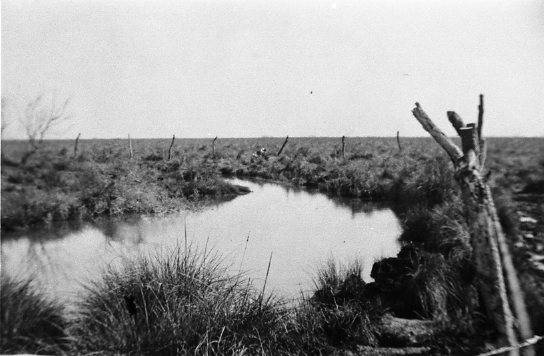
Schultz tank at the O’Connor Ranch on Copano Bay. Courtesy of Victoria Regional History Center.
The measure of Shannon’s persistence is seen in the way he makes his return to Victoria and resumes his investigation of the gambler, no matter the cost. Among further clues are strange manuscript account in Spanish recording the indigenous culture of the region, and a pattern of inexplicable land purchases on barrier islands. On a visit to the prison in Huntsville. Shannon finds the prisoner he expected to interview has been murdered. Chasing Stephens down a stairway that couldn’t exist, Shannon finds himself again in the land of the skull-heads, and the poker-playing begins in earnest. The stakes couldn’t be higher.
— — —
In a review of an exhibition of paintings by J. M. W. Turner, critic Jackie Wullschläger usefully articulates the notion that Turner’s work began to push “beyond realistic description”. As readers and writers, all we have are words, but sometimes that is sufficient. The Silverberg Business is a book that demonstrates what fiction is all about.
Continuity is a convenient illusion. The discontinuities of Shannon’s subjective experience — dream, beautiful maritime interludes, fugue states, hallucination, or return to consciousness after getting clobbered on the head — are as cut-up as anything from Burroughs, and the psychological and geographical terrain of the novel are vast spaces, but Shannon is unflappable, no matter how weird it gets. The Silverberg Business is linear and direct in its narrative line even as the words dance across time and space from sentence to sentence within a single paragraph.
I wasn’t sure I would be able to function . . . I . . . Stephens, looming gigantic , his red eyes roasted my flesh. Shriveled strips floated on the waves, adhered to the sides of the boat, and the ocean, all its weight above, squeezing me into nothingness. I swam into a cave, a cavern so vast it held the world, and beyond, the sparkling Mediterranean of Salonica’s harbor. Captain Bellis gave the order “Moor ship!” and our boat thumped into the remnants of a Galveston pier.
Wexler’s prose is shocking, funny, and vivid, and can go anywhere, and he goes to some very strange places (the summary above leaves off about halfway through the book, so buy the book and read it).
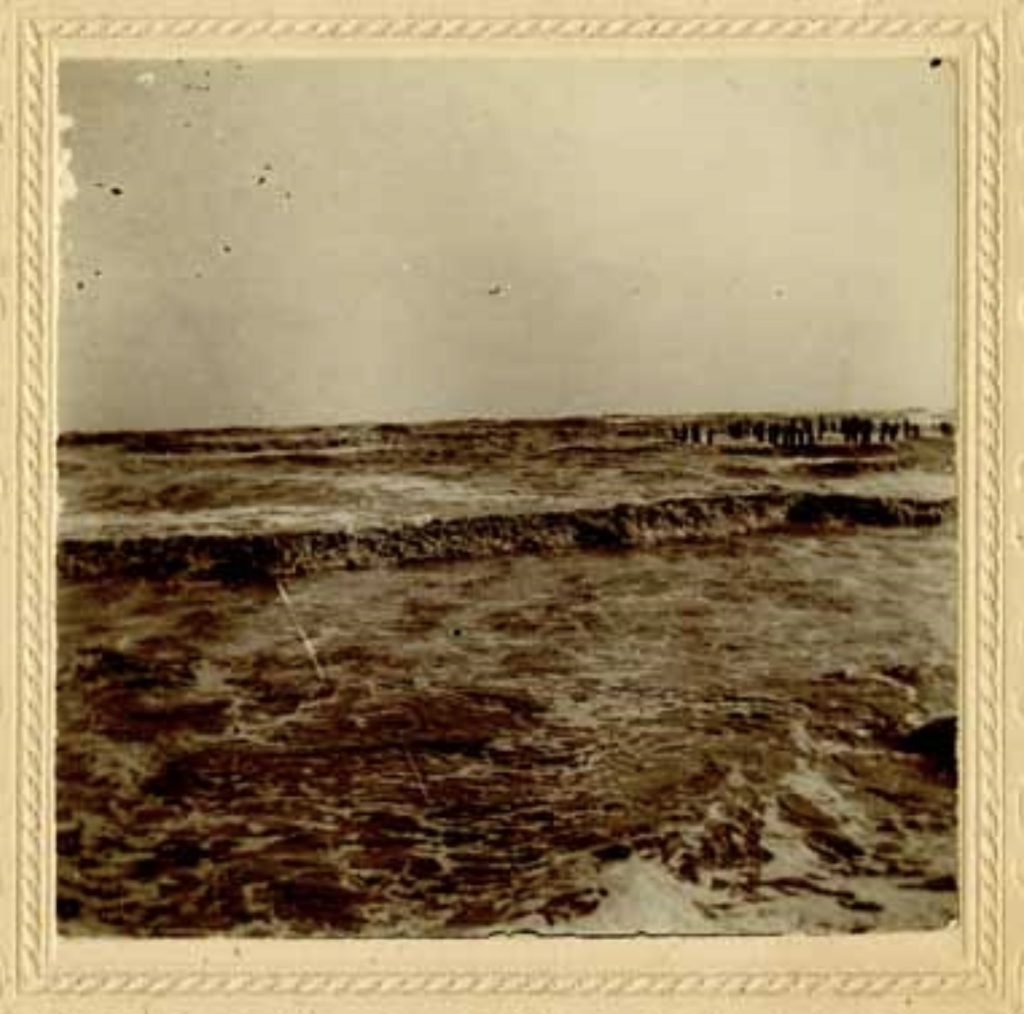
Galveston beachfront after the 1900 hurricane. Courtesy of the Galveston and Texas History Center, Rosenberg Library.
In The Silverberg Business, there are also countless playful allusions to elements of American literature high and low, among them Winsor McCay’s Little Nemo; Dashiell Hammett and William S. Burroughs, as noted earlier; and, though his name is nowhere mentioned, H. P. Lovecraft, especially in the sense of menace and the notion that human actors would be serving malign powers and non-human entities. The Silverberg Business is also a notable evocation of Jewish life in late-nineteenth century Texas. Wexler’s narrator unifies all these many fissiparous elements, and the concluding passages are tragic, deeply earned, and very moving. An outstanding work, the best book I’ve read this year.