
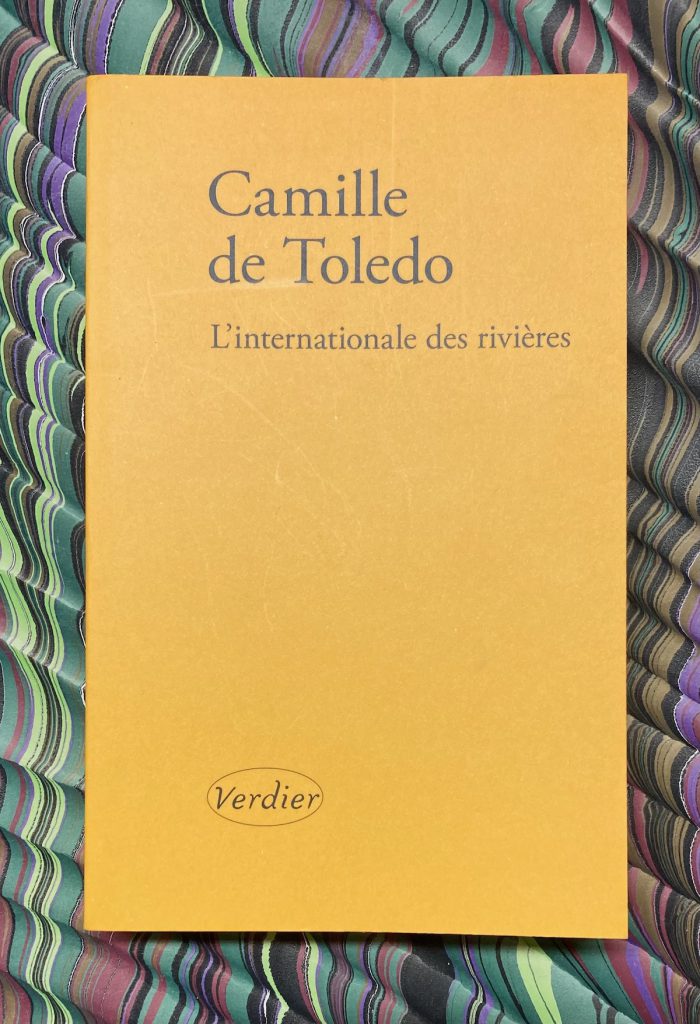
— Camille de Toledo [Alexis Mital]. L’internationale des rivières. Un recit de l’avenir. With four illustrations from photos by the author. 231, [4], [3, ads] [1, imprint] pp. Verdier, [février 2026].
Once upon a time there was a river . . . .
L’internationale des rivières is a fairy tale of ecology and economics, a hybrid text of science fiction and law and the imagination. The title proclaims that L’internationale des rivières is an anthem of global relevance ; it is, as the subtitle suggests, “a tale of the future”, one that makes its own hybrid form : the memoir or day book of an elderly professor recalling, circa 2055, events that began two decades earlier. He is closely entwined with efforts to establish legal personhood for a river, and what comes after : “I was more than a sympathizer during these first years”.
Much like James Watson’s The Double Helix, the narrative of events unfolds as things happen (with occasional meanders), and this gives the work a surprising immediacy and tension not present in the dry recitation of facts. There is little dialogue, the tone is dry as the narrator chronicles his classroom lectures, the public debates and court proceedings, and the activities in the French parliament, with digressions to review contemporary objections and his own hesitations and concerns ; and yet the cumulative effect is fascinating. The unnamed elderly narrator, who might be Camille de Toledo (pseudonym of Alexis Mital), recounts the origins of the legal structures of the ecological movement, from Christopher Stone in California in 1972 to the constitution of Ecuador in 2008, to Colombia in 2016 and the Te Awa Tupua case in New Zealand in 2017.
In 2035, a nationwide vote is held in France on a law to create legal standing for the river L ; despite all the efforts of the reactionary right to counter it, the loi Henriette passes (the name is a nod to one of the book’s dedicatees and evidence that the author does not leave his collaborators as roadkill). This designation of a river as a non-human person with legal standing is merely the beginning : rivers and places in England and elsewhere have been given similar status.
Il arrive bien souvent que la pratique, la vie du droit anticipent la pensée. [It often happens that practice, the life of law, anticipates thought.]
L’internationale des rivières is a revolutionary book, for in the aftermath of the law of 2035, the trustees of the river, the “human voices”, bring an action to recognize the river L as a corps travailleur, a “working body” [or even, a working stiff], entitled to all the rights commensurate with that status. “They invented a future for the law of 2035 instead of folding under the inertia of regulations”.
L’internationale des rivières is a legal thriller, not in the sense of courtroom drama, but in the sequence of judicial decisions and the formulation of contracts recognizing obligations and “retributions” (as the financial compensations paid to the river are designated). It is a thriller of the rule of law.
When the judge in the highest court in France confirms this status, a model is swiftly proposed to structure fractional compensation for the “work” of the river, a few mills here, a few fractions of percentages there, from each and all of the entities benefitting from the river : people, towns, farmers, hydroelectric dams, and so on, over the entire length of the river from source to delta. The trustees can dispose of these funds for the immediate benefit of the river — open space preservation, pollution remediation, and so on — or use them in solidarity with other ecosystems. Despite massive propaganda campaigns from the capitalist right and the “addict state”, despite the sluggishness of the appeal process and parliaments, the suit of the river L is successful.
Science fiction has long struggled with the question, what will replace capitalism ? L’internationale des rivières adapts the financial structures of extractive capitalism to force a new, post-capitalist economic model for the region and the planet, a “terrestrial political economy”.
Camille de Toledo is especially good at highlighting tensions between the popular basis of ecological actions and the (present) tendency of the state to favor private sector exploitation of natural resources. Page 75 includes a beautiful litany :
The designation of natural parks as sanctuaries, the struggle against industrial fishing, the combat against the disasters of excess tourism, campaigns against the privatization of life, especially against the patenting process ; resistance to infrastructure projects : dams, power plants . . .
. . . and data centers, one might add. The text chronicles the economic pushback and the inevitable instances of corruption when selfish actors inveigle themselves into an income stream ; but the thrust of the book is an account of a triumph over the utilitarian vision of classical economic theory. It is a fundamentally optimistic book. The book concludes with an interview of the narrator dated 30 November 2055, and two chronologies of the rights of nature. The first traces actual events, 1972-2025 ; and the second the chronology of the future events in this book. L’internationale des rivières is the best, most interesting book I have read in years. I have already started to give away copies to friends.
L’internationale des rivières is, as I wrote at the beginning, a fairy tale of ecology and economics. France is still a country of laws ; I am less certain about the willingness of economic actors outside the EU to recognize constraints upon their exploitation of people or ecosystems. This does not diminish the importance of this book as a call to “expand the perspective” and to see the world in new ways.