commonplace book :
From Tatlin ! Six stories by Guy Davenport (1974) :
Our sense of the old is always modern. Starlight is hundreds of years old. We live in the phoenix time of antiquity.
[from “1830”]
Perhaps only in the awful light of the extraordinary was there real calm in human action. Nothing he might do was superfluous to the moment.
[from “The Airplanes at Brescia”]
an everlasting fire, dying and flaring up again
[from “Herakleitos”]
— — —
recent reading :
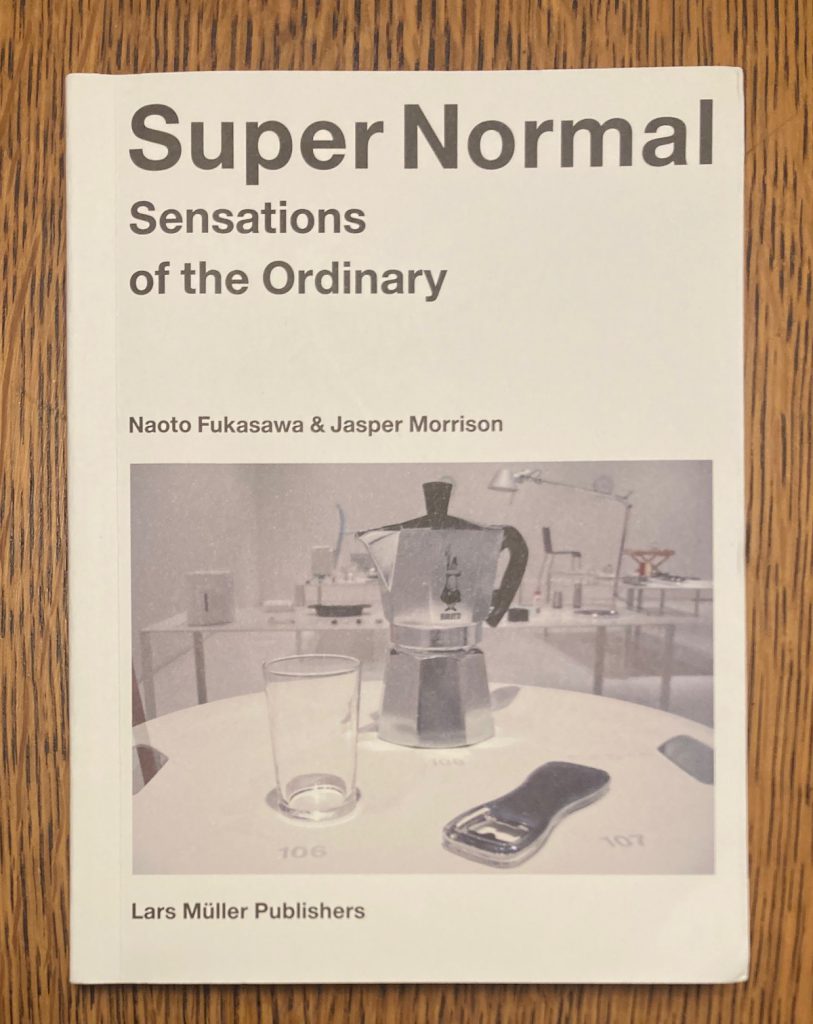
— Naoto Fukasawa and Jasper Morrison. Super Normal. Sensations of the Ordinary [2007]. Lars Müller Publishers, [2024].
Fascinating exhibition of objects from daily life, Tokyo and London 2006 ; Trienniale di Milano 2007.
— Anthony Powell. At Lady Molly’s [1957] and The Kindly Ones [1962].
I picked up At Lady Molly’s and was drawn in, and then on to another . . . An earlier reader of the copy of The Kindly Ones has noted a few passages : not always ones I might have marked, but I like these :
Moreland could never get used to the fact that most people — in this case, Templer — lead lives in which the arts play no part whatsoever. That is perhaps an exaggeration of Moreland’s attitude. All the same, he always found difficulty in accustoming himself to complete aesthetic indifference.
It was like trying to shake hands with Ophelia while she was strewing flowers.
One passes through the world knowing few, if any, of the important things about even the people with whom one has been from time to time in the closest intimacy.
I have read the complete cycle, out of sequence, and several of the novels more than once or twice ; with the Dance I don’t think it matters whether or not one reads the books in any particular order, for Powell’s prose moves across time within each book and sometimes within a single paragraph, always with such clarity that there is no doubt (indirection and obliqueness, yes : muddiness, no). Once one has the work as a whole in one’s head, the characters and incidents and phrases play out in memory and recreation. My favorite remains The Military Philosophers, with At Lady Molly’s close on its heels.
The most interesting parts of Hilary Spurling’s Invitation were the indices of literary or musical references and places, to tease out subtle allusions that slipped by unnoticed ; the index of persons with biographical summaries and concordance of appearances gives a doleful feeling : a litany of all the facts with none of the pleasure of the text.
— — —