Wreckage by Peter Straub : the Endless Bookshelf book of the year 2025

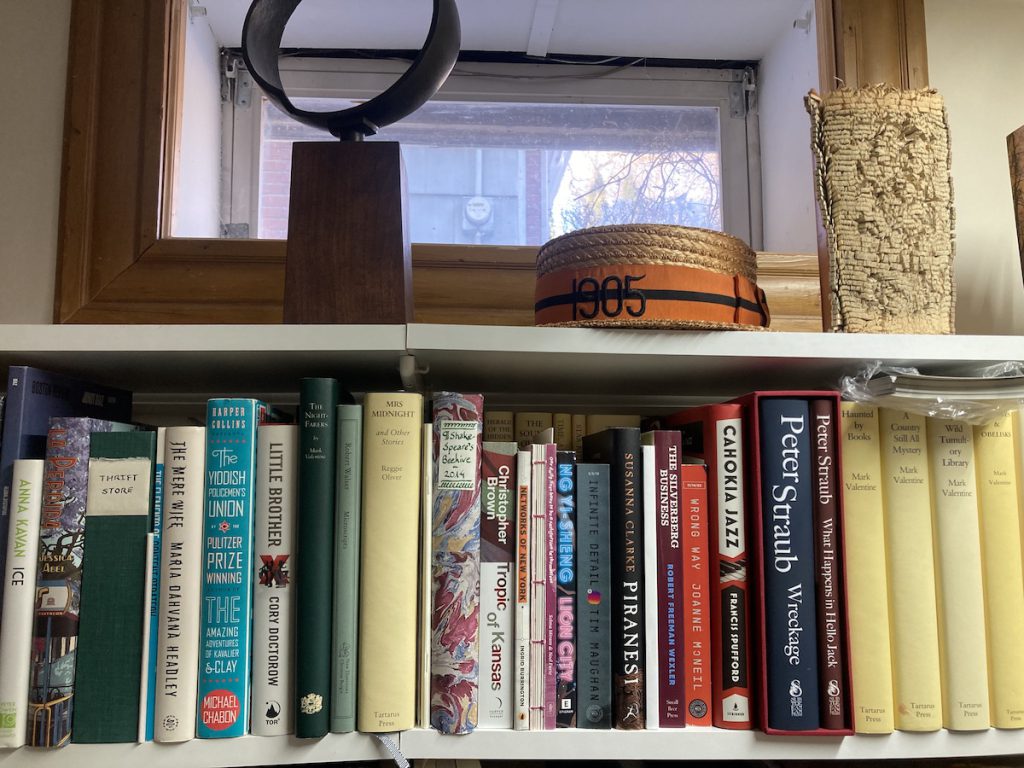
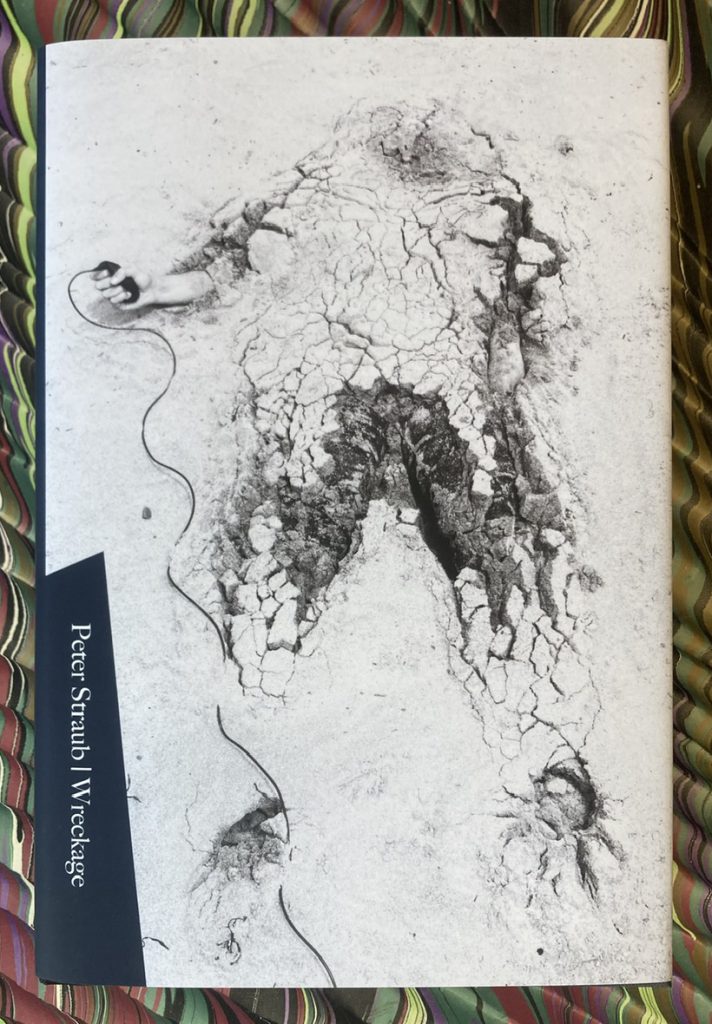
— Peter Straub. Wreckage [Introduction by Susan, Benjamin, and Emma Straub]. What Happens in Hello Jack [Introduction : Linkages, by Gary K. Wolfe]. 447 ; 141 pages. 2 vols., Subterranean Press, 2025. Edition of 500 numbered copies. [Dust jackets after photographs by Jenny Calivas].

‘party to some larger, less explicable understanding’

WRECKAGE, the unfinished final novel of Peter Straub, is the best book I have read this year. “It was to be a near perfect interweaving of Jack the Ripper and Henry James, two of Peter’s abiding interests : a timeless unsolved murderous mystery with the ultimate stylist and artist” (from the introduction by his family). The book is in two parts : the long sustained narrative of Wreckage is as fine and subtle and tricky (and funny) as anything Straub ever wrote, and What Happens in Hello Jack is a succinct, complete linear outline and summary of Straub’s plans for the novel (prepared in 2103), with extensively detailed and even polished vignettes. Why wouldn’t a modern master of horror grapple with the conceits and sources of The Turn of the Screw, that masterpiece of American imaginative prose ?

incidents in the life of Henry James

Wreckage is nineteen chapters (most with multiple episodes) chronicling events in the life of Tilly Hayward, whose activities as a serial killer in Milwaukee are masked by the deep and undetectable cover of his life in Columbus, and his sister Margot Mountjoy, whose married life in one of the richer suburbs of Minneapolis was one hell of an American Dream, the anatomy of which is charted as she begins her new life as a wealthy widow. These two lines are deeply rooted evocations of midwestern America in the late 1950s, even as they are connected to The Gathered Clan, a painting stolen from the ancestral home, Blane, by an English great grandfather as he fled to America, and to other events of seventy years before, when Henry James accepted an invitation to a country house weekend and encountered uncertainty. The “interlude” early in the novel, a vignette of Henry James in Monte Carlo (published last year in Conjunctions) makes explicit one of the transtemporal narrative threads. The Archbishop’s Tale, recounted in slightly different form in The Process, takes on new implications in Wreckage when a sinister group of three persons, that “larger, less explicable understanding”, recurs in odd variations throughout the novel (in the 1950s as well as the 1880s). The settings and minor characters are as accomplished as anything Straub has written. And the conversation between Tilly Hayward and one of his victims after her death, and more precisely, how and where the narrative runs with this, where the ghost of Lori Terry leads Tilly — “Ridiculous, he knew, yet . . .” — are quite simply spectacular, and a key to understanding the psychogeography and chronology of the narrative. Wreckage is, of course, a gripping headlong race to the cliff of incompletion, but the reader, this reader, goes willingly.

What Happens in Hello Jack offers pleasures of a different order. It dates to 2013 and Straub continued to work on the book for a decade beyond that fixed moment in time, so that the two volumes are sometimes usefully at odds with each other. I have no issue with fragmentary or even contradictory narratives, and the summary carries the several arcs through to the end. The prose is accomplished even as the terrain remains inherently unstable : “as James watches, Ayling seems briefly to vibrate in and out of sight [. . .]. James thinks he may have tricked himself into seeing this, but Ayling appears to waver in front of his canvas”. And then, in the space of a few pages, Straub thrusts Henry James into primal territory and a scene unlike any other in any fictional account of Henry James. Following this encounter, Straub has James draft two letters unknown to scholars, along with the explanation of how what we have just read is not preserved. The insightful and provocative Henry James set pieces are inseparable from the entangling narratives, and both volumes resonate with elements from A Dark Matter and The Skylark and The Process (a short novella which I loved), and offer variant riffs on earlier, teasing pieces presented at Readercon and in accounts of the artistic movement Das Beben. All of this amplifies the stories nested within Wreckage.

WRECKAGE is facinating in so many ways, chief among them the way in which the main narrative Wreckage demonstrates how Straub repeatedly altered and reworked the lines laid down in the Hello Jack summary. It is a gripping tale. The matter of Jack the Ripper is addressed and is made new. The playfulness of the novelist, is found everywhere, too, with stray shots at a country house partridge shoot (in equal measure homage to Isabel Colegate’s The Shooting Party and riff on an incident in the life of Dick Cheney, I think) ; the imaginary books, especially “that dreary children’s book”, The Distant Land, and what ripples out from it ; the episodes in the life of painter Hugo Ayling gleaned from a fourth volume of the Autobiography of Francis Frith ; and in the cameo appearances by Sherlock Holmes, Philip Marlowe, and “Little Alex C.”, a depraved juvenile Aleister Crowley ready to embark upon mischief and worse.

When, deep in the labyrinth of story, when Henry James tells Tilly Hayward : ‘It is in the nature of this place, which is not real except in the mind’, it is Peter Straub who has led the reader there.

The Endless Bookshelf book of the year.

recent reading : mid- and late november 2025

recent reading :

Mélissa Bonin, Un jardin après la mousson, 2011

journey into metaphor
— Mélissa Bonin. Lorsque les Bayous Parlent. When Bayous Speak. Poésies et Peintures. [2023]. Bilingual illustrated collection of evocative « voyages» into the bayou as “métaphore de la vie et du féminin”.

— — —

— Thomas Pynchon. Shadow Ticket. Penguin Press, 2025.

‘an outward and visible expression of paths not taken, personal and historical’

The first hundred so pages are dazzling paranoid fun set in end of Prohibition Milwaukee, with zany incidents and songs and gross-out confections and drinks. After Hicks McTaggart is encouraged to leave town for New York City and then fed a Mickey Finn and loaded aboard a transatlantic steamer, the pyrotechnics continue. The transition from Tangier to a Budapest-bound train is abrupt and, a bit cheesy at times, the book wobbles for a few a pages before returning to the deftly choreographed espionage play of language and fashion and color along the Danube. Plus a Moto Guzzi with a side-car, vacuum tubes, a theremin sextet, paranormal  incidents, philately, Versailles-compliant golems, atrocious acronyms, and more.

— — —

— Frank Macshane. The Life of Raymond Chandler [1976].  Hamish Hamilton, [1986].
Excellent and sympathetic chronicle of Chandler and his struggle to get his novels written to his satisfaction. Plucked off the shelf to look up a date, gripped immediately and anew by the way MacShane allows Chandler’s own words (letters, essays, etc.) to tell the story. Chandler on style is not that far removed from Ruskin.

— John Ruskin. Letters on Art and Literature. Edited by T. J. Wise. Privately printed, 1894.
To  J. J. Laing, 1854 : “If you are to do anything that is really glorious, and for which men will for ever wonder at you, you will do it as a duck quacks — because it is your nature to quack — when it rains.”

— Suave Mechanicals. Essays on the History of Bookbinding. Volume 9. Julia Miller, editor. Legacy Press, 2025.

— Patti Smith. Bread of Angels. Random House, [2025].

— Ellen Datlow, editor. Night. Dreadful Dark : Tales of Nighttime Horror [bound dos à dos with] Day. Merciless Sun : Tales of Daylight Horror. Saga Press, [2025].

— Paul Muldoon. Rising to the Rising. Gallery Books, [2016].

Now the world’s been brought low. The wind’s heavy with soot.
Alexander and Caesar. All their retinue.
We’ve seen Tara buried in grass, Troy trampled underfoot.
The English ? Their days are numbered, too.

— — —

— Margery Allingham. The Beckoning Lady [1955]. Penguin Books, [1961].

— Edmund Crispin. Buried for Pleasure [1948]. Penguin Books, [ca. 1980].
——. Love Lies Bleeding [1948]. Penguin Books, [1954].

— — —

commonplace book :

from The Deep Blue Good-By (1964) by John D. MacDonald, a list poem, with attitude (line breaks added) :

And I do not function too well on emotional motivations. I am wary of them. And I am wary
of a lot of other things,
such as
plastic credit cards,
payroll deductions,
insurance programs,
retirement benefits,
savings accounts,
Green Stamps,
time clocks,
newspapers,
mortgages,
sermons,
miracle fabrics,
deodorants,
check lists,
time payments,
political parties,
lending libraries,
television,
actresses,
junior chambers of commerce,
pageants,
progress,
and manifest destiny.
I am wary of the whole dreary deadening structured mess we have built into such a glittering top-heavy structure that there is nothing left to see but the glitter, and the brute routines of maintaining it.

— — —

A singular interview with Christopher Brown

Mossback

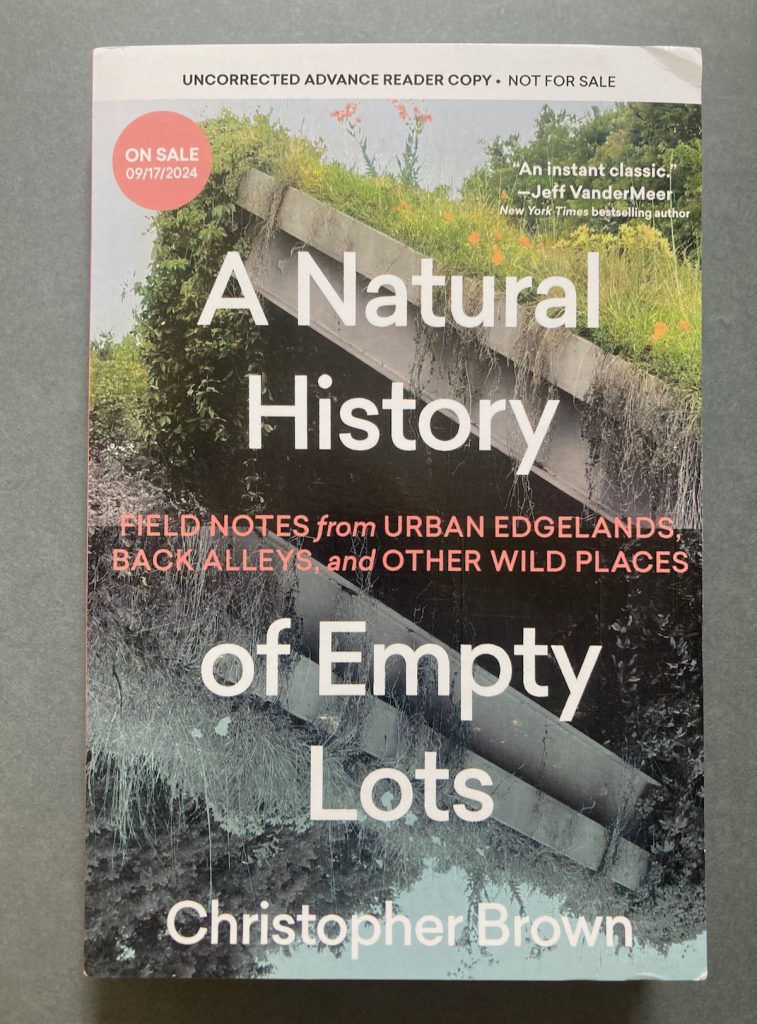
I have known Chris Brown for many years, first through reading his essays in the pages of The New York Review of Science Fiction and other publications, and then in person at Readercon and in a few larger cities. We share an interest in the ragged edges of the planet and in science fiction, and we’ve walked together to one or two of the green worlds you can find just a few steps from the usual paths. His novel Tropic of Kansas  was an Endless Bookshelf Book of the Year, “dark, nimble, hilarious, deeply alarming, truly American”, and he was a good person to talk to when I was writing A Conversation larger than the Universe. His Field Notes newsletters are always interesting and fun.  Disqualified by such ties of friendship from writing a review of A Natural History of Empty Lots, a book that grew from his years of walking and thinking around in his neighborhood, I asked him the only question that needs asking, and his answer in this singular interview (from A Natural History) is elegant and definitive.

Henry Wessells  : Have you ever seen a chupacabra ?

Christopher Brown : Almost a decade after I went on the Bigfoot watch, I had a close encounter with a chupacabra. It was May 2015, on the Sunday night before Memorial Day. We were in Marfa, Texas, where we had taken our visiting friends, Henry Wessells and Mary Jo Duffy, native Philadelphians who live in New Jersey and work in New York. After dinner on our last night, we headed east on Highway 90 to check out the Marfa Lights. It was around 9 p.m. The radio was tuned to the local public radio station, which was playing its “Space Music” show-ambient instrumentals that suited the mood. About two-thirds into the nine-mile drive, a ghostly creature crossed our path, walking right across the road, rather slowly.

Slow enough that we got a long look as it passed through the beams of our headlights. Four-legged, definitely not a deer, a figure of ethereal white. Bigger than a dog, different than a coyote — even though that’s probably what it was. They say most chupacabra sightings are really just coyotes with mange. We all saw it, were similarly baffled, and agreed that it was both something that had a rational explanation that the brevity and circumstances of our sighting would not let us figure out, and that we also had just experienced an encounter that had an authentically paranormal frisson. It was definitely a chupacabra, we understood, as we also understood that a chupacabra is simply a creature you encounter that does not follow the taxonomic indicators of its species, looking so strange, in the moment you see it, as to provide you an experience of the alien and a welcome excuse to make up your own legend.

Tree Portal

— — —

Chris Brown’s new book, A Natural History of Empty Lots

— Christopher Brown. A Natural History of Empty Lots. Field Notes from Urban Edgelands, Back Alleys, and Other Wild Places, forthcoming 17 September 2024 from Timber Press.

link : https://www.hachettebookgroup.com/titles/christopher-brown/a-natural-history-of-empty-lots/9781643263366/?lens=timber-press

Copyright © 2024 by Christopher Brown. Reprinted by permission.

— — —