commonplace book : december 2025

far fetch :

— Mark Tewfik. Two Weeks in Ecuador and the Galapagos [drop title]. [8] pp. Santa Cruz, Galapagos Islands : Lanterne Rouge Press, 2025. Printed self wrapper with ornamental headpiece.
Fun travelogue with a truly exotic imprint, even for this peripatetic press.
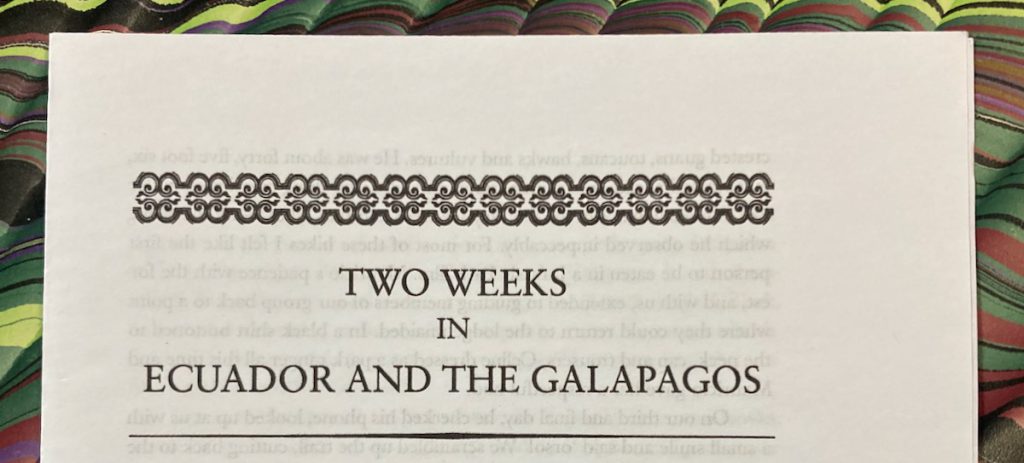
and at the foot of the last page, the imprint, below :
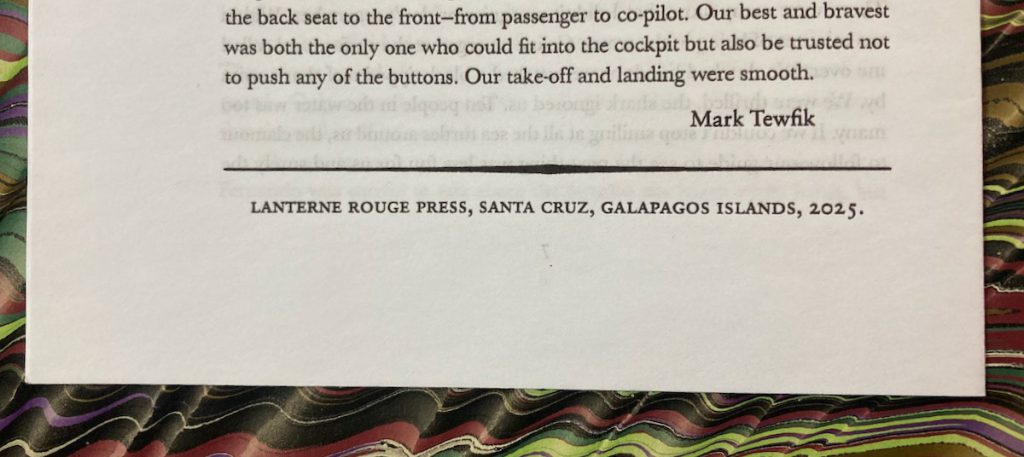
— — —
farewell to an old friend :

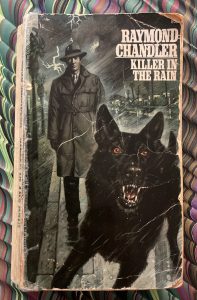
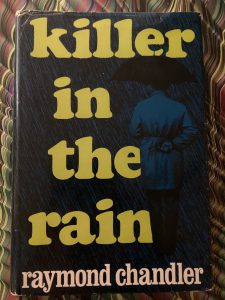
— Raymond Chandler. Killer in the Rain. With an introduction by Philip Durham. [1964]. Ballantine Books, [1972].
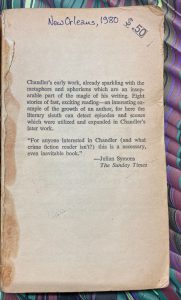
This book collects eight early pulp stories Chandler which had refused to reprint in his lifetime, because he had “cannibalized” them and transformed the raw material into the substance of three novels : The Big Sleep ; Farewell, My Lovely ; and The Lady in the Lake. Reading it was an education and single dose corrective to prose excesses rooted in obsessive teenage readings of H. P. Lovecraft. This copy, bought for 50 cents at the State Street Book Mart, a paper back exchange shop in New Orleans, has stuck with me for many years.

After re-reading parts of MacShane’s Life of Chandler, I pulled down Killer in the Rain to look at some of the stories, and it will not survive this reading. I will save the browned flyleaf and title page for a bookmark in a copy of the original Houghton Mifflin printing I bought last month : so I still havea copy of  Killer in the Rain ; and I will wait for a stormy day to say farewell to Killer in the Rain in the rain ; but the small gap on the paperback shelf will stay open for a time.
— — —

from the Epigrammata of Martialis (Epigrams of Martial)

Lucanus
Sint quidam qui me dicunt non esse poetam :
Sed qui me vendit bibliopola putat.

Lucan
[Some say I am no poet : but the bibliopole* sells me as one]


* – bookseller, for you moderns, sez Old ’Pole

— — —
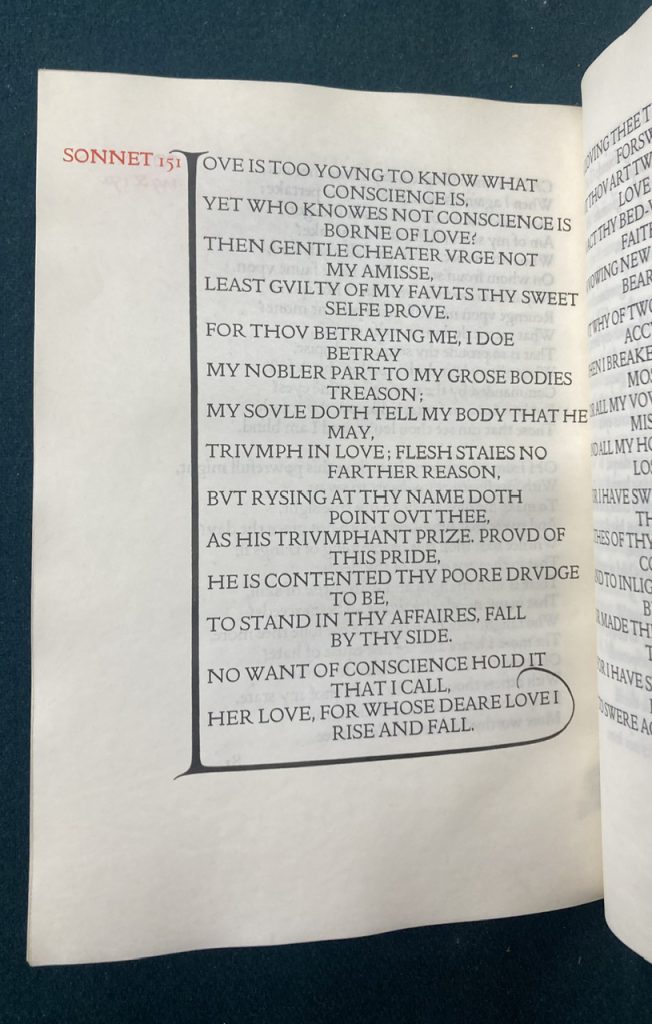
Sonnet 151 with initial L by Edward Johnston, in the Doves Press edition of Shakespeare’s Sonnets, 1909.

— — —

— — —

‘Pardon this intrusion’

The first words the monster speaks, in vol. II of Frankenstein; or, The Modern Prometheus. Philadelphia : Carey, Lea & Blanchard, 1833.

— — —

recent reading :

— J. I. M. Stewart. Myself and Michael Innes. A Memoir. W. W. Norton, [1988].

— Charles Willeford. Everybody’s Metamorphosis. Dennis McMillan, 1988. Edition of 426 copies signed by the author.

— Dorothy L. Sayers. Whose Body ? A Lord Peter Wimsey Novel [1923]. Harper & Row, [n.d., ca. mid-1950s]. Dust jacket design by Shirley Smith.

— Hilary Spurling. Invitation to the Dance. A Guide to Anthony Powell’s Dance to the Music of Time. Little, Brown, [1977].

— Margery Allingham. The Case of the Late Pig [1937]. Penguin Books, [1957].

— — —

Cat and Girl in Oz

Dorothy Gambrell’s Cat and Girl are somewhere in Oz. They started on the yellow brick road here :

https://catandgirl.com/were-off-to-see-the-boss-class/

— — —

read this

Erin Kissane’s remarkable essay on the geophyics of the 1964 tsunami at Valdez, Alaska, and her extrapolations to articulate a brilliant, useful metaphor for the post-information age :

https://www.wrecka.ge/landslide-a-ghost-story/

— — —

“Two sculptural titans are thus now fittingly face-to-face, Rodin the culminating figure of an ancient representational tradition that was revived during the Renaissance and Calder the initiating figure of a modernist reconception that took the medium off its pedestal.”

— Martin Filler, from his review of the Calder Foundation gardens in Philadelphia, in the New York Review of Books .

[what a sentence ! 2,500 years of art history in a single swoop]


— — —

Andromeda
Now Time’s Andromeda on this rock rude,
With not her either beauty’s equal or
Her injury’s, looks off by both horns of shore,
Her flower, her piece of being, doomed dragon’s food.
     Time past she has been attempted and pursued
By many blows and banes ; but now hears roar
A wilder beast from West than all were, more
Rife in her wrongs, more lawless, and more lewd.

     Her Perseus linger and leave her tó her extremes ? —
Pillowy air he treads a time and hangs
His thoughts on her, forsaken that she seems,
     All while her patience, morselled into pangs,
Mounts ; then to alight disarming, no one dreams,
With Gorgon’s gear and barebill, thongs and fangs.

from : Gerard Manley Hopkins. Poems (Oxford, 1918).

— — —


recent reading : mid- and late november 2025

recent reading :

Mélissa Bonin, Un jardin après la mousson, 2011

journey into metaphor
— Mélissa Bonin. Lorsque les Bayous Parlent. When Bayous Speak. Poésies et Peintures. [2023]. Bilingual illustrated collection of evocative « voyages» into the bayou as “métaphore de la vie et du féminin”.

— — —

— Thomas Pynchon. Shadow Ticket. Penguin Press, 2025.

‘an outward and visible expression of paths not taken, personal and historical’

The first hundred so pages are dazzling paranoid fun set in end of Prohibition Milwaukee, with zany incidents and songs and gross-out confections and drinks. After Hicks McTaggart is encouraged to leave town for New York City and then fed a Mickey Finn and loaded aboard a transatlantic steamer, the pyrotechnics continue. The transition from Tangier to a Budapest-bound train is abrupt and, a bit cheesy at times, the book wobbles for a few a pages before returning to the deftly choreographed espionage play of language and fashion and color along the Danube. Plus a Moto Guzzi with a side-car, vacuum tubes, a theremin sextet, paranormal  incidents, philately, Versailles-compliant golems, atrocious acronyms, and more.

— — —

— Frank Macshane. The Life of Raymond Chandler [1976].  Hamish Hamilton, [1986].
Excellent and sympathetic chronicle of Chandler and his struggle to get his novels written to his satisfaction. Plucked off the shelf to look up a date, gripped immediately and anew by the way MacShane allows Chandler’s own words (letters, essays, etc.) to tell the story. Chandler on style is not that far removed from Ruskin.

— John Ruskin. Letters on Art and Literature. Edited by T. J. Wise. Privately printed, 1894.
To  J. J. Laing, 1854 : “If you are to do anything that is really glorious, and for which men will for ever wonder at you, you will do it as a duck quacks — because it is your nature to quack — when it rains.”

Suave Mechanicals. Essays on the History of Bookbinding. Volume 9. Julia Miller, editor. Legacy Press, 2025.

— Patti Smith. Bread of Angels. Random House, [2025].

— Ellen Datlow, editor. Night. Dreadful Dark : Tales of Nighttime Horror [bound dos à dos with] Day. Merciless Sun : Tales of Daylight Horror. Saga Press, [2025].

— Paul Muldoon. Rising to the Rising. Gallery Books, [2016].

Now the world’s been brought low. The wind’s heavy with soot.
Alexander and Caesar. All their retinue.
We’ve seen Tara buried in grass, Troy trampled underfoot.
The English ? Their days are numbered, too.

— — —

— Margery Allingham. The Beckoning Lady [1955]. Penguin Books, [1961].

— Edmund Crispin. Buried for Pleasure [1948]. Penguin Books, [ca. 1980].
——. Love Lies Bleeding [1948]. Penguin Books, [1954].

— — —

commonplace book :

from The Deep Blue Good-By (1964) by John D. MacDonald, a list poem, with attitude (line breaks added) :

And I do not function too well on emotional motivations. I am wary of them. And I am wary of a lot of other things, such as

plastic credit cards,
payroll deductions,
insurance programs,
retirement benefits,
savings accounts,
Green Stamps,
time clocks,
newspapers,
mortgages,
sermons,
miracle fabrics,
deodorants,
check lists,
time payments,
political parties,
lending libraries,
television,
actresses,
junior chambers of commerce,
pageants,
progress,
and manifest destiny.

I am wary of the whole dreary deadening structured mess we have built into such a glittering top-heavy structure that there is nothing left to see but the glitter, and the brute routines of maintaining it.

— — —

man about town

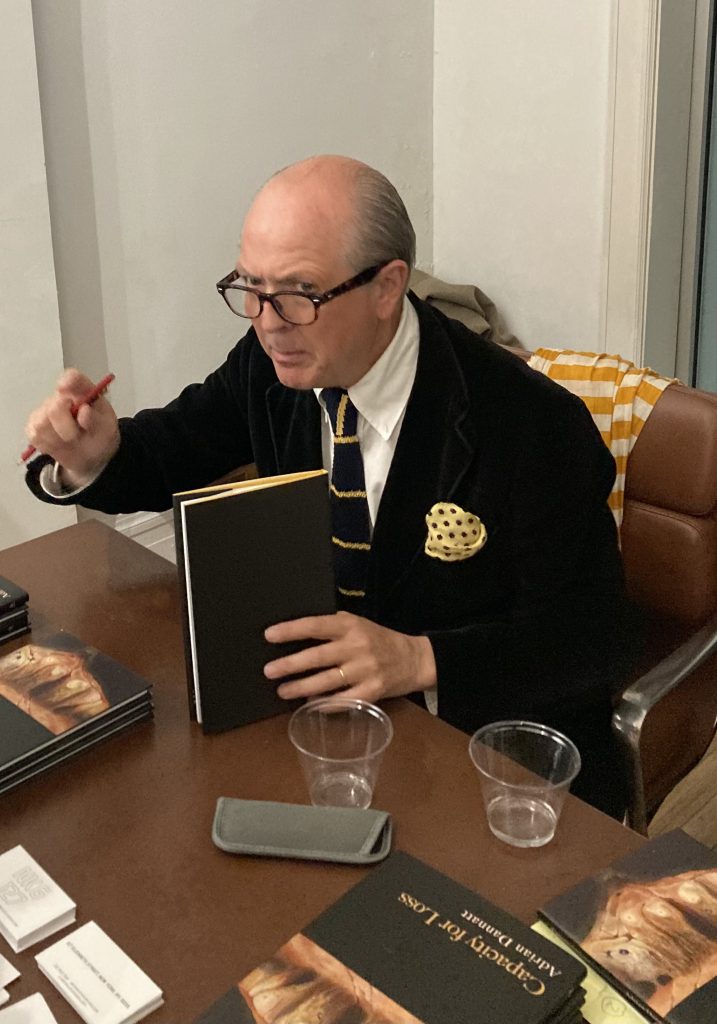
poet Adrian Dannatt gestures after signing a copy of his collection of poetry, Capacity for Loss. It's a pretty good book

— Adrian Dannatt. Capacity for Loss. [Opium Books, 2024]. Edition of 300.  Yellow cloth, dust jacket with illustration, Gaia, from the painting by Danny Moynihan.
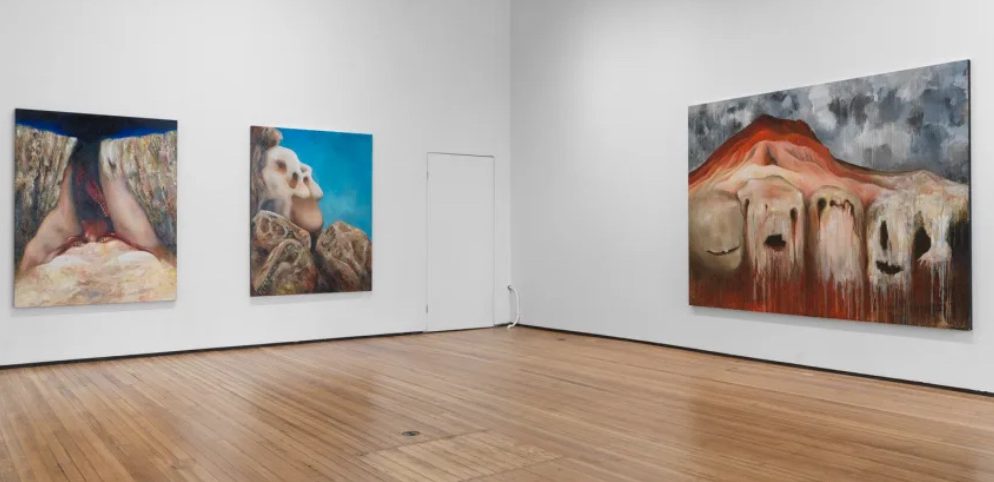
Author Adrian Dannatt, debonair man about many towns, is seen in mid-gesture above, just a few minutes ago at the publishing party for the launch of his collection of poems, Capacity for Loss, at Nathalie Karg Gallery, amid an installation of Danny Moynihan’s paintings.
Danny Moynihan paintings at Nathalie Karg Gallery

— — —

Sard Harker by John Masefield’ is an essay published for the centenary of this adventure novel set in Santa Barbara, most leeward of the sugar countries of South America, now up on Wormwoodiana. It is set in a South America of abandoned villages and mysterious temples, a land of adventure and visions, a paradise of metaphor and simile.

— — —

Your correspondent will be at the Boston International Antiquarian Book Fair, Friday through Sunday 8-10 November, at the Hynes Convention Center (Cummins booth 514). Come say hello. I will have copies of The Private Life of Books and others available.

— — —

recent reading : april 2024

‘among the dust and shadows’
— Mark Valentine. Qx and other pieces. Zagava, 2024.
Collection of 21 fugitive short works at the boundaries of fiction and memoir (3 unpublished). The Blue Mean One — “entirely autobiographical” — is a very tricky (and funny) pub variation on the vanishing magic shop. An elegant and pleasing book to hold in the hand, and in which to read one’s way to unexpected places.

— — —

— Anthony Powell. The Valley of Bones [1964]. The Soldier’s Art [1966]. The Military Philiosophers [1968].
Re-reading a familiar book, in a new light: The Military Philosophers quotes and riffs on Proust, explicitly and by imitation ; and in the autumn of 1944 Jenkins passes through the decayed Cabourg, the original of Proust’s seaside resort town Balbec. The Military Philosophers is, also, hilarious in its descriptions of rank and hierarchy and bureaucratic machination ; allusions range from Wagner to The Prisoner of Zenda by way of hymns and sixteenth or seventeenth century poets ; and yes, a bit dry. But the way the sentences start off in one direction and swerve, wobble, undermine, and mock, to arrive at a thought almost the polar opposite of where it began.
And now, having read Proust, I understand this note (first encountered in May 2011) rather more clearly  :

“I’m reading Anthony Powell’s A Dance to the Music of Time, an hilarious and very good work. The only book I know that takes Proust’s habitual narrative gestures, Anglicizes them, and succeeds in the effort. In fact, Powell is the best critical study of Proust.”
— Guy Davenport. “Fragments from a Correspondence”, ed. Nicholas Kilmer. Arion (Third Series) 13:3 (2006), p. 106.

— — —

— Dwyer Murphy. An Honest Living [2022]. Penguin Books, [2023].
A good New York book and a pretty good rare book McGuffin to send the young lawyer on his chase (just enough to be interesting without getting too detailed or wrong).

— — —

— Zito Madu. The Minotaur at Calle Lanza. Belt Publishing, [2024].
Memoir of Madu’s experiences in Venice during the first months of the pandemic. The chronicle of isolation draws upon his childhood in a Nigerian immigrant family in Detroit, and is painfully honest in his reflections upon his anger towards his father, compounded and complicated by love. And then one evening in Venice a shocking literalization of the metaphor. Concise and wrenching.

À la recherche du temps perdu

at a forest crossroads where paths converge
— Marcel Proust. À la recherche du temps perdu.  Édition publiée sous la direction de Jean-Yves Tadié. 4 vols., Bibliothèque de la Pléiade, Gallimard, [2019].
I. Du côté de chez Swann [1913]. À l’ombre des jeunes filles en fleur (Première partie) [1918].
II. À l’ombre des jeunes filles en fleur (Deuxième partie) [1918]. Le Côté de Guermantes. [1920-1].
III. Sodome et Gomorrhe [1921-2]. La Prisonnière [1923].
IV. Albertine disparue [1925]. Le Temps retrouvé [1927].
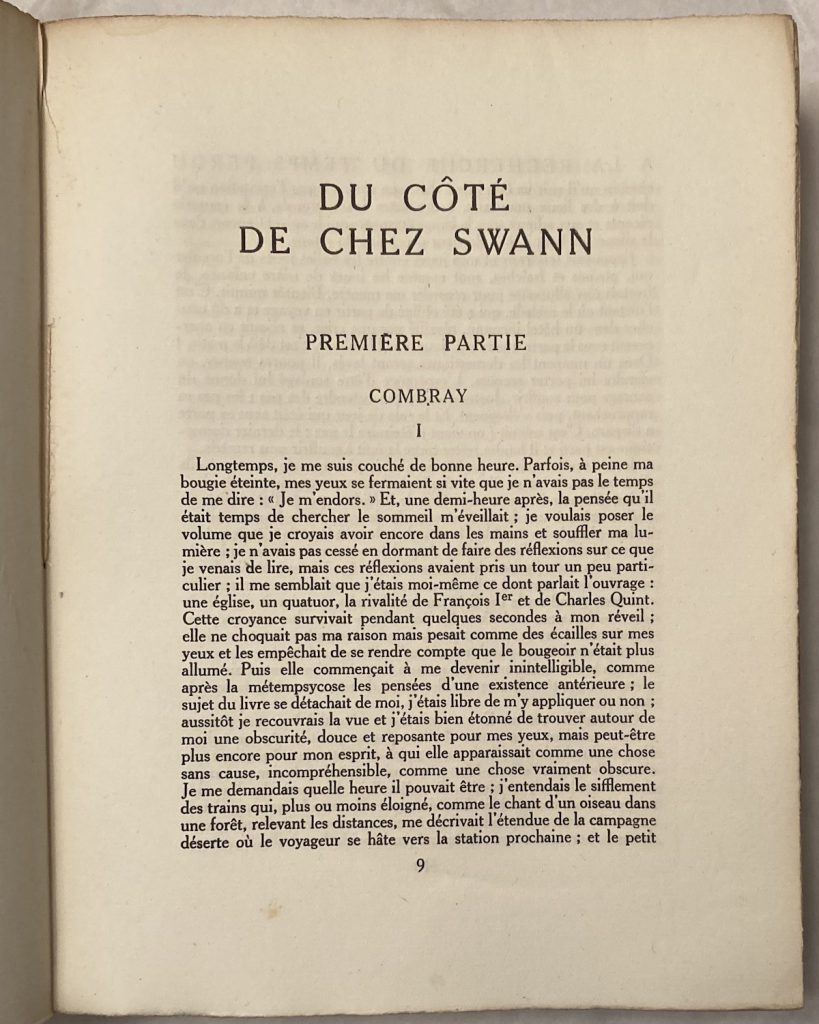
[The picture below is the first page of the text of the second edition of Du côté de chez Swann.]
Yesterday 23 March 2024 at 21h07 I finished reading À la recherche du temps perdu, with a mixture of awe and admiration, glee and sadness, exasperation and wonder. And no regrets whatsoever : these characters will kick around in my head for years, and I now see traces and hear echoes of Proust in many books read earlier. I began reading Du côté de chez Swann on 30 October 2021 and at first made steady progress, even writing a preliminary essay, “Monocles, Hawthorn, and Memory, or, A Short Despatch on a Long Book”, for the final issue of Wormwood in the spring of 2022. The third volume was slow going for me at times, as the narrator’s spinning thoughts and whining self-involvement were sometimes too much. Part of the pattern, of course, and often leavened with flashes of humor. The fourth volume is a page-turner, and wrenching. The last 75 pages of Albertine disparue are filled with travel, diplomacy, weddings, deaths, deceptions : a whirl of exterior incident after the cycles of involution of the first two chapters ; and the movement across time, narrative time and historical time, when (for example)  the narrator suddenly glimpses Albertine’s Fortuny coat in a painting by Carpaccio in Venice. And then in Le temps retrouvé, the slow motion urgency is compelling. Proust runs up and down the scale from micro to macro, not quite Rudy Rucker transrealism but busy, and even veering toward cosmic materialism. The concluding metaphor of the forest crossroads is a delight, and the transversales connecting all the rides, all the persons of the novel, are a glimpse of Borges’ garden of forking paths decades before that story. There are so many things to say about À la recherche du temps perdu, and I am sure that most of them have already been said elegantly by distinguished scholars. I would re-read this book endlessly if had no other obligations or were a tenured professor, But I am not, and I do have books to write and, like Proust’s narrator, I wonder if there is time or sufficient competence to complete them.
And yet there is one observation I have that might be worthy of relating.  In the descriptions of the air raids over Paris and the aeroplanes rising to the skies, Proust assimilates Wagner and the Walkyries into military aviation : « c’était à demander si c’était bien des aviateurs et pas plutôt des Walkyries qui montaient » [one might well ask if it were aviators or in fact the Walkyries who took off]. The book was published in 1927, years after his death, but those passages seem to have been composed close to the time of the events in 1916. Earlier in the passage, the doomed marquis de Saint-Loup talks to the narrator of the beauty of the planes flying in fixed formation (‘faire constellation’ in French), and the greater beauty when the engagements begin, “the moment when they ‘make apocalypse’ and even the stars no longer keep their place”. There was something in the air, certainly : in Images of War (1919), Richard Aldington, who was an early English reader of Proust, has a poem entitled “Barrage”, which begins : “Thunder / The gallop of innumerable Walkyrie impetuous for battle”. My observation is that Proust is the true antecedent of the helicopter cowboys blasting Wagner in Apocalypse Now! And that smell of napalm on the morning is a dark, diabolical, ironic madeleine.
I had better stop there.

The Book Blinders by John Clute

Millions More Missing
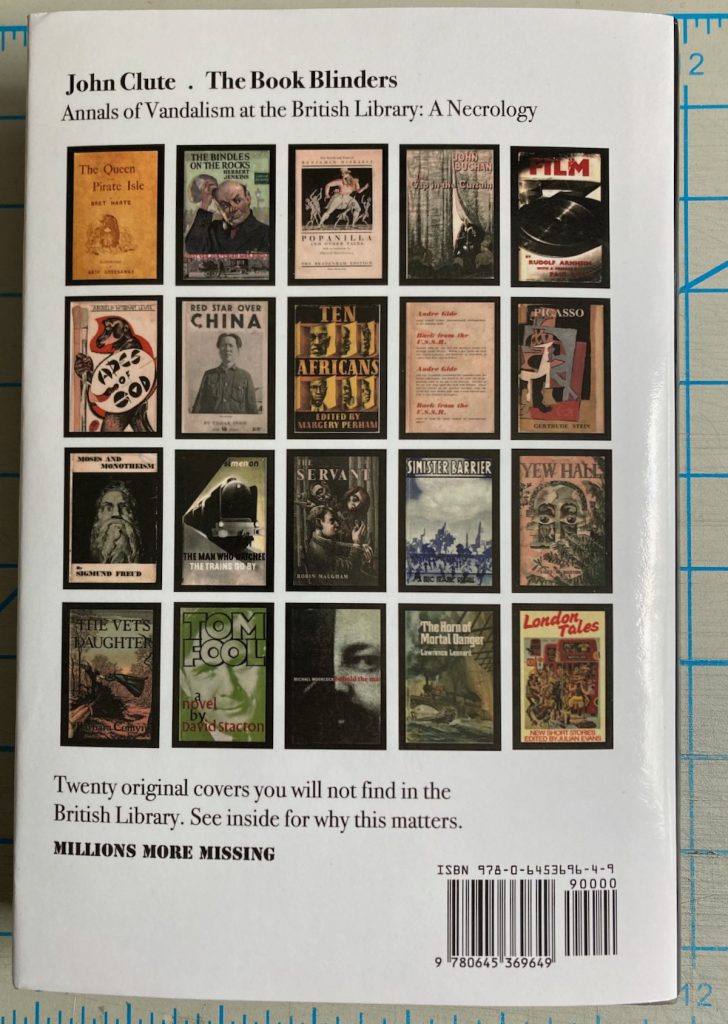
— John Clute. The Book Blinders. Annals of Vandalism at the British Library: A Necrology. Illustrated throughout. 499, [1, errata] pp. Norstrilia Press, [2024].
There has been a steady production of scholarship on the history of the publisher’s dust jacket in the past fifty years. These ephemeral pieces of paper encode all manner of information about the moment in time and both how publishers perceived their wares and how they wanted the reading and book-buying public to receive the newly published books. Much emphasis has been on nineteenth-century jackets in recent research, including in G. Thomas Tanselle’s Book-Jackets: Their History, Forms, and Use (2011), which updates work he first published in 1971, and Mark Godburn’s Nineteenth-Century Dust-Jackets (2016). And yet it is really in the early twentieth century that jackets proliferate and assume the form and function we now understand. Vast conceptual leaps in design and presentation of information occur in the interval between The Wind in the Willows (1908) and What Not (1918/1919) or In Our Time and The Great Gatsby (both 1925). And yet this is not solely the province of literary high spots. Across all types of literature, the dust jacket functions as the outer face of the book.  Clute’s title, The Book Blinders, is descriptive of the practical effect for the reader of a long-standing institutional policy of discarding dust jackets or separating the jacket from the book and storing them elsewhere, uncatalogued. This policy prevailed at the British Museum (later British Library) and at other depository libraries from the emergence of the dust jacket and continued for most of the twentieth century. With more than 100 examples of dust jackets not in BL (from the years of the first world war through 1990), John Clute documents the importance of the dust jacket and considers the implications of this vandalism from within. How about these three or four: Rose Macaulay, What Not (1918), a tale of eugenics and privilege, suppression of a libellous passage delaying actual publication until 1919 (Clute’s copy is Michael Sadleir’s own, saved from the memory hole); C. E. M. Joad, Priscilla and Charybdis (1924), “undeterred by the gruelling wordplay of the title, [I] took a look, and found found this this on pages 206-207; a seductive Joad-like protagonist is addressing a young woman on a train ride they are sharing: ‘Darling [he purrs], have you ever travelled without a ticket?’” (this one alone is worth the price of admission); or Ezra Pound, Make It New (1934):

Faber (which is to say Eliot) clearly thought it sagacious to wrap in sheep’s clothing the already notorious Ezra Pound’s new publication with its incendiary title: a ticking bomb that needed no bush. But the underlying message cannot be missed: Pound’s title, a modernist wake-up slogan he’d been using offhandedly since 1928, is manifestly inflammatory, once grasped; a challenge to his various enemies who (he maintains) clog the literature pews: an up-yours bombination clearly audible through the enfant-sauvage mask Pound wore until it was too late. This bomb needed to slip through the gates before exploding.

or Robert Graves, The White Goddess (1948), Tom Eliot again; or Lawrence Leonard, The Horn of Mortal Danger (1980); or London Tales (1983), edited by Julian Evans. Clute’s selections are fascinating testimony to the breadth of his reading and collecting and his critical range; the text sparkles with his crunchy and apt vocabulary. It seems almost a homoeopathic distillation: “I’d reckon that out of every 8,000 or so books to arrive at the British Library complete with dust-jacket, I’ve commented here on a maximum of one”. (Excessive candor moment: John Clute is a friend of more than twenty-five years; I am the source for the images of the only jacket not from his own collection.) This is an important book.

———

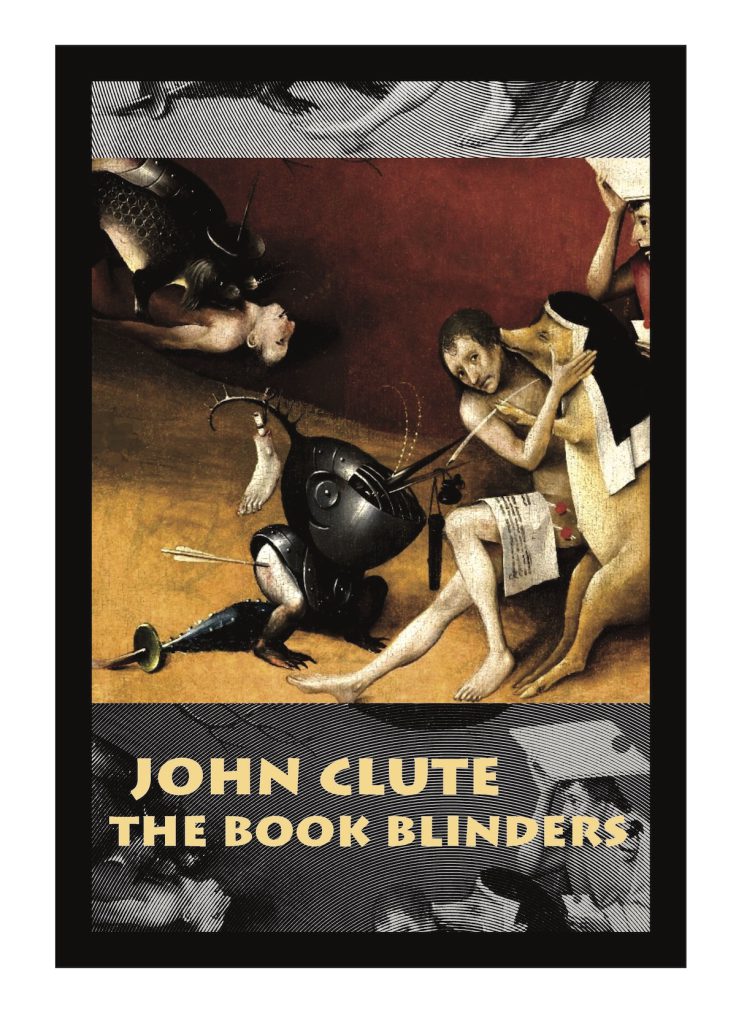
Addendum (3 May): I wrote the notice above after reading digital proofs of the book. Today I have a copy in hand (a print on demand product manufactured in Tennessee on 19 April), and it is nice to see the book in the wild. In the U.S. the book is available from bookshop.org and elsewhere. Oh, yes : The Book Blinders is issued with a dust jacket (designed by Judith Clute). Here is the back panel :

I was looking for a street

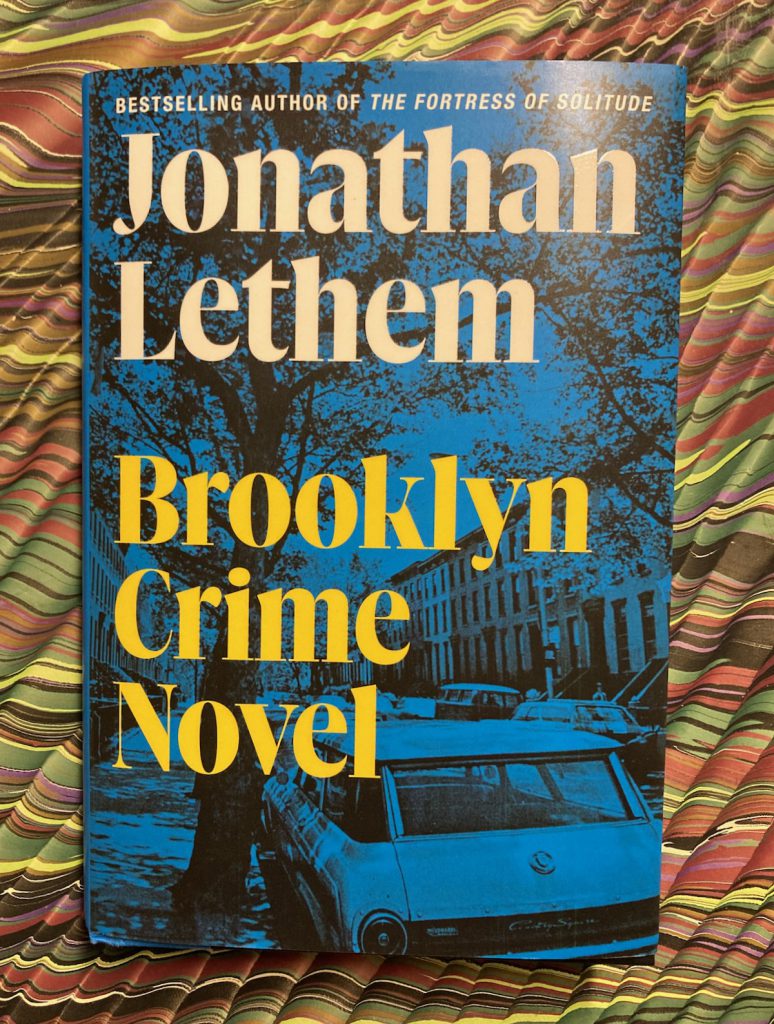
— Jonathan Lethem. Brooklyn Crime Novel. Ecco, [2023]

Brooklyn Crime Novel is a fun and tricky book. Let’s get right to the metaphor: a city street with its posse of fungible boys is the whaling ship Pequod with its disparate crew. These are two worlds that seem self-contained but are not, for each is an economic construct in the service of a global market and deeply entangled with the world outside its confines : the City is the Ocean. The cataloguer of Brooklyn childhoods is blood-brother to the sub-sub-librarian compiler of cetology. So is the Brazen-Head Wheeze. This means I got right to Melville, who (like H. P. Lovecraft) shows up at this block party.

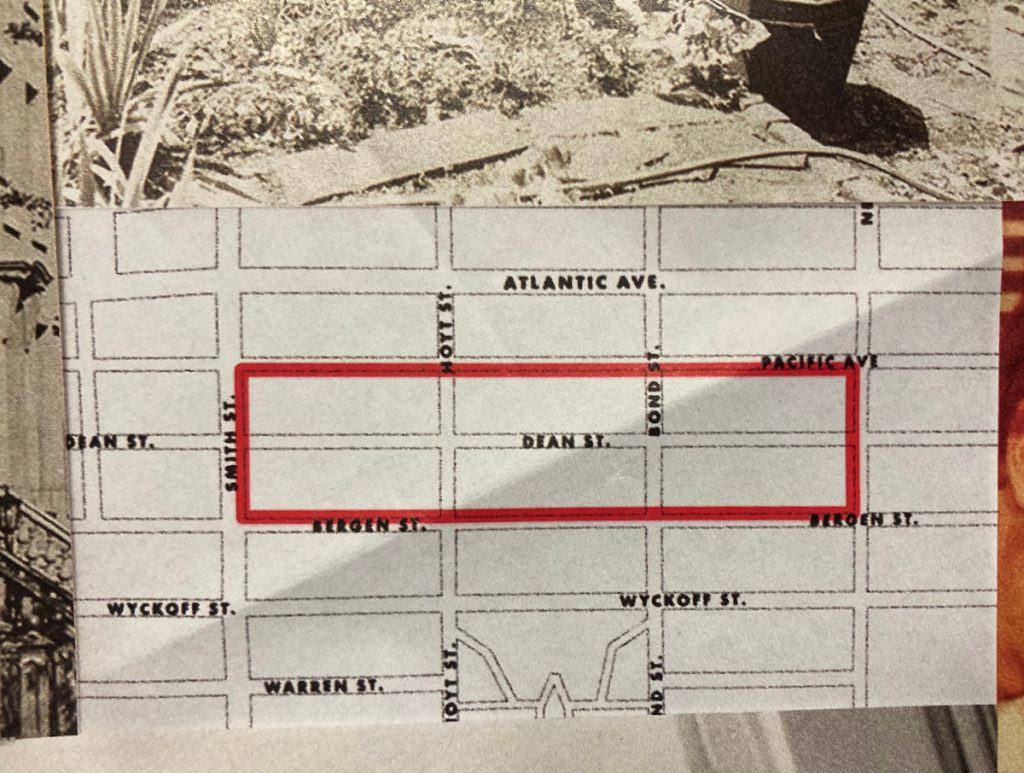
If this were a fantasy novel, one would expect a map at the endpapers or frontispiece. Instead, one can turn to a nonfiction cognate of Brooklyn Crime Novel, “A Neighborhood, Authored”, published by Lethem in the New Yorker a couple of months before his novel appeared (28 August 2023). This is a metatextual examination of the geography and sociology of his childhood as charted in “The Making of Boerum Hill”, a  New Yorker article  by Jervis Anderson (14 November 1977). Very helpfully, for readers outside the Neighborhood, there is a map:

This is an agglutinative tale (124 numbered sections) : a catalogue and “an infinite regress” of life on the brownstone blocks of the Brooklyn neighborhood : the brownstoners, the Screamer, Milt the Vigilante, the millionaire, and others.  The boys leave the false oases of family life and the safe parts of the block every time they go out to school. They are taxed by kids from rougher streets and projects, and learn the expected behavior of an urban dance of confrontation, what is said, and the gaps and silences of what is unspoken. “The dance is a dance because no one can tell you in words. The dance is a dance because you have to learn how to do it.”

At first I had wondered about just who might be complicit in this editorial or authorial “we” that began sneaking into the text, but Lethem soon confronts this unease and incorporates it into the narrative. There is a collective voice of the neighborhood, and “we” sometimes means “Everybody” ; and sometimes again, that universal consciousness seems to concentrate itself into a single person:

using in each realm his special talents to ingratiate himself to his friends’ parents, too, to get inside all their houses and say a political ma’am to somebody’s mother like he was trained to do, thus enabling him to conduct his serial investigations, C. felt he was the only person who knew everything about this place. He was stretched like a bridge across worlds.

One funny thread is the recurring notion that H.P. Lovecraft’s library has survived in a basement somewhere in Brooklyn (he did live there in a one-room apartment for a few miserable months in 1925-1926), and this gets tangled up with the chronicle of the apprentice bookseller. Some people barely survive their childhoods, and Brooklyn Crime Novel steps into that territory for a while. Cruelties are enacted unflinchingly; and the boys of the neighborhood disperse into adulthood. Sometimes their paths cross again. Lethem shows considerable courage in revisiting childhood terrain, gently mocking versions of his younger self. The narrator says, “Me ? I’m just a character in this novel, the one who happens to be writing it. But someone like me surely existed.” He and the Brazen Head Wheeze are scathing about “the novelist”. “He’s the same kid, the kid we knew. He’s only a bigger kid.” When they track “the novelist” to another bar, the Brazen Head Wheeze lets him have it, “You’re our prodigal collective mouthpiece. Our bard, if I may [. . .] Let me take you to the bridge, you said, and you did. You took me to the bridge, and from that soaring span I beheld the city whole and entire.” Jonathan Lethem knows you can’t go home again but in Brooklyn Crime Novel he deftly enables the rest of us visit the neighborhood for a while.


Wrong Way by Joanne McNeil : the Endless Bookshelf book of the year – 2023

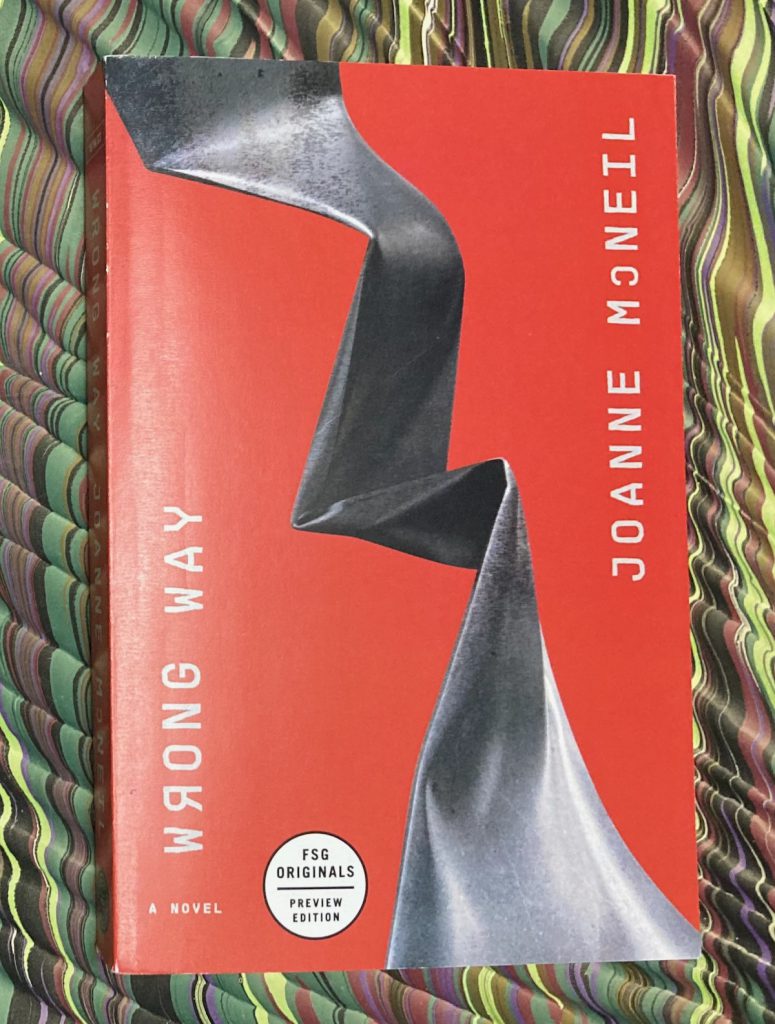
— Joanne McNeil. Wrong Way. MCD x FSG Originals, [2023].

i see things from
the under side
Don Marquis, the lives and times of archy and mehitabel

Drop everything and find a copy of Wrong Way.
This remarkable book is many things : a deep history of America through the lens of marginal employment, a social history of isolation, and an economic palimpsest of the architecture of New England mill towns. Wrong Way is the first novel by Joanne McNeil, who has a fine ear for American usages and a sneaky sense of humor evident from the first pages; her entangling memoir of technological change, Lurking. How a Person Became a User (2020) is well worth looking for. Wrong Way is a science fiction novel of the near new future, charting the life and times of Teresa Kelly, a Massachusetts woman in her late forties who swims laps the way others might jog or cycle or meditate, and who aces a virtual hand eye coordination test. “There is nothing to win,” says the recruiter, except that is never really true.
We follow Teresa in a close third-person narration that attends to small sensory details in the present and is resilient enough to sustain digressions into a litany of the jobs she has held over the years. “This could be a good job . . . ” is the voice of a pragmatic optimist and, it becomes clear, actually a pretty high bar.
The opening chapter is superb in its evocation of Teresa’s present circumstances and where she came from. Her first job as a teenager was at the jewelry counter in the showroom for an omnipresent catalogue company. “It was a good job, but those stores don’t exist now. Those jobs don’t.”
Say “Cedars” softly, without stressing the medial dental consonant.
The cognitive estrangements creep in swiftly and subtly as the shuttle bus proceeds from Boston South Station to a long-abandoned airport now repurposed as Render Falls, regional hub of the “worker first” internet company AllOver, “more than a service and experience platform”: it functions as search engine, ticketing conciergerie, payment processing, digital currency, and more. Teresa has been hired as a contract worker in the driverless car division, CR, a “transportation alternative” for top tier AllOver users. The AllOver executives — Falconer Guidry, CEO and self-made man, and Vermont Qualline, SVP of automotive engineering and daughter of a nineties country singer — have stepped from the pages of the business section of tomorrow’s newspapers, and the AllOver corporate rhetoric, ecological self-righteousness, and aspirations to a “Holistic Apex” are pitch perfect. Teresa is mature enough, and jaded enough, to be a skeptical witness, and some of the other trainee “seers” who answered the Drivers Wanted ad voice their doubts about the AllOver mission. “What kind of bottom-up change begins with people who spend fifty gs or so on an app every year?”

‘like a cockroach hiding in the kitchen walls’

The billboard in Brixboro that used to say “We Will Buy Ugly Houses” has been replaced by a picture of Plum Sasha lounging in a CR. Her teeth and blue eyes are clear and perfect. She looks carefree and young. There’s a retro eighties feel to the bubbly blue letters that read, “Luxury. Privacy. Spotless. Priceless. The CR has arrived. See it.”

Plum Sasha is an “icy-looking” teenage influencer and the advertising campaign for AllOver’s “CR driverless experience” is omnipresent. It is good advertising and pretty tough going those on the delivery side of the product. Teresa soon discovers her work as a “seer” at AllOver is not what she expected, and that things are not what they seem. On page 89, Teresa sees clearly: “It seems obvious, from the moment she sees it, but it never occurred to her earlier. Every trainee in the hangar has dark hair. There’s something else they all have in common: slim, compact bodies. It is a room of ectomorphs, each one of them about five and a half feet tall, give or take a couple of inches. Long limbs and short torsos. Bodies small enough to hide.”
At pages 110-11, things as they are become even clearer, in a “moment of weightless surrender  [. . .] She is uncomfortable, still, and clings to her discomfort — once driving the CR feels natural to her is the moment she will lose control.” Coupled with the downward spiral of Teresa’s past work experiences — “The longer she worked at the museum, the more it felt like training in reverse” — this might suggest a pretty bleak book, but McNeil’s nimble prose and her eye for beauty in the mundane offer a different arc. The epigraph to this review, the refrain from “ballade of the under side” by Don Marquis, articulates my sense, from the earliest pages, that this is a novel from the economic underside of the American tech miracle. And so it was a small pleasure to see the simile “like a cockroach hiding in the kitchen walls” at page 119, part way into into the narrative drive. For drive it is: Wrong Way threads and weaves through the greater Boston area with a sureness of inborn knowledge — I have visited many times and still have no clues as to how Cambridge and Boston and the Charles River are braided together.

‘Route 128 when it’s dark outside’

We read and write on analog paper, and we read and write on electronic paper. We live in a world where the analog and the digital reciprocally permeate each other; we are hybrids, and so are our media.
Lothar Müller, Weiße Magie / White Magic, The Age of Paper (translated by Jessica Spengler)

Science fiction demands that metaphor be taken literally. Wrong Way is a science fiction novel about the hybrid nature of work in the twenty-first century. Teresa puts herself — contorts herself — into her job in a way that employers take to the bank. Capitalist systems are designed for economic returns with little heed for the human costs. “When things are good with work, all it means is, things will get worse.” The soundtrack to Wrong Way might well include “Roadrunner”, Jonathan Richman’s paean to the highway late at night, Route 128 when it’s dark outside, just before a tech boom that forms part of the geologic past of Wrong Way. The brief moments of camaraderie with fellow seers or with truck drivers are nicely done yet serve only to highlight a chronicle of isolation. I don’t want to leave the wrong impression: Wrong Way is a novel that addresses serious topics with flashes of wit and wild imagination. McNeil takes the reader to strange places. And just what happens in the last two chapters will be a matter of personal interpretation. I can’t wait to discuss it with other readers.

Drop everything and find a copy of Wrong Way. It’s an engaging and provocative work, the best book I’ve read this year.

The Endless Bookshelf book of the year 2023.

A singular interview with Henry Wessells, by Michael Swanwick

Singular Interviews, by Michael Swanwick.  Tenth in an Occasional Series

Henry Wessells is not only a writer of fiction, criticism, and critical fictions but a bookman as well — a professional dealer in rare books and related materials. It is in this latter capacity that this question was posed.

Michael Swanwick: If you could own one essentially unobtainable rare genre book, what would it be?

Henry Wessells: I would like to own Erasmus’ own copy of Utopia (Louvain, 1516); or, failing that, More’s own.
But you know me very well, Michael, to ask such a question, for I (or a character calling himself “I”) have answered your question twenty years ago in the pages of NYRSF, when I summoned into being an imaginary book “I” needed to know in order to write about the work of Don Webb. That book is Irimari, ou, la reine zombie de la Guiane (Brussels: Auguste Poulet-Malassis, 1866) by Gérard de Kernec, and its English translation by Swinburne, Eurydice in Guiana, published anonymously in 1871 by John Camden Hotten. In “Book becoming power” (NYRSF, March 2000), D. owned Lester Dent’s copy of that book, and even now I wouldn’t mind owning a copy of either edition myself.
That was easy; there was no hesitation, for I have been thinking about the literature of the fantastic ever since I was seven years old. Not that I read Utopia at that age. I have seen the copy of Frankenstein which Mary Shelley inscribed to Lord Byron (one genius to another), but I never felt I needed to possess it.
I did, of course, answer your singular question in a concrete sense, by thinking about a book which did once exist, for a key aspect of our mode of literature is the literalization of metaphor.

— — —

First published in the New York Review of Science Fiction 355 (June 2021).
Copyright © 2021 Michael Swanwick. Reprinted by permission of the author.