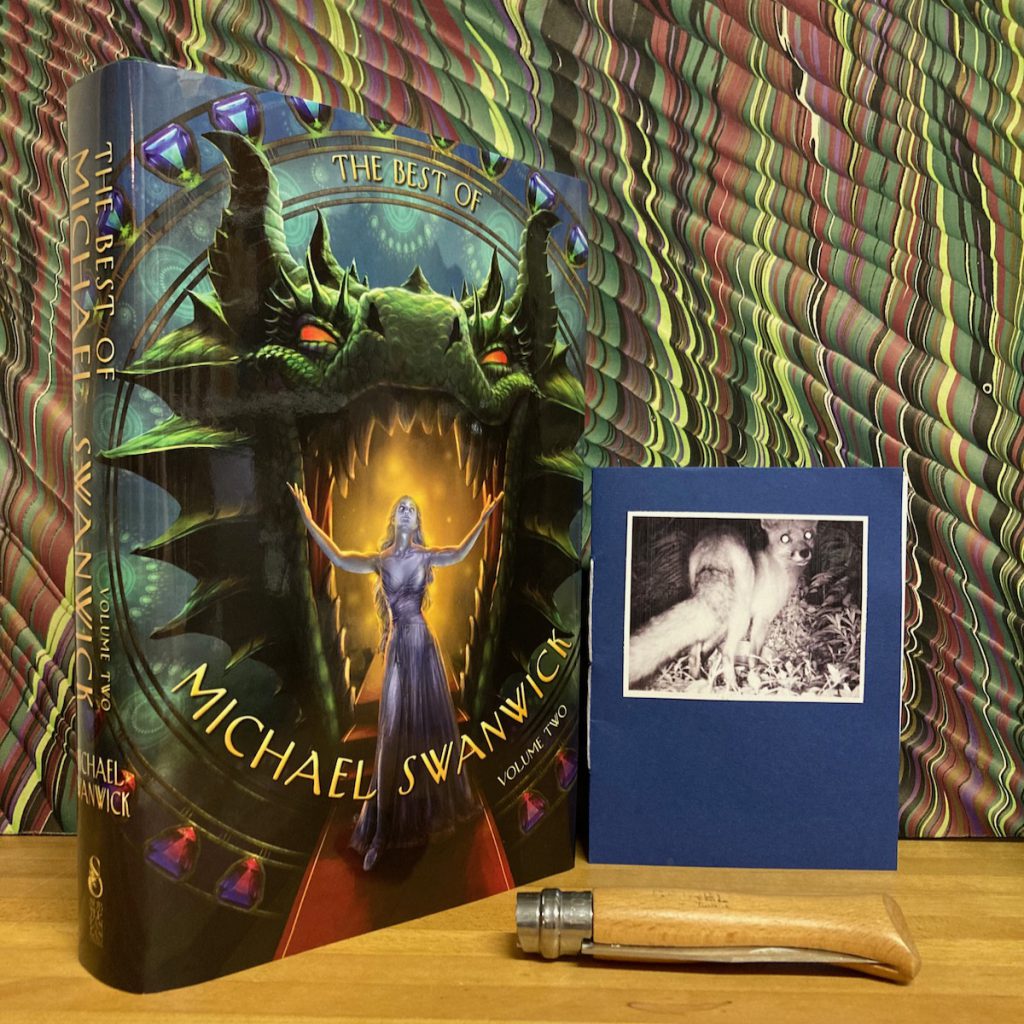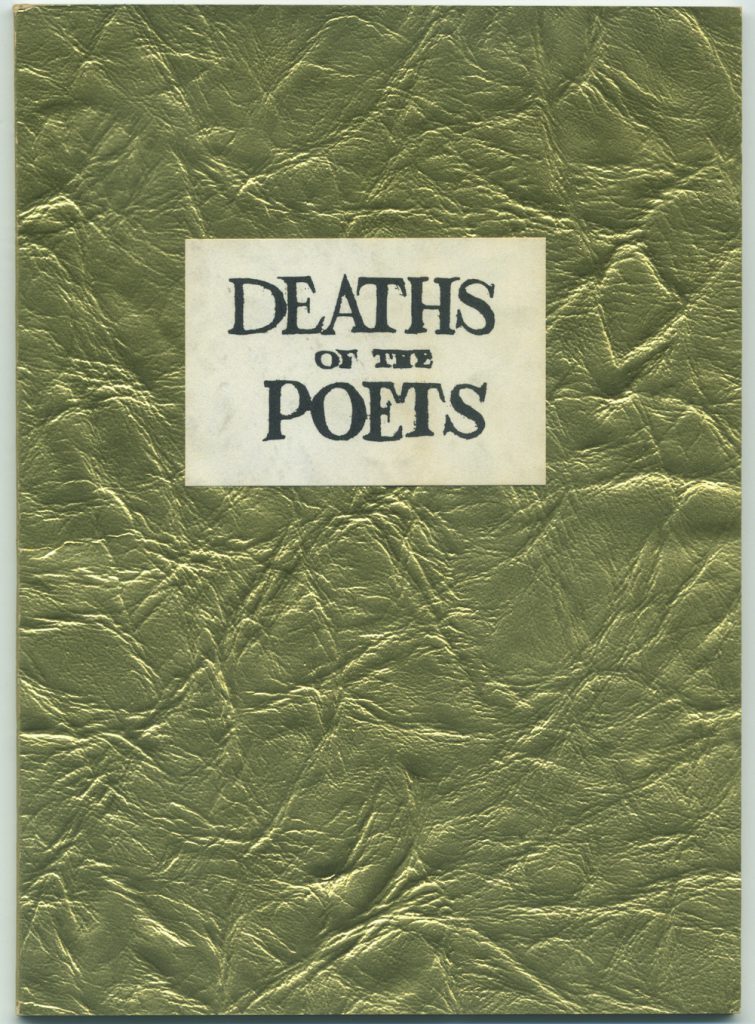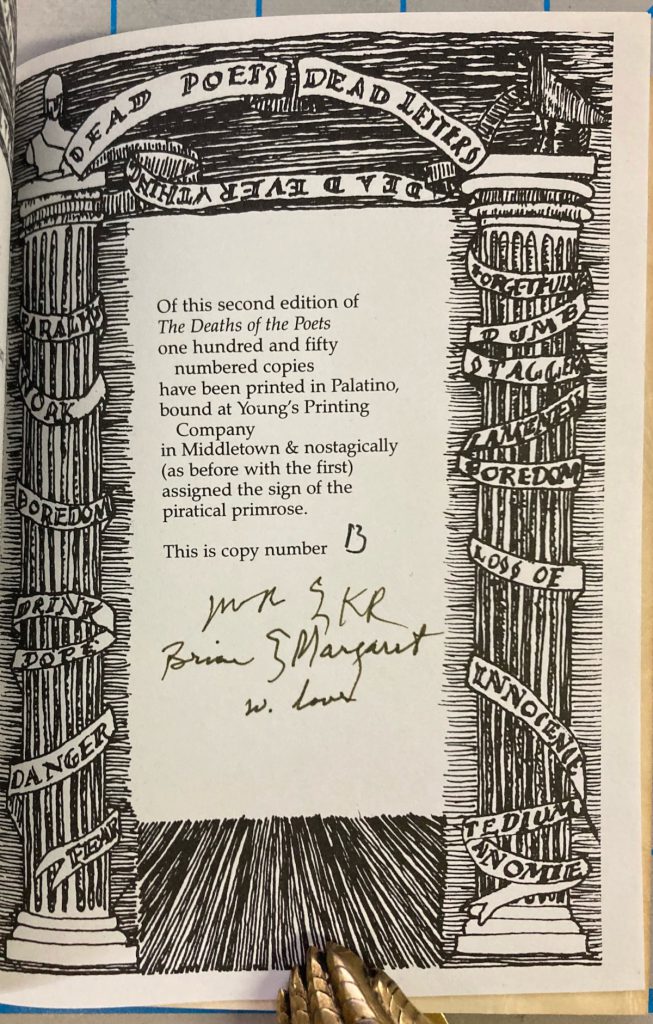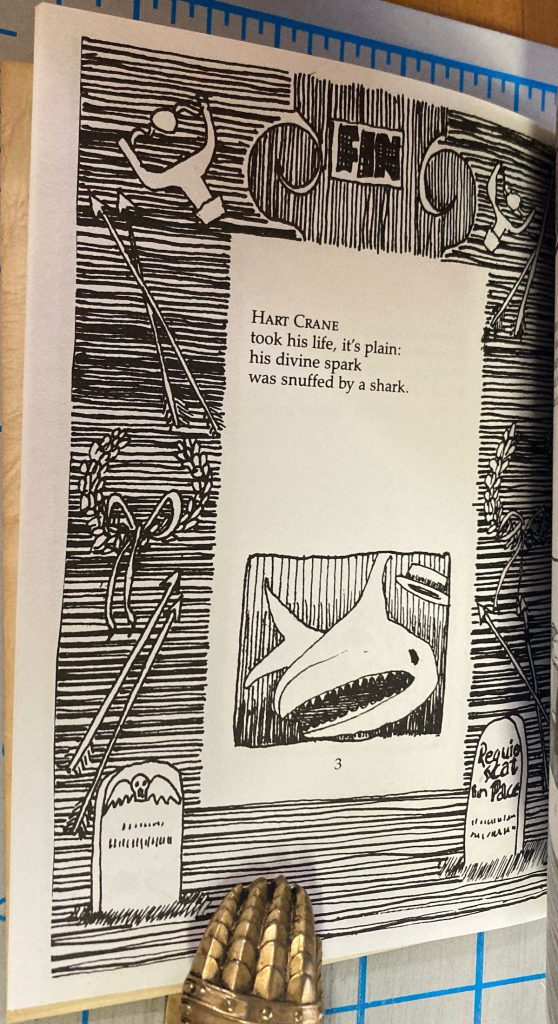
commonplace book — late spring 2023

“happy as always in the faculty of finding infinity round the corner of any street, within five minutes of anywhere”

— Arthur Machen, The London Adventure (1924)

— — —

On Defining Genre

The problem with defining a genre — science fiction, for example, or fantasy — is that once you’ve declared what it is, you’ve also declared what it can’t be. And if it can’t be anything but what it has already been, it’s of no interest to any serious artist.

— Michael Swanwick, Brief Essays on Genre (2023)

— — —

“de la doctrine des hommes comme de l’eau, qui n’est iamais plus belle, plus claire & plus nette qu’à sa source”

— Gabriel Naudé, Advis pour dresser une bibliothèque (1627)

— — —

“But I knew that I always enjoyed looking back on things more than actually doing them.”

— George Sims, The Terrible Door (1964)

— — —

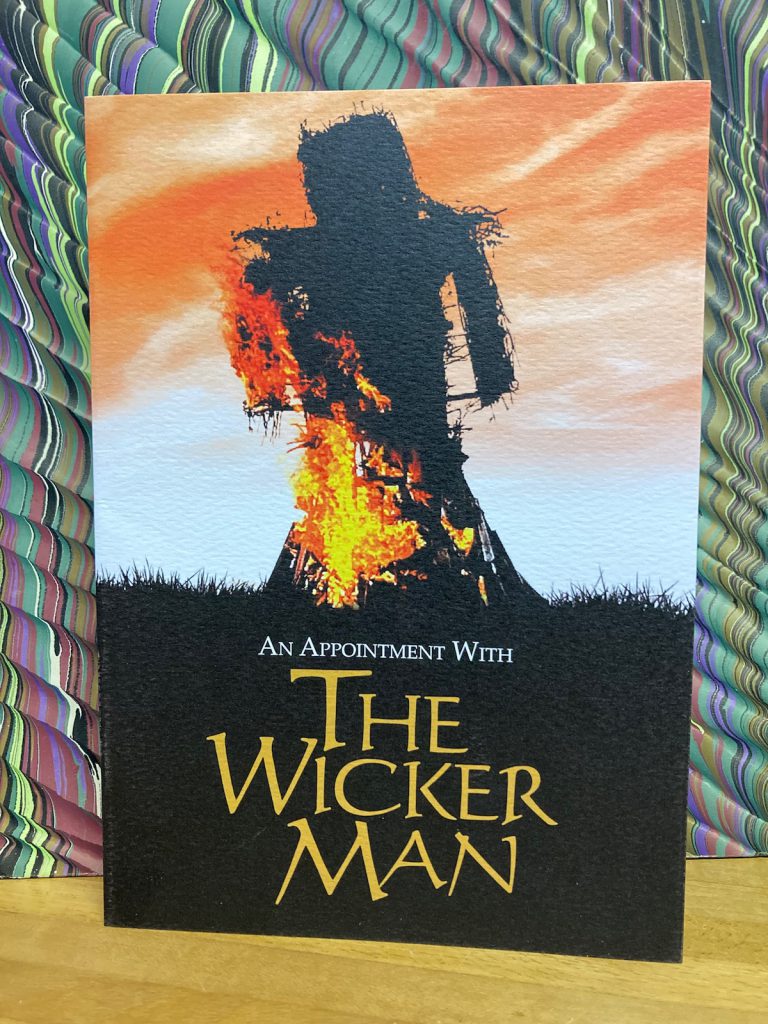
Hazelnut cake for the Avram Davidson Centenary Garden Party

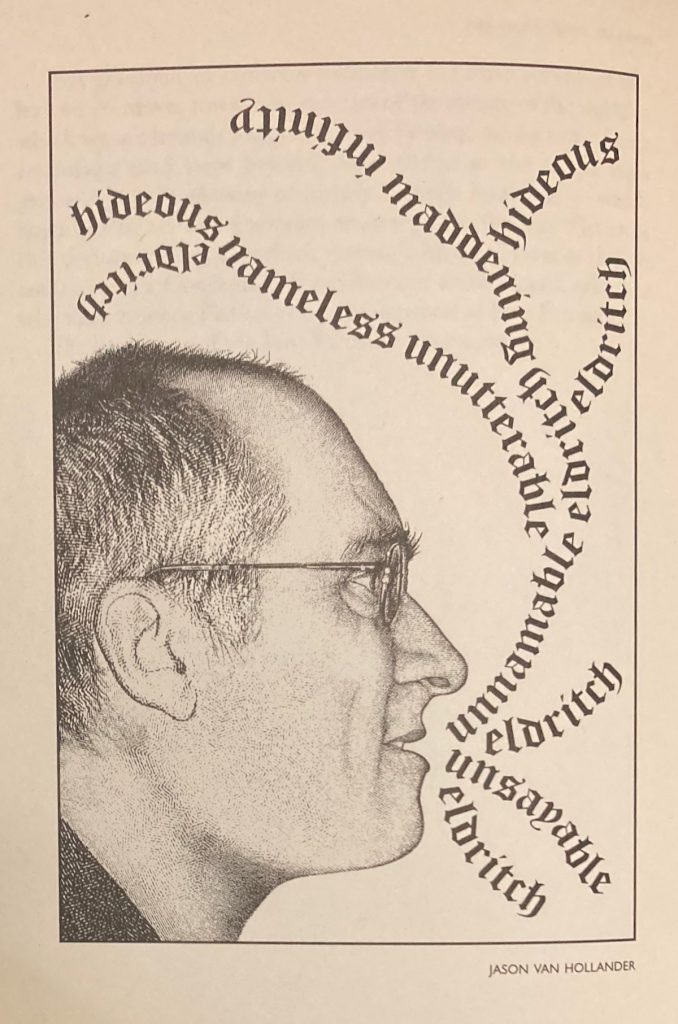
Brief Essays on Genre by Michael Swanwick

— Michael Swanwick. Brief Essays on Genre. [Dragonstairs Press, 2023]. [16] pp. Stitched in wrappers. Edition of 75 signed copies.

Michael Swanwick is a trickster and a master of concision. In “A User’s Guide to the Postmoderns (1986)*, he danced his way through a discussion of contemporary science fiction and the apparent divide between the cyberpunks and the humanists, exhibiting familiarity with the work and the writers, all without ever quite planting a foot on either side of the fence.  He was a skeptic of movements and manifestos back then; and when Farah Mendlesohn’s Rhetorics of Fantasy (2008) seemed to chart a structure and laws, Swanwick set out to write a work that violated all of them and yet was unmistakably fantasy. So he has a playful side. He performed several rigorous, extended virtuoso sequences of short short stories, with Puck Aleshire’s Abecedary for The New York Review of Science Fiction (2000), The Periodic Table of the Elements for Ellen Datlow’s Sci Fiction (2000-2003, collected in 2005), and The Sleep of Reason, riffs on Goya’s Los Caprichos for The Infinite Matrix (2002-2003). His Christmas cards are a blast, short shorts that sometimes wrench your heart.

And now Swanwick has returned to nonfiction, with Brief Essays on Genre, which collects 25 sharp observations on writing and the literature of the fantastic. He knows how to get right to the heart of the matter. There is not a word of excess. The conclusion of the Brief Essay upon literary movements reaffirms his earlier position. “By the time you’ve heard of somebody else’s, it’s over.” If this approaches aphorism, nonetheless it rings true. Of course the difficulty in writing about these essays is that one find oneself in the situation of Avram Davidson writing his editor about  “The Last Wizard”, in a letter of explanation as long as the story.  I can’t, however, help citing this essay:

On Defining Genre
The problem with defining a genre — science fiction, for example, or fantasy — is that once you’ve declared what it is, you’ve also declared what it can’t be. And if it can’t be anything but what it has already been, it’s of no interest to any serious artist.

This approaches, from a different angle, William S. Wilson’s observation, “Writing within conventions of language, and of genre, is like swimming in society rather than in a pond under a waterfall.” It is often at the edges or boundaries where interesting things happen.

Don’t be fooled by the brevity or levity of Swanwick’s essays, this is a notable book.

Brief Essays on Genre sold out upon publication but you may read the essays as they appeared serially on Flogging Babel, beginning here.


* collected, with “In The Tradition” (1994), a cruise through the disputed waters of Fantasy, in The Postmodern Archipelago (1997).

Borges

The work of Jorge Luis Borges has always been a touchstone for me: the concision and entanglement of his fictions and artifices and inquisitions are a source of great pleasure and inspiration. I am pleased to report that James Cummins Bookseller catalogue 145, Jorge Luis Borges, is ready, describing more than 400 items from the private collection of Gary Oleson, proprietor with Franny Ness of Waiting for Godot Books in Hadley, Massachusetts. Waiting for Godot were long- time specialists in twentieth century literature (among many other fields), including Latin American authors, and Oleson began buying Borges material in the late 1980s and early 1990s.

The collection includes books owned by Borges, manuscripts of essays and stories, autograph  notes, photographs, inscribed books, and a comprehensive group of books, periodical appearances, ephemera, and secondary literature. The cover illustrates a book by Capt. Marryat, signed by Borges at age 11, 25, 33, and 42, and with the ownership signature of his English-born great aunt, who taught him English

As with the writings of Borges, patterns and connections reveal themselves across the pages of the catalogue, which is published on the occasion of a Borges centenary, the hundredth anniversary of the publication of his first book of poems, Fervor de Buenos Aires (1923). [HWW]

Catalogue 145, Jorge Luis Borges is in two sections, an illustrated catalogue of 130 items, and a descriptive listing of 275 items. A printed catalogue is available, and many items will be on display at the New York Antiquarian Book Fair 27-30 April at the Park Avenue Armory, in the Cummins booth A1. Your correspondent will be there, come say hello.

The Avram Davidson Centenary

Sunday 23 April 2023 is the centenary of the birth of Avram Davidson.

On this occasion, worthy of celebration wherever the readers of this website may find themselves, it is worth looking back at origins. I count myself fortunate to have discovered the work of Avram Davidson, when in late 1992 I first read a battered but intact copy of The Enquiries of Doctor Eszterhazy paperback. I was surprised, again and again. The rambling sentences and digressions impressed me, but most of all it was the way in which Davidson integrated obscure and bizarre knowledge into these stories: knowledge that in anyone else’s hands would be dusty and uninteresting or an info-dump that strangled or squashed the flow of language. Davidson was genuinely learned, as even a single sentence taken at random will reveal. There is a healthy measure of irreverence to temper this erudition, too, so that a reader is never oppressed by the weight of information imparted. I know that I was re-reading the Enquiries in late April or early May 1993, for when I decided to order the two books then in print and called up George Scithers, publisher of the Owlswick Press (and Weird Tales), in King of Prussia*, Penna., he answered my inquiry with the statement, “Avram Davidson died last week.”

portrait of Avram Davidson (1923-1993), American science fiction author and essayist

Over the next several months and years, the quest for other works by Davidson, at first to read them, but soon I began preparing lists in an attempt to understand the range of his work. I corresponded with or met folks in and out of science fiction, many of whom I still count as friends. The rest is history, some of it chronicled in back issues of The Nutmeg Point District Mail newsletter and in the archives of the Avram Davidson website. From small seeds and many friendships, the Avram Davidson Society (largely imaginary but important for all that) has fostered interest in the writings of Avram Davidson.

In recent months, I have been re-reading lots and lots of Avram Davidson with great pleasure, the Eszterhazy stories (a perennial favorite), but also “Lord of Central Park” and El Vilvoy de las Islas (if Naples is the most elegant book I have published with the imprint of the Nutmeg Point District Mail, El Vilvoy is the most important). And then there is The Avram Davidson Treasury (1998), the great triumph of Grania Davis and her efforts in the first wave of posthumous publications. And if the Treasury unaccountably omitted three essential stories, “Lord of Central Park”, “The Dragon Skin Drum”, and El Vilvoy de las Islas, well, all three appeared in collections within the next few years, in The Investigations of Avram Davidson and The Other Nineteenth Century. And Everybody Has Somebody in Heaven gathered together material relating to Avram Davidson as an American Jewish writer; the biographical essay by Eileen Gunn remains the most important survey of Davidson’s life and work. These are solid foundations upon which all else has built.

And now, for the Avram Davidson Centenary year, there will be a century of stories, AD 100. 100 Years of Avram Davidson. 100 Unpublished or Uncollected Stories, a two volume collection assembled by Seth Davis and forthcoming in 2023 from  Or All the Seas with Oysters, the publishing arm of the Estate of Avram Davidson. Your correspondent had an early look at the table of contents and it is a fascinating assembly: early writings, some of which I have never seen, and stories published in a variety of periodicals and anthologies — within and without the genres— many of them ephemeral, fleeting, and extinct. Once upon a time, dear reader, it took fantastical amounts of luck and patience and effort and, above all, TIME to trace these stories, simply for the pleasure of reading them. Now, this pleasure will be yours, as you peruse two thick volumes. I look forward to doing so myself.

The preparation of AD100 is a colossal accomplishment and a landmark in the posthumous career of Avram Davidson as significant as publication of The Avram Davidson Treasury in 1998. Here’s to the next twenty-five years!

On the occasion of the Centenary, I acknowledge, in memoriam, a short list friends and correspondents who were instrumental in promoting the legacy of Avram Davidson: Grania Davis, Guy Davenport, Reno W. Odlin, George Scithers, and David G. Hartwell.

* King of Prussia, named for an eighteenth-century crossroads tavern, is the wonderfully named town near where I spent much of my youth. I suspect Avram Davidson took a certain amount of pleasure in the unusual name of the town where his friend and long-time editorial champion George Scithers (1929-2010) lived for many years.

[This essay appeared in slightly different form as part of The Nutmeg Point District Mail, vol. XXI, no. 1, archived at http://avramdavidson.org/nutmeg48.htm.]

Ambrosia Arabica : Books & Coffee in History

Arbre du Café, from Voyage de l’Arabie heureuse, 1716

For many readers, a cup of coffee is the ideal accompaniment to a carefully chosen volume. The recent vogue of uniting bookstores with coffee shops that is rippling through the book world is but a modern revival of older custom. For of all foods and beverages, coffee has perhaps the closest and most interesting connections with the printed word. Its introduction into seventeenth-century Western Europe from the Middle East came at a time when geographical and scientific knowledge was increasing, and in turn the rise of the coffee house transformed many areas of social, intellectual, and commercial life.

Newspapers, the Lloyd’s insurance and maritime intelligence operations, the New York Stock Exchange, the British postal system, and political and social clubs are some of the diverse institutions that trace their origins to these places where people gathered to drink coffee. Coffee figures in early botanical, medical, and Orientalist books, and in numerous volumes recounting seventeenth-century travels and explorations. In literature and the arts, coffee is at the core of a similar array of books and musical and theatrical compositions.

To be sure, wine has a longer literary heritage, with various threads extending back to Ancient Rome, Persia, and China. In the end, however, the fruit of the grape induces somnolence rather than the alertness and perspicacity that are characteristic of many book people. So with all due apologies to those who favor a glass of port and a comfortable armchair for their reading on a wintry evening, this essay will look at the relationship between coffee and modern culture, with particular attention to the printed book. One of the most venerable myths about coffee — concerning its introduction to Vienna — will be dispelled, and the truth made known.

To read the complete essay, click here : https://endlessbookshelf.net/coffee.html


[Originally published in slightly different form in AB Bookman’s Weekly, December 15, 1997. Copyright 1997, 2023, by Henry Wessells. All rights reserved.]

The Philosophical Exercises of Janwillem van de Wetering. By Henry Wessells

With A Checklist of Books by Janwillem van de Wetering

Author of a highly acclaimed series of mystery novels, world traveller, former Zen student, and former police officer Janwillem van de Wetering brings an unusual perspective to the detective genre.  His novels and stories feature a diverse and richly drawn cast of characters and settings that range from the streets of Amsterdam to the Caribbean and from rural Maine to Japan, South America, and New Guinea.  A careful eye for the details of police investigations is joined with a quirky sense of humor and a keen interest in philosophical and spiritual matters.

[ To read the complete review essay, click here : https://endlessbookshelf.net/wetering.html ]


[ This article was first published in slightly different form, as “The Mystery Novels of Janwillem van de Wetering” in the issue of AB Bookman’s Weekly for 7-14 September 1998. This digital version was for a long time posted at the Avram Davidson website. All rights reserved. ]
sixteen years of the Endless Bookshelf

24 January 2023

Today marks sixteen years of the Endless Bookshelf, and the past year was an eventful one to be “simply messing about in books”.  To have played a part in the long history of The Book of Ryhmes (1829) by Charlotte Brontë, now at the Brontë Parsonage Museum in Haworth, was a signal delight. It was a good year to be a reader, too.

The Endless Bookshelf book of the yearThe Silverberg Business by Robert Freeman Wexler (Small Beer Press, 2022), is a work that affirms the utility and possibility of fiction, and it’s a weird, fascinating story.

There were plenty of other recent books of note:
— John Crowley. Flint and Mirror. Tor, [2022].  Reviewed here.
— Alice Elliott Dark. Fellowship Point. A Novel. Mary Sue Rucci Books | Scribner, [2022]. Noted here.
— Elizabeth Hand. Hokuloa Road. Mulholland Books. Little, Brown, [2022]. Noted here.
— R. B. Russell. Robert Aickman. An Attempted Biography. Tartarus, [2022].
— R. B. Russell. Fifty Forgotten Books. With numerous illustrations. 255 pp. Sheffield : And Other Stories, 2022. Reviewed here.
— Christelle Téa. Bibliothèques. Dessins 2018-2021. Librarie Métamorphoses, [2022]. Exhibition catalogue.
— Mark Valentine. The Fig Garden and other stories. Tartarus, [2022]. An excellent new collection, with several original stories.
— David R. Whitesell. A Curator’s Wunderkammer. A Decade of Collecting for the University of Virginia. Exhibition Catalog. [Charlottesville: University of Virginia Library], 2022. Reviewed here.
— Eric G. Wilson. Dream Child. A Life of Charles Lamb. Yale University Press, [2022].
— Paul Witcover. Lincolnstein. A Novel. [Hornsea:] PS, [2021]. Reviewed here.
I found one antiquarian title I had been seeking for many years  :
— F. & E. Brett Young. Undergrowth [1913]. Cassell, [Popular Edition, 1925].
Your correspondent is an optimist by temperament and looks forward to what the year ahead will bring. I’m still working my way through Proust in the Pléiade edition, with pleasure. I lost momentum during the crazy, circling jealousies of La prisonnière, which rewards with flashes of humor (and the short sudden passage on the heat death of the universe); I am currently at the stage of Albertine disparue. A few pieces of writing are forthcoming in the Book Collector and elsewhere, and others are in progress on the desk. 23 April 2023 is the centenary of the birth of Avram Davidson.

— — —

In February, I expect to be at the California International Antiquarian Book Fair in Pasadena, booth 514 (James Cummins Bookseller) at the Oakland Marriott City Center, Friday 10 February through Sunday 12 February. If you are in the vicinity, come by and say hello (and please let me know in advance if you would like a pass). I will have a handful of Temporary Culture publications on the booth.

— — —

Peak Machen : 1923

signature of Arthur Machen

In 1923, a century ago, Welsh author Arthur Machen was at the height of his literary reputation on both sides of the Atlantic. It had been a long path from his “horrible” juvenile poem Eleusinia (1881) and such early books as The Anatomy of Tobacco (1884) and the numerous translations of the 1880s and early 1890s. But with The Great God Pan (1894) and The Three Impostors (1895), Machen produced a small group of supernatural tales that shocked upon their first appearance and then proved to be enduring.  The other great work written in the late 1890s, The Hill of Dreams, Machen’s “‘Robinson Crusoe’ of the soul” depicting the aesthetic visions of young Lucian — and the tensions between pastoral and urban life — remained unpublished until 1907. Literary success was never easy for Machen and indeed he spent an interval as an actor with a provincial repertory company before returning to literary journalism and newspaper work, during which he created a modern myth of the first world war, The Bowmen. This is the barest outline of Machen’s career, and more detailed accounts can be found in Mark Valentine’s 1995 monograph or The Life of Arthur Machen, John Gawsworth’s biography (begun during Machen’s lifetime but published only in 2005). But that is to get ahead of things.

In 1923, Machen had many books in print: the year before, his edition of the Memoirs of Jacques Casanova (1894) had been reprinted in twelve volumes, and Far Off Things, a collection of wartime columns from the London Evening News, entitled “Confessions of a Literary Man” and recounting his hard apprenticeship in the 1880s and early 1890s, had been published. In 1923, his London publisher, Martin Secker, brought out another volume of autobiography,  Things Near and Far, and a new work of fiction, The Secret Glory, as well as a signed large paper edition of The Hill of Dreams (the latter on blue paper, illustrated at top and below). In 1923, Henry Danielson published a Bibliography of Machen’s works through 1922, with retrospective “annotations” on each work by Machen, and with a deluxe issue signed by Machen. Secker published the Caerleon Edition of the Works of Arthur Machen in nine volumes dated 1923; in New York the enterprising Alfred A. Knopf brought out an attractive series of Machen’s books: The Hill Of Dreams, The Three Imposters,  Far Off Things, The House of Souls, Things Near and Far, and Hieroglyphics; with others to follow in 1924: Dog and Duck, Ornaments in Jade (signed by the author), and The London Adventure.  It really was peak Machen.

What else was going on at this time? It’s useful to look at Machen in the context of other books published and contemporary literary currents around 1923. One notable work  of fantasy was William M. Timlin’s The Ship That Sailed to Mars, illustrated by the author; lush and imaginative, it had little in common with Machen’s themes. The Club Story and the told tale showed itself alive and well with Sapper’s The Dinner Club; and master of the uncanny Algernon Blackwood published his curiously incomplete autobiographical work, Episodes before Thirty.  Aleister Crowley’s The Diary of a Drug Fiend was fiction rooted in the author’s own experience: transgressive, but again in a manner unlike Machen’s. If Ornaments in  Jade, Machen’s sequence of prose poems, seems almost a harbinger of modernism, such was the conservatism of English letters that it is to the early modernism of Baudelaire that these point.* When one considers works such as Joyce’s Ulysses (1922) and Hemingway’s Three Stories and Ten Poems (1923) and the sudden emergence of the modernist aesthetic (in both minimalist or encyclopedic modes), it becomes quickly apparent that Machen achieved his greatest popularity at a moment when the world changed. “By the time he was rediscovered in the 1920s he was near retirement and no longer capable of producing high-calibre material”  (SFE). This position of being somewhat at odds with the dominant modernism points to an explanation of the near obscurity of Machen’s work well into the 1980s when a revival of interest in  the writings began, with the formation of an Arthur Machen Society, and later the Friends of Arthur Machen.

As a bookseller, I had three Machen items of great interest, sold long ago: the manuscript of his late essay “The True Story of the Angels of Mons” (1938); an extended autograph quotation from The Hill of Dreams (almost certainly written out for a collector in the mid 1920s); and a signed photograph of Machen in costume as Doctor Johnson from a film shoot circa 1922, which was reproduced as the dust jacket illustration when the Friends of Arthur Machen and Tartarus published The Life of Arthur Machen.  His is a household name only within the literature of the fantastic now, but the books are more readily available and sometimes read. Machen’s work is always worth exploring.

* In fact, as I learn from reading The London Adventure, the prose poems of Ornaments in Jade were written in the 1890s, more or less at the same time as The Hill of Dreams.


Ghosts & Recovered Memories : Tom Disch’s Amnesia

‘You wake up feeling wonderful. But also, in some indefinable way, strange’

The other day Tom Lecky handed me something he found while tidying up his shop, Riverrun, or more precisely tidying up old stuff from its earlier existence when Chris Stephens ran it as a street-level open shop in Hastings on Hudson. Mr. Lecky (whom I call Tom but in a moment you’ll see why the usage remains formal) knew I’d be interested because when he first took over, I had bought the proof copy of On Wings of Song (1979) marked by Thomas M. Disch with corrections for the Gollancz publication of the novel. What Mr. Lecky  handed me was a pictorial printed sleeve for Tom Disch’s early interactive fiction, Amnesia, empty except for a printed map of Streetwise Manhattan (copyright date 1984) with a curious gold sticker on it, “compliments of the Sunderland Hotel” (not a hotel I had ever heard of). The sleeve is undated and bears a Harper ISBN 0-06-668006-9, and is signed by Disch with his formal signature.

This a trickier object than it might seem at first glance, for it is a bibliographic ghost: the Harper and Row  Amnesia by Tom Disch never existed.

In Contemporary Authors Autobiography Series, vol. 4 (Gale Research, 1986), Tom wrote:

I’ve completed a computer-interactive novel, Amnesia, which should appear from Electronic Arts in May of 1986. For a while it was touch-and-go whether Amnesia would ever exist. Harper and Row Software contracted for it in the fall of ’83, and then a year later, when the project was halfway to completion, Harper and Row dissolved their software department before it had put a single product on the market, a decision dictated by considerations of accounting [. . .] and then when Electronic Arts took over Amnesia I returned to work on that. And now that’s done [. . .]

He was indeed a pioneer in this new field and Amnesia is a text of branching paths, beginning when the “player” awakens in a hotel room in the Sunderland Hotel somewhere in Manhattan with, as the Harper sleeve copy says, “no idea of who you are, with no clothes, with no money — and with fifteen minutes until you have to check out of your hotel room.”

The text adventure was published by Electronic Arts in 1986. Interviewed by Larry McCaffery in Across the Wounded Galaxies (1990), Tom observed

When you’re working on this kind of text, you’re operating in an entirely different mode from when you’re writing other forms of literature. [. . .] In a very literal sense, any computer-interactive text deconstructs itself as you write because it’s always stopping and starting and branching off this way and that. You are constantly and overtly manifesting those decisions usually hidden in fiction because, of course, you don’t normally show choices that are ruled out — though in every novel the choices that are not made are really half the work, an invisible presence. With Amnesia, I found myself working with a form that allowed me to display these erasures, these unfollowed paths.

The history of the Harper ghost is also well known. In the fall of 2008, Stephane Racle, a specialist in computer games bought an example of the Harper sleeve and a typescript  of Amnesia, the Script for my U-Dun-It, Disch’s text for the interactive adventure.

More recently, Rebooting Electronic Literature: Documenting Pre-Web Digital Media, volume 1 (2018), from the Electronic Literature Lab at Washington State University, Vancouver, includes a section on Disch’s Amnesia with a “traversal” or demonstration of the 1986 Amnesia, with a critical essay and links to reviews and earlier articles.

— — —