recent reading : early september

current reading :

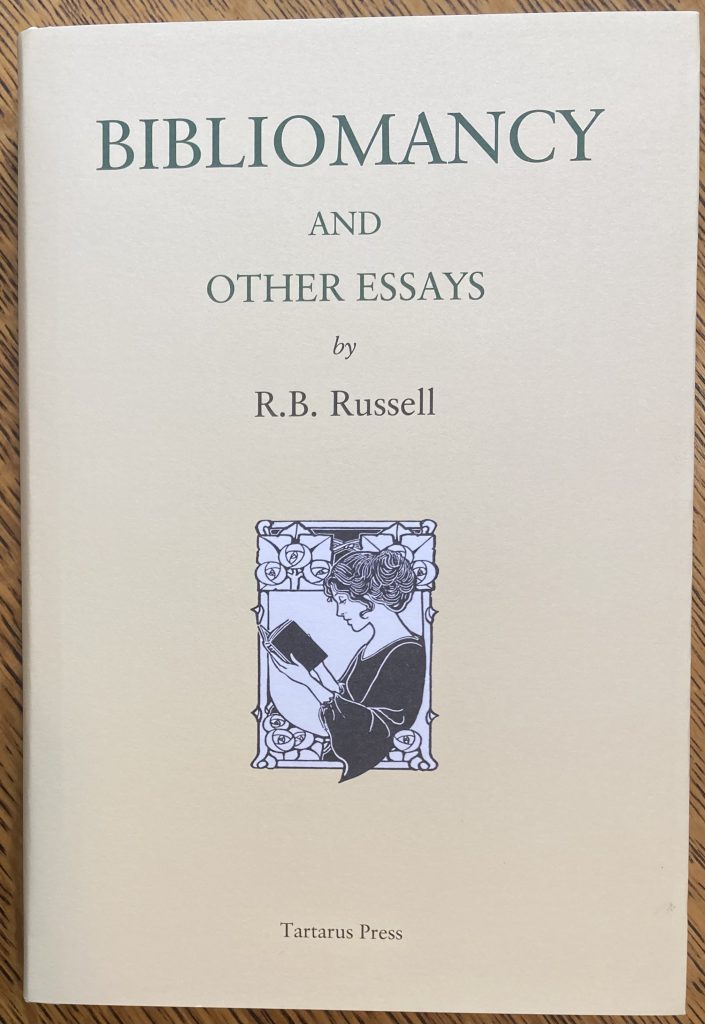
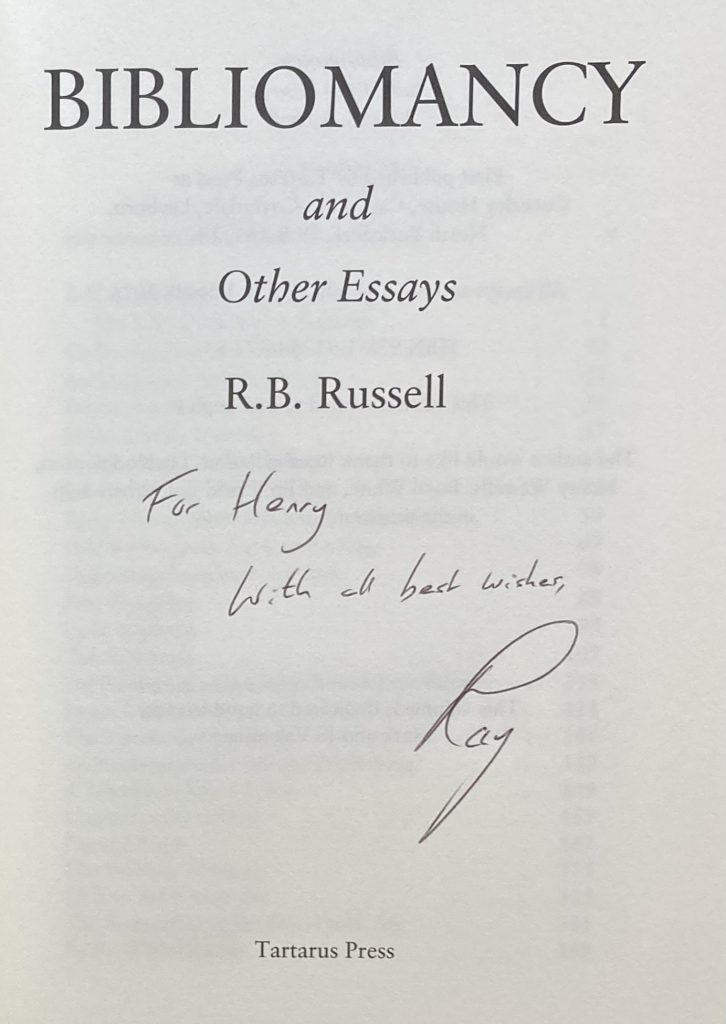
— R. B. Russell. Bibliomancy and Other Essays. Illustrated. [xii], 369 pp. Tartarus Press, [2026].
Collection of essays and reminiscences about books and writers and collecting, including Arthur Machen, Robert Aickman, the Sarban papers, on publishing the first edition of a work by Charlotte Brontë, and Barry Humphries.
— — —
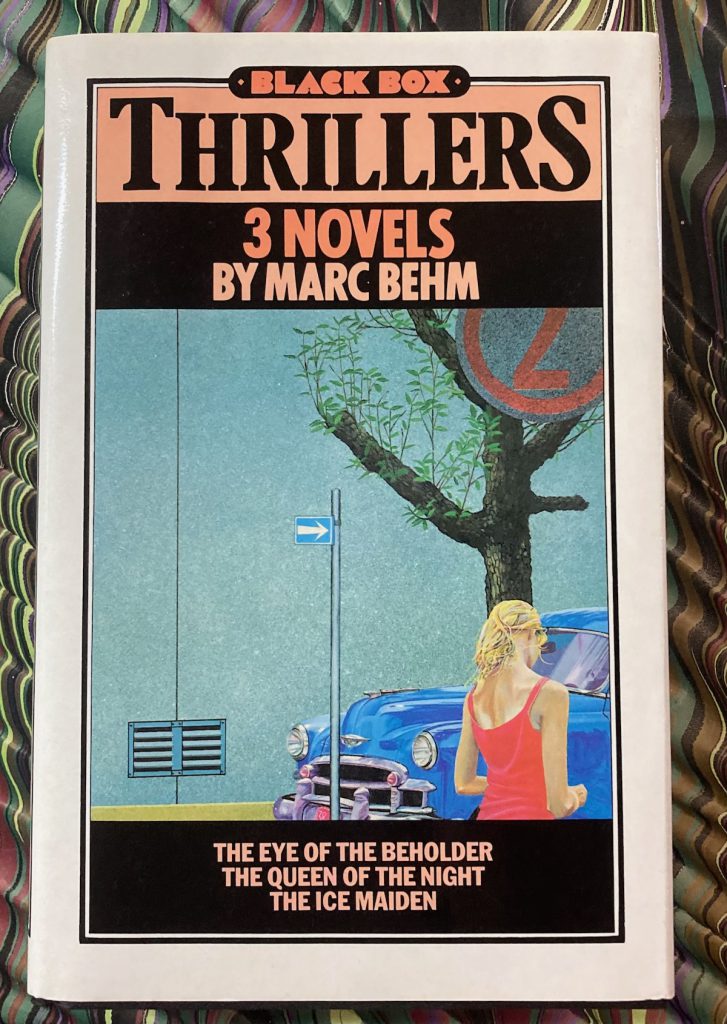
—Mark Behm. The Eye of the Beholder. The Queen of the Night. The Ice Maiden. Zomba Books, [1983]. A Black Box Thriller.
The Ice Maiden is an inventive twist on the vampire novel, enacting a hilarious collision of Old World tropes (and the Anne Rice novels) with the exigencies of the American economic system. Gangsters, vampires, religious fanatics, history infodumps, and greed ! The Zomba Black Box books were good stuff in the early 1980s revival of American noir : I had several (Jim Thompson, Horace McCoy, Fredric Brown, and Cornell Woolrich), but hadn’t seen the Marc Behm collection until now. The first two novels were published in 1980 and 1977 ; this is the first (and perhaps only) publication of The Ice Maiden. The proofreading and copy editing are sloppy, but the action never lets up.

— — —

recent reading :

— Larry McMurtry. Walter Benjamin at the Dairy Queen. Reflections at Sixty and Beyond. Simon and Schuster, [1999].

But the problem with reading lists, even one as intelligent as Cyril Connolly’s The Modern Movement, is that they are all in a sense dead letters, guides for the unadventurous, those without the time or the ambition to hunt around and make discoveries for themselves. The great readers will always know about books that neither the marketplace nor the academy has got around to.

McMurtry, novelist and screenwriter whose writing career was sustained by his other life as book scout and antiquarian bookman, here expresses ever so clearly the unvoiced contempt some booksellers have for their customers. In 1999, McMurtry opened Booked Up in Archer City, Texas. It was his book town, a contrarian and rearguard enterprise in defiance of the internet that endured for several years. I have few regrets, but one of them is that I never made it to Archer City, or to the auction when the books were dispersed. This is the punchiest of his memoirs.

——. Books. A Memoir. Simon and Schuster, [2008].
——. Literary Life. A Second Memoir. Simon and Schuster, [2009].
——. Hollywood. A Third Memoir. Simon and Schuster, [2010].

These three entertaining memoirs cover some of the same ground as the earlier book, in chapters short enough to be aphorisms, and there is some inevitable tangling when the lines of his life refuse to conform with categories (and some repetition). McMurtry’s forebears were cattle ranchers ; his clear-eyed recognition of himself as a rancher of words and books is an excellent metaphor.

— J. I. M. Stewart. My Aunt Christina and other stories. Gollancz, 1983.
Collection of stories, several with academic settings, by scholar and author Stewart, whose highly accomplished Appleby novels appeared under his pseudonym Michael Innes. “The Doctor’s Son” is savage about academic politics; and “Variations on a Theme of Oscar Wilde’s” considers a painter whose works capture events in the future.

— George Sims. The Terrible Door. The Bodley Head, [1964].
An engaging novel of death and the antiquarian bookseller, with plot devices suggestive of the trade in Baron Corvo. The death is an antiquarian bookseller run down by a motorcycle in suspicious circumstances ; his inventory (some letters he once owned) is, for a time, the plot engine. Sims was a very good writer.

—Robert Jackson Bennett. The Tainted Cup. Shadow of the Leviathan : Book 1 [2024]. Del Rey paperback.
An eccentric genius criminal investigator in a fantasy world of Imperial hierarchies and body modifications : the murder has ramifications into the corridors of power.
recent reading : october 2025

current reading :

‘It’s wonderful, Margot thought, Tilly always tells the truth, but it never means what you think it does.’
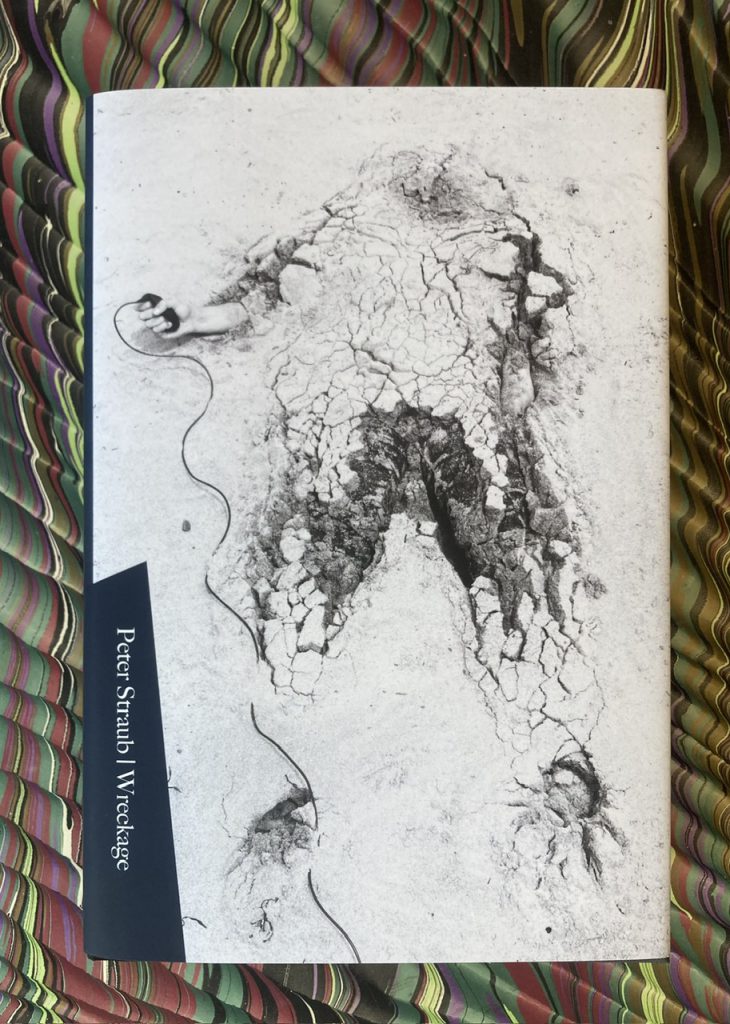
— Peter Straub. Wreckage [and:] What Happens in Hello Jack. 447; 141 pages. 2 vols., Subterranean Press, 2025. [Dust jackets after photographs by Jenny Calivas].
I am a few chapters into Wreckage, the first publication of the substantial novel left unfinished by Peter Straub, intended as an “interweaving” of Henry James and Jack the Ripper. My understanding is that What Happens in Hello Jack is a detailed summary of the intended arc of the novel. I’ll leave that for later : I dove right into Wreckage. It is wonderful to read passages of Straub’s prose and see connections unfold to certain parts of his late work : the Das Beben movement, Tilly Hayward, the invented memoir of an overheard conversation in the life of Henry James*. “An Incident at Monte Carlo”, extracted from Wreckage, appeared last year in Conjunctions. I don’t know where this is going : off the cliff of incompletion, perhaps, but I am on the road. Straub’s interest in Henry James was of very long standing, but he was also always true to his midwestern roots, and that deep America is everywhere in his books.

* “Beyond the Veil of Vision : Reinhold von Kreitz and the Das Beben Movement” by Peter Straub and Anthony Discenza ; The Process (is a Process All Its Own) ; A Dark Matter, readings at past Readercons, etc.

— — —

recent reading :

— Michael Innes. Operation Pax [1951]. Penguin Books, [1964].
— —. Silence Observed [1962]. Penguin Books, [1964].
— — . The Ampersand Papers [1978]. Penguin Books, [1980].
— —. A Night of Errors [1948]. Penguin Books, [1966].
— —. The Appleby File. Detective Stories [1975]. Book Club Associates, [1975].
— —. Appleby Talking. Twenty-three detective stories [1954]. Penguin Books, [1973].
— —. Appleby Talks Again. Eighteen Detective Stories [1956]. A Four Square Book, [1966].
— —. The Bloody Wood [1966]. Penguin Books, [1968].
— —. The Daffodil Affair [1942]. Penguin Books, [1968].
— —. The Open House. [1972]. Penguin Books, [1973].
— —. The Long Farewell.[1958]. Penguin Books, [1971].

I have now read through most of the box of Innes, and always with pleasure. I found the three collections of Appleby short stories witty but lacking in the digressions and piled up absurdities and extended word play that are at the heart of the novels. I particularly enjoyed The Ampersand Papers and The Long Farewell.  I have even started notes toward a Note or Essay.

30 years of the Avram Davidson website, and other news

Some thirty years ago this month, in September 1995, the Avram Davidson website went live on a subfolder of a borrowed server, courtesy of my former colleague Jim Nicholson. He responded to my asking for help turning a mess of information into a database by saying, Let’s turn it into a website. And so using a primitive DOS text editor, I coded a preliminary title index to the writings of Avram Davidson (1923-1993), and the website was launched. I never met Davidson but when I first started reading his work it compelled my interest and curiosity. Science fiction is a warm room on a cold night, as Paul WIlliams once wrote, and the field is pretty welcoming to newcomers. As electronic penpals and in real life, I met dozens of readers who shared an interest in Davidson’s work, or who had known him, or edited him, etc. The list is long: Michael Swanwick, Eileen Gunn, Gregory Feeley, Gordon Van Gelder, Phillip Rose, and others; and also friends now dead, among them Reno W. Odlin, David G. Hartwell, and George Scithers.
The first few years were rich in correspondence, especially once The Nutmeg Point District Mail electronic newsletter took shape, and the Avram Davidson Society (still largely a notional organization). The late Grania Davis, executor of the Estate, worked diligently to bring new books into being over a period of a decade, and I helped with many of them. The website grew organically and sent out digressions and personal flourishes, and even produced a monograph series of the publications of the Avram Davidson Society (the most substantial evidence of its existence). In 1999, the website came into its own with the avramdavidson.org domain. Always coming back to the work of Avram Davidson, with delight and wonder.  For me it was always an irregular shoestring midnight sort of operation, with periods of high yield followed by fallow periods. That title index remains at the core of the website : a bibliographical resource for the ages.
And if some of those digressions of mine (such as the Endless Bookshelf) are now more active than the Avram Davidson website, that is partly because other writing projects compel my energies and attention (there might be one of two publications still to come from The Nutmeg Point District Mail). But most importantly, once Grania’s son Seth Davis started his own process of discovering the writings of Avram Davidson, he began building the Avram Davidson Universe —  https://avramdavidson.com — and recruited a wide pool of new contributors and participants for interview podcasts and simultaneously embarked on a systematic project to publish the works of Avram Davidson. Always coming back to the work of Avram Davidson, with delight and wonder.
— — —
2025 has been a bonzer* year for me in books, with publication of the following works :
A Melville Census, John Marr & Timoleon (January)
A Book of Ryhmes by Charlotte Bronte (Brontë Parsonage Museum / Tartarus Press, April), which includes my essay, Travelling with Charlotte
Another Green World (Zagava, June 2025)
The Critical Mess by Michael Zinman (Distributed by Temporary Culture, August 2025)
and the hardcover issue of Another Green World is in production at Zagava’s binders.
If you haven’t already done so, buy a book or two from Temporary Culture. The Private Life of Books is always a nice gift for a friend.
* (that’s an Avram Davidson word, which he traces to bonanza and the Sydney Ducks, a California Gold Rush era gang in a neighborhood of San Francisco)
— — —
I have been reading my way through a box of Penguin paperback editions of works by Michael Innes, whose books were recommended to me (independently) by John Clute and Mark Valentine. I share their high esteem for Appleby’s End (1945), also praised by H. R. F. Keating in Crime and Mystery The 100 Best Books. I am having a fine time and will write something about the Innes books. Kelly Link sent me the beautiful Small Beer edition of The Book of Love (2024) in four volumes, and that is next on my reading list.
I will be in Boston for the Boston Antiquarian Book Fair 7-9 November 2025, if you are there, come say hello (at the Cummins booth 213)
Peace,
Henry Wessells, 29 September 2025

late september : more Innes, book fair, etc

It’s late September, and preparations are afoot for the Empire State book fair (Friday to Sunday (26-28 September) at Vanderbilt Hall near Grand Central Terminal. I continue to read my way through the box of Michael Innes, always with pleasure. If you come to the fair, come say hello, I’ll be there (at the Cummins booth). Copies of The Critical Mess by Michael Zinman will be available, as well as copies of my own books.

— — —

recent reading :

— Michael Innes. Christmas at Candleshoe [1953]. Penguin Books, [1961].
— —. A Connoisseur’s Case [1962]. Penguin Books, [1966].
— —. A Family Affair [1969]. Penguin Books, [1972].
— —. Death at the Chase [1970]. Penguin Books, [1971].
— —. An Awkward Lie [1971]. Penguin Books, [1974].
— —. Appleby’s Answer [1973]. Penguin Books, [1978].
— —. Appleby’s Other Story [1974]. Penguin Books, [1978].
— —. Appleby and Honeybath [1983]. Penguin Books, [1984].

And with two additions to the titles in the box :

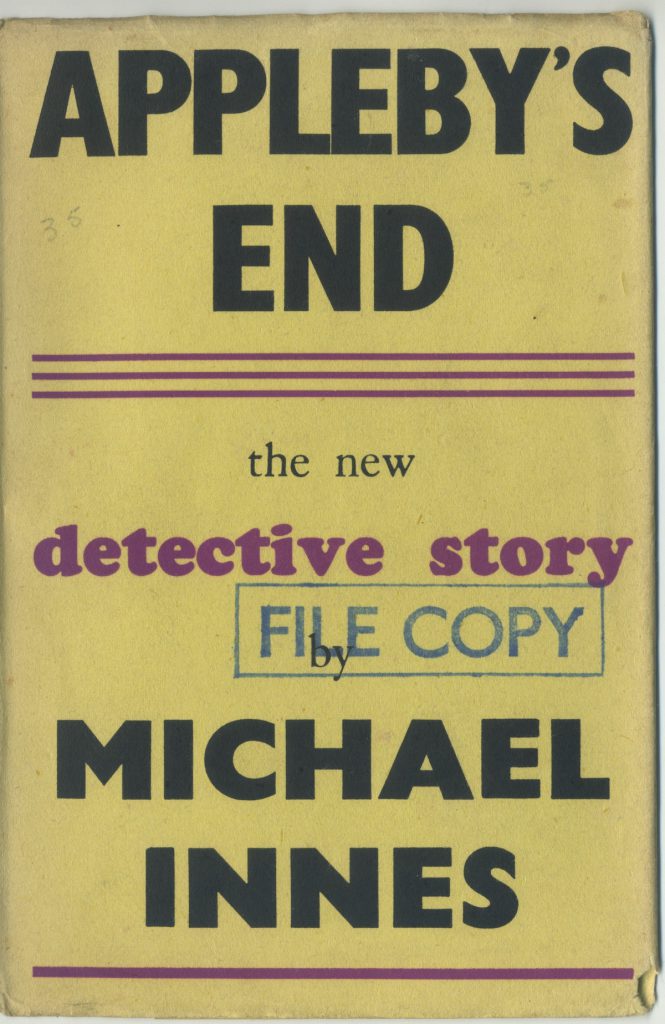
— Michael Innes. Appleby’s End. Gollancz, 1945. File copy in the (slightly faded) yellow dust jacket.
This is the best of them all, (though The Secret Vanguard runs a close second).

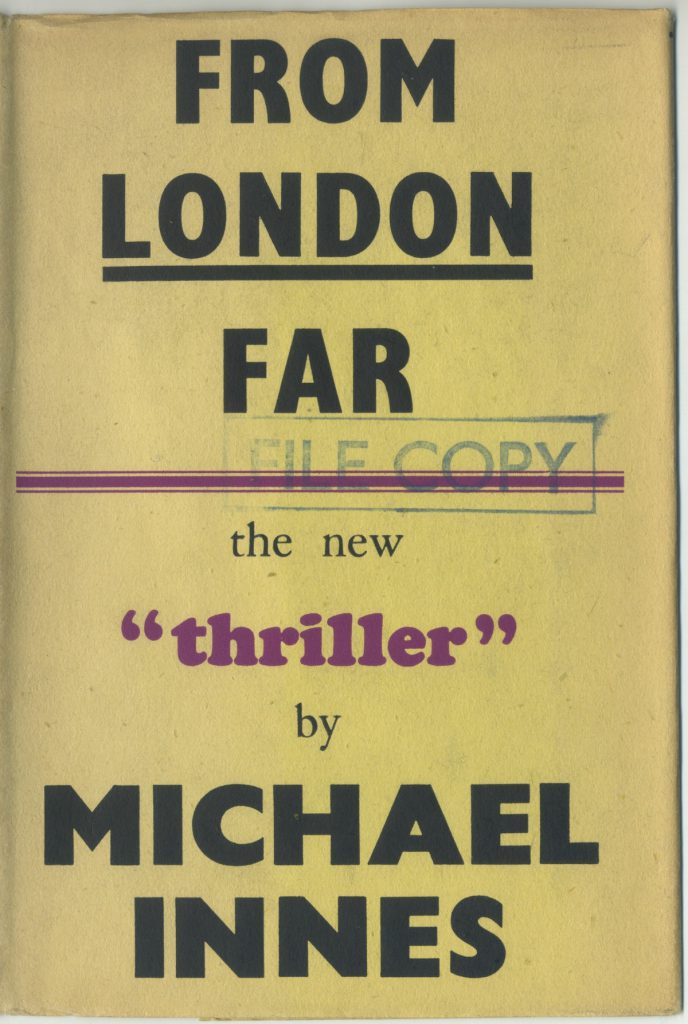
— Michael Innes. From London Far. Gollancz, 1946. File copy in the (slightly faded) yellow dust jacket.
Hilarious, madcap conspiracy of international art smuggling in a background of  the end of the second world war, impeccably choreographed (with knowing aside to John Buchan), and a crazed mastermind whose secret lair is the wildest ever, and with a suitable catastrophe ending.

/ file under : Fleming (or : Bond) and his precursors

— — —

how I spent my summer vacation, part ii

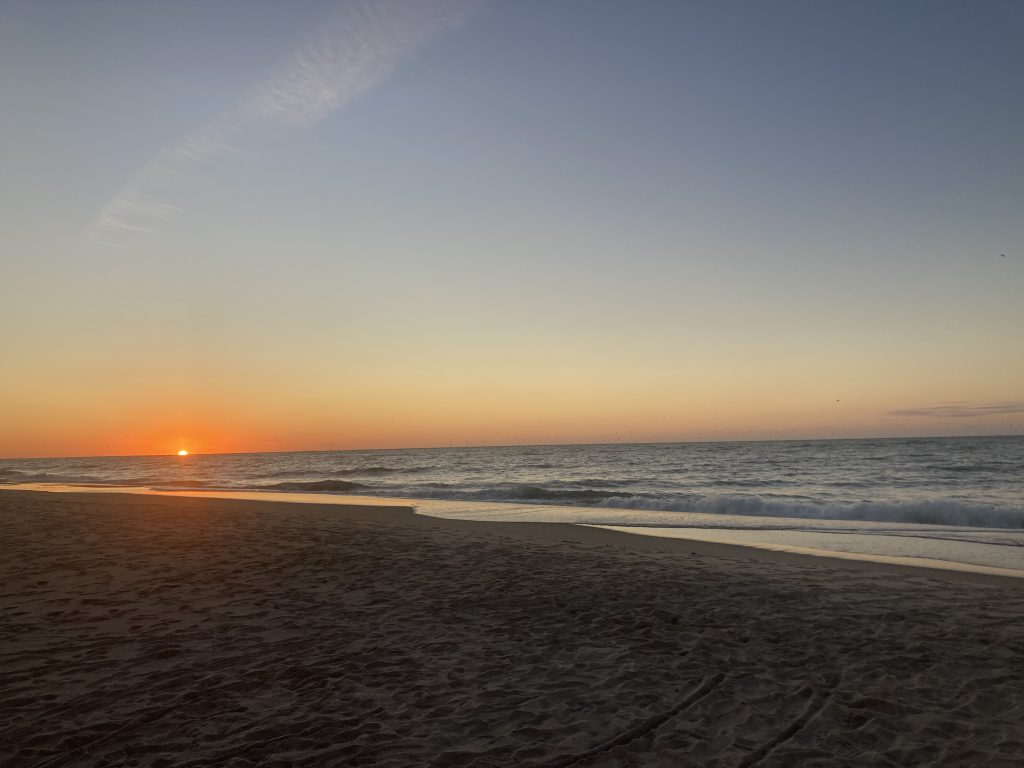
the first part in Copenhagen (see : here) and the second bit near the seashore :

sunrise on a beach

(this is the etc. in the title)

— — —

end of summer mailbag :

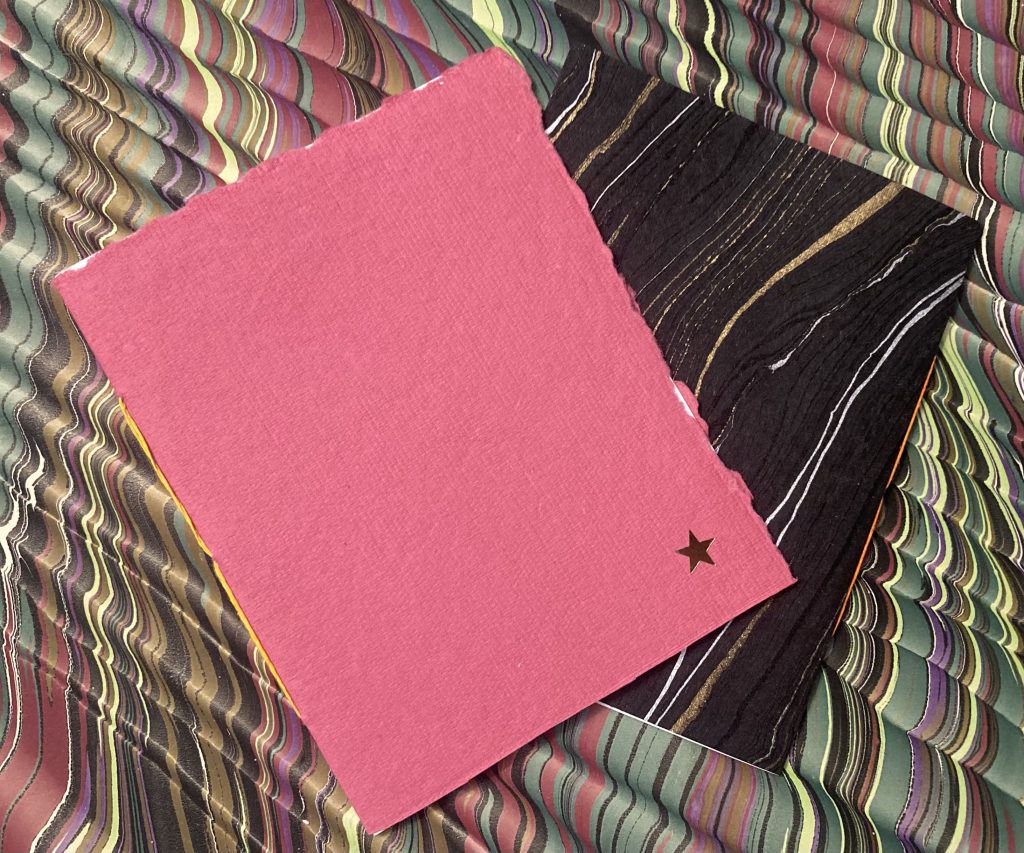
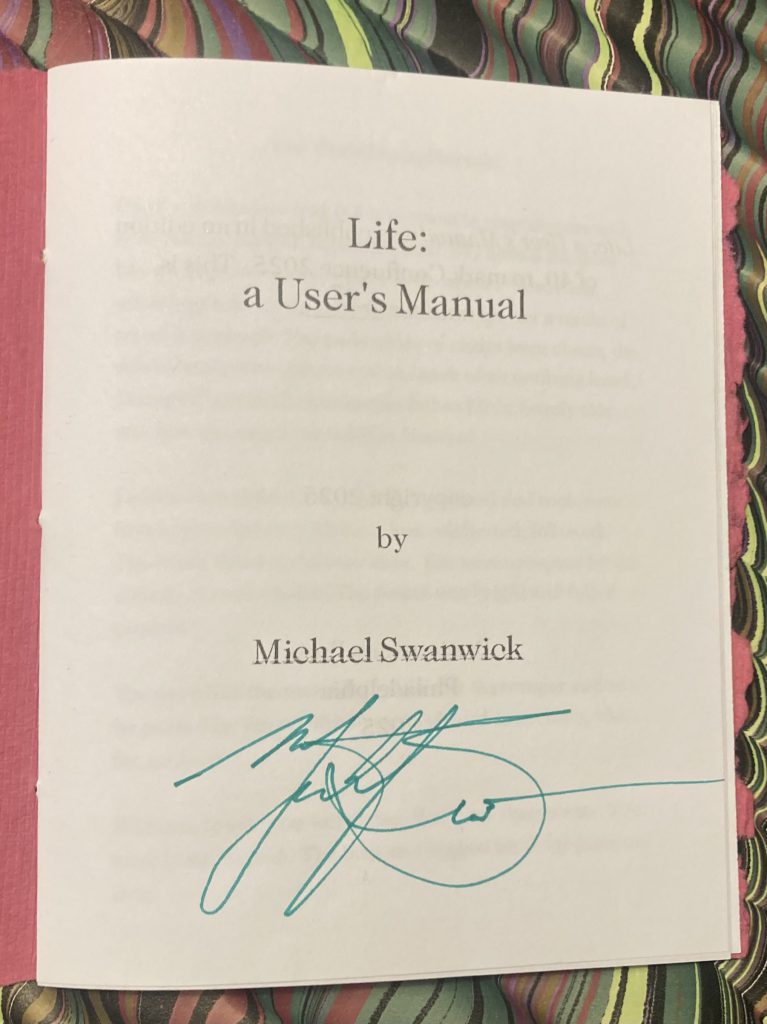
— Michael Swanwick. Life : a User’s Manual. [Dragonstairs Press, 2025]. Edition of 40.
Seven miniature essays, including The Abyss, which begins : “This is a test.”

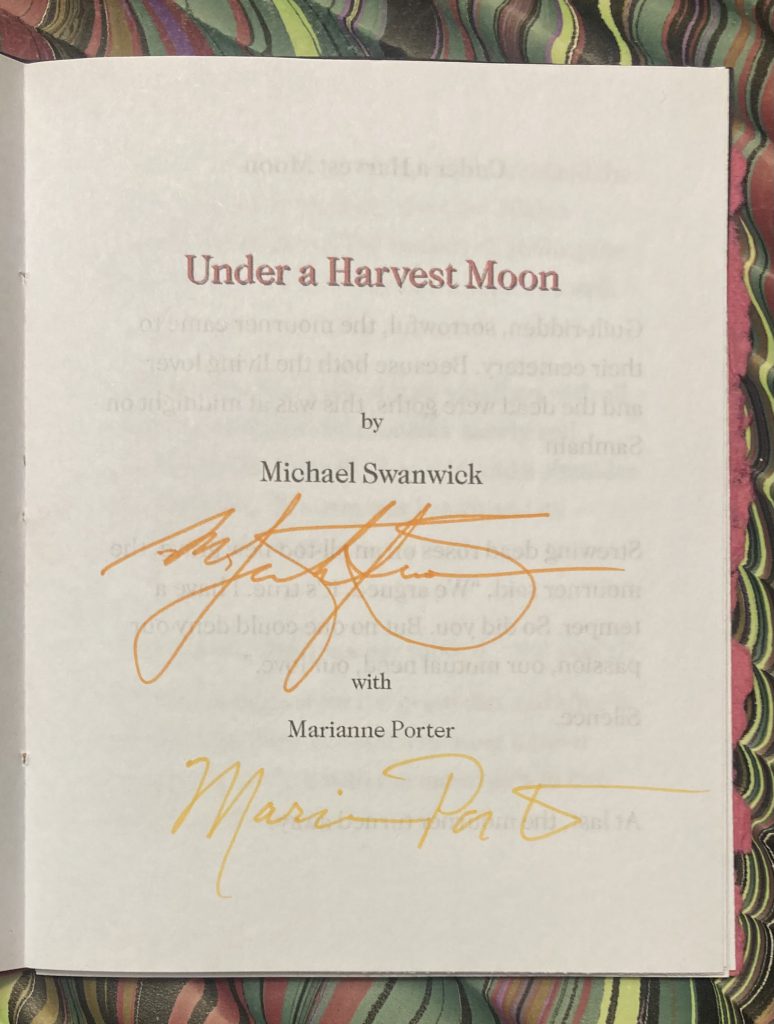
— Michael Swanwick, with Marianne Porter. Under a Harvest Moon [2023]. [Dragonstairs Press, 2025]. Edition of 80.
Printed record of a work of landscape art, “written on leaves in and near cemeteries in Philadelphia” in the autumn of 2023.


A Chapin Centenary, Michael Innes, & others : recent reading mid-august 2025

recent reading :

100 Years 100 Voices. The Chapin Library. [Edited by Anne Peale.] Williams College, [2025].
A beautiful and richly illustrated celebratory catalogue, presenting selected items from the Chapin Library at Williams College, established with gifts from Alfred C. Chapin in 1923. Chapin had been buying very good and interesting books from the best dealers for nearly a decade before the initial gift, and the collection has grown since, through purchase and donation. The Chapin Library had a dynamic founding librarian, Lucy Eugenia Osborne, and has always functioned as a teaching library for undergraduate instruction. This intention shines through in this anthology.  The collection ranges from European incunables and an Eliot Indian Bible (1663) to an Audubon Birds of America purchased from James Drake, from a miniature printing press owned by John Fast to a recent risograph artist book (and four copies of the 1855 Leaves of Grass). The short pieces about the books are by alumni (long gone and recent), past and present curators and librarians, faculty members, and others. The photographs, by Nicole Neenan, are nicely reproduced. This is an important publication, a concise and compelling testimony about why books and libraries are central to education.

— — —

— Timothy d’Arch Smith. The Stammering Librarian. [Strange Attractor, 2024]
I am delighted to have come across this collection of essays by bookseller, novelist, and bibliographer Timothy d’Arch Smith, whose novel Alembic (1992) appears in my Grolier Club exhibition checklist. The title essay and one or two of the other pieces link up directly to the concerns of his excellent memoir of bookselling in London in the 1960s, The Times Deceas’d (2003). There are memoirs of persons real and imaginary, including The Rev. T. Hartington Quince M.A., a Nicholas Jenkins / Anthony Powell pastiche now first published for a wider audience, though the British Library entry for the original appearance (in an edition of 15 copies in 1991, shelfmark YA.1992.b.6526), records Nicholas Jenkins as a “creator” ! Cricket, novelist Julia Frankau, school slang, and Aleister Crowley are other topics.

— — —

Over the next several weeks it will become ever clearer that I have embarked upon reading Michael Innes, whose wordplay and inventiveness are a pleasure. John Clute alerted me to The Secret Vanguard, and Mark Valentine lists Appleby’s End among his short list of Finest Quality Old English Yarns. I am enjoying the variety of this box of mostly tatty paperbacks — after reading a POD edition of The Secret Vanguard I decided that I am happier with a worn paperback — and I will eventually do something than merely extract interesting phrases.

— Michael Innes. Stop Press [1939]. Penguin Books, [1958].
——The Gay Phoenix. A Novel [1976]. Book Club Associates, [1976].
——. Hare sitting up [1959]. Penguin Books, [1964].

Jean turned and faced him. ‘Could you possibly,’ she said, ‘cut the cackle? And tell me what all this is about?’

——. Appleby’s End [1945]. Penguin Books, [1972].

Abbott’s Yatter, King’s Yatter, Drool, Linger Junction, Sleeps Hill, Boxer’s Bottom, Sneak, Snarl, Appleby’s End, Dream

‘Mister,’ he said heavily, ‘did ’ee ever see a saw ?’

— — —

— Michael Zinman. The Critical Mess. [Privately printed], 2025.
Compendium of articles by and about legendary collector of Americana Michael Zinman, whose “critical mess” theory is trickier than a casual glance might suggest :

“If you have enough stuff, good and not so good, you see things that someone collecting only fine copies will miss. This doesn’t in any way cast aspersion on the collector who desires the finest copy of a work, it’s just another way of approaching this world.”

— — —